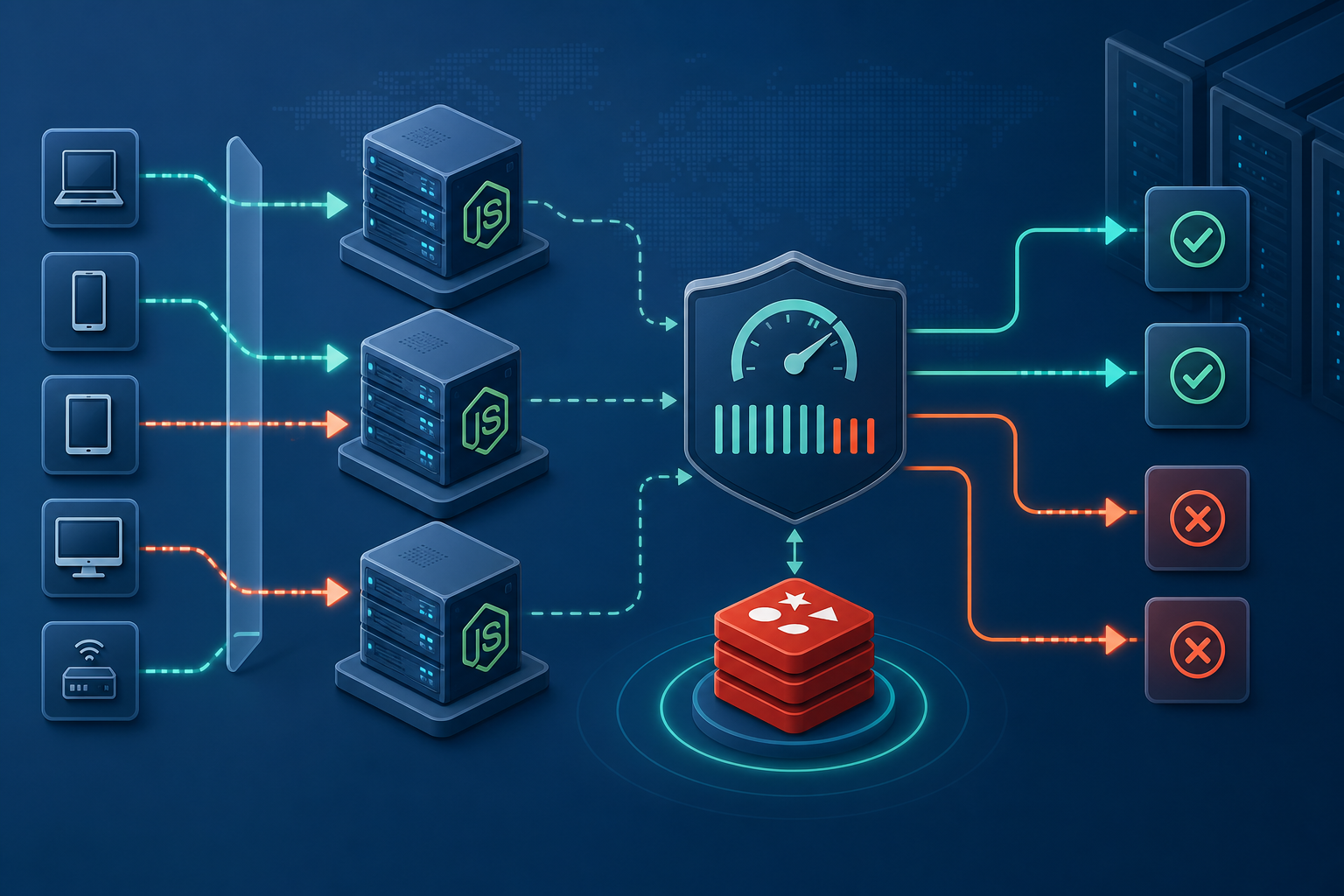
Why Node.js API security fails in practice
The practical problem is not that Node.js APIs are uniquely insecure; it is that small implementation gaps accumulate quickly in an event-driven runtime that often sits directly on the internet. A missing validation rule, overly permissive CORS setting, weak token handling flow, or leaked secret can turn a well-structured service into an easy target for abuse, data exposure, or account takeover.
This matters operationally because API security failures rarely stay isolated. A single weak endpoint can become the path into internal systems, create noisy incident response work, or force emergency rollbacks when production traffic is already under load. After reading this article, you should be able to decide which Node.js security controls matter for your API, apply a practical workflow for validating them, and verify what to check before production use.
Key takeaways
- Secure Node.js APIs by controlling input, identity, secrets, transport, and observability together rather than as separate concerns.
- Prefer explicit allowlists, strict schemas, and narrow authorization checks over broad trust in client-provided data.
- Use authentication and authorization as separate decisions; a valid token does not automatically mean the caller can perform the action.
- Treat security headers, rate limits, and logging as operational controls that reduce blast radius when something goes wrong.
- Verify behavior under your actual runtime, framework, and deployment settings before relying on defaults.
What secure API development in Node.js actually means
In a Node.js API, security is mostly about reducing trust. Every request can arrive malformed, replayed, automated, or intentionally hostile. The server must assume that query parameters, JSON bodies, headers, cookies, file metadata, and even upstream identity claims can be manipulated unless they are explicitly checked.
The key operational implication is that secure design in Node.js is less about adding one library and more about consistently enforcing boundaries. A request should only reach business logic after it has passed schema validation, authentication, authorization, and contextual controls such as rate limiting or abuse detection. If your service also handles uploads or session state, those paths need their own validation logic; for example, stream-based file upload validation helps reject unsafe content before it is stored.
How the core controls fit together
A safe API request flow usually has the same logical order even when the exact middleware differs by framework:
Network edge -> TLS -> basic request filtering -> schema validation -> authentication -> authorization -> business logic -> structured logging/auditing
This sequence matters because each control depends on the earlier one. For example, authorization rules are only useful if the identity is trustworthy, and logging is only useful if it captures the request context without leaking credentials.
In practice, this means you should design the API so that insecure requests fail early and cheaply. Invalid payloads should be rejected before they touch downstream systems. Requests from anonymous or expired callers should not reach expensive database work. High-frequency clients should be slowed down before they can generate excessive load or brute-force token endpoints. If you are diagnosing latency while security middleware is enabled, event loop behavior can help distinguish blocked JavaScript from downstream delays; event loop monitoring is useful when security checks themselves start affecting request timing.
Input validation and output shaping
Input validation is the first real security boundary in most Node.js APIs. The goal is not just to avoid crashes; it is to prevent unexpected data from changing application behavior. Validate body payloads, path parameters, query parameters, headers that influence routing, and any nested objects that reach persistence or authorization logic.
A practical rule is to validate against an allowlist schema and reject unknown fields unless you have a deliberate reason to accept them. This reduces the risk of mass assignment, hidden flags, and downstream confusion caused by unexpected properties. It also makes your API easier to reason about during incident response because the accepted shape is explicit.
Output shaping matters too. Do not return raw internal objects if they contain roles, tokens, passwords, reset codes, internal IDs, or infrastructure details. API responses should include only the fields required by the client. That discipline reduces data exposure even when a query or serializer is misconfigured.
Authentication and authorization are not the same control
Authentication answers the question, "Who is this caller?" Authorization answers, "What may this caller do now?" Secure APIs need both.
If your API uses bearer tokens, session cookies, or federated tokens, verify token handling carefully. Token format, expiry, audience, issuer, rotation behavior, and revocation assumptions all need to be understood in the context of your deployment. If your environment uses JWTs, OAuth 2.0, or both, make sure the chosen flow matches the operational need and the actual trust boundaries; secure API authentication with JWT and OAuth 2.0 is most effective when paired with strict verification rules and narrow scopes.
Authorization should be checked at the resource level, not just the route level. A caller who is allowed to read "an invoice" is not automatically allowed to read every invoice. A user with one tenant membership is not automatically authorized across all tenants. In Node.js APIs, the most common mistake is trusting an identifier supplied by the client and assuming it belongs to the authenticated user.
Secrets, configuration, and dependency risk
Node.js applications often fail security review because sensitive data leaks into code, logs, build artifacts, or developer machines. API keys, database credentials, signing keys, and webhook secrets must live outside source control and should be loaded from environment-specific configuration or a managed secret store according to your platform controls.
The important verification point is not just where the secret lives, but how it is rotated and scoped. A secret that is hard-coded into application code is usually harder to revoke safely. A secret that grants broad access is dangerous even if storage is secure. Use the minimum privilege needed for each service, and verify that non-production environments do not reuse production credentials.
Dependencies also require attention. Security posture depends on your package set, lockfile discipline, and update process. Review new packages for necessity, transitive risk, and maintenance signals. Prefer small dependency surfaces when possible, and verify that package installation rules in CI/CD match what is expected in production.
HTTP hardening, sessions, and browser-facing exposure
For browser-facing APIs, transport and response hardening are part of the security baseline. TLS should be mandatory, and any redirect or proxy setup should preserve the security properties you expect. Security headers can reduce exposure to certain client-side attacks, but they are not a substitute for server-side authorization or validation.
If your API uses cookies for session management, verify the cookie attributes that matter for your deployment: Secure, HttpOnly, SameSite, domain scope, and expiry. A cookie-based session that is correct in development may behave differently behind a proxy, across subdomains, or under cross-site request patterns.
CORS deserves special caution. It is not an authentication mechanism. It only controls which browser origins may make requests that the browser will expose to client-side scripts. An API that accepts credentials should use a narrow origin policy and be tested with the actual front-end domains in use, not a permissive wildcard that happened to work in a test environment.
Rate limiting, abuse controls, and resource protection
Rate limiting is a practical defense against brute force, credential stuffing, enumeration, and load amplification. It also protects downstream systems when request volume spikes. In a Node.js API, rate limits should be aligned with the sensitivity of each endpoint. Login, password reset, token exchange, and verification endpoints usually deserve stricter thresholds than read-only public endpoints.
Do not assume rate limiting is only about total requests per minute. Consider concurrency, per-account limits, per-IP limits, and per-tenant throttles where appropriate. Also decide how the system should behave when a limit is hit: reject immediately, queue, or degrade gracefully. The correct choice depends on whether the endpoint is user-facing, machine-to-machine, or security-sensitive.
You should also distinguish between abuse controls and performance protections. A request flood can be a security event or an operational incident, and sometimes both. Logging, alerting, and retry behavior should reflect that distinction.
Logging, auditing, and incident usefulness
Security logging should be useful without being dangerous. Capture who did what, when, from where, and with what outcome, but avoid logging secrets, session tokens, passwords, full card data, or raw personal data unless you have a strong retention and access model.
A useful log entry includes a request identifier, authenticated subject, tenant or account context, route, outcome, and timing information. That is enough to reconstruct most incidents without exposing sensitive payloads. If you need deeper diagnostics, use controlled sampling and redact aggressively.
The operational trade-off is straightforward: more detail helps investigations, but more detail also increases the impact of log exposure. Decide upfront which fields are safe, how long logs are retained, and who can access them.
Practical scenario you will recognize
Imagine a Node.js service that powers a partner-facing API for orders and customer records. The service works well in staging, but production traffic includes automated clients, a browser-based admin console, and a small number of internal scripts with elevated access.
In this environment, the real risks are not exotic exploits. They are predictable failures: a partner sends an unexpected field that the API stores accidentally; a token is valid but used against the wrong tenant; a retry storm hits a password reset route; a debug log captures an authorization header during an incident; or a permissive CORS policy exposes more than the browser should allow. These are the cases where security best practices pay off immediately because they prevent common implementation mistakes from becoming production incidents.
Common mistakes that weaken Node.js APIs
Several mistakes appear repeatedly in audits and incident reviews:
- Trusting request payloads because the client is "internal" or "trusted".
- Using authentication as a substitute for authorization.
- Logging full request bodies or headers that contain secrets.
- Allowing unknown fields in updates and accidentally creating mass assignment paths.
- Leaving overly broad CORS rules in place after development.
- Reusing secrets across environments or services.
- Relying on defaults without verifying framework, proxy, or runtime behavior.
- Treating rate limiting as optional because the endpoint is not "important".
The recurring pattern is over-trust. Node.js makes it easy to build APIs quickly, so teams sometimes assume the middleware stack has done the hard work. It has not. The application still needs explicit decisions about what to accept, who may act, what to log, and how to fail safely.
Trade-offs you need to evaluate
Security controls are not free. Validation adds implementation time and can reject borderline clients. Strict authorization logic can increase code complexity, especially in multi-tenant systems. Strong logging improves investigations but raises privacy and retention obligations. Rate limiting can frustrate legitimate users if thresholds are too low. Dependency discipline can slow feature delivery if updates are not automated.
The right balance depends on the endpoint’s risk. For a low-sensitivity public read API, strict payload validation and basic throttling may be sufficient. For an account management or payment-related API, you should expect narrower permissions, stronger token checks, detailed audit logs, and tighter abuse controls. The decision should follow data sensitivity, business impact, and the cost of a failed request, not developer convenience.
What this means in practice
If you are responsible for a Node.js API in production, security work should focus on proving that unsafe input cannot become unsafe behavior. That means validating request shape, checking identity and permissions separately, limiting damage from repeated requests, and ensuring secrets never appear where they do not belong.
It also means your security controls should be testable. You should be able to point to the schema that rejects unknown fields, the authorization rule that prevents cross-tenant access, the log format that excludes credentials, and the operational limit that slows abuse. If those controls cannot be verified in a staging or pre-production environment, they are not ready to rely on.
Decision guidance for choosing the right controls
Use this simple rule set when deciding how much to implement:
- If the endpoint accepts user input, enforce schema validation and output shaping.
- If the endpoint changes data or exposes private records, require both authentication and resource-level authorization.
- If the endpoint can be automated or brute-forced, add rate limiting and request anomaly detection.
- If the endpoint handles browser traffic, review cookies, CORS, and security headers with the actual deployment topology.
- If the endpoint touches sensitive data, verify secret handling, logging redaction, and audit retention before release.
If your system has multiple services, apply the same controls at the edge and within the application boundary. Defense in depth is useful because one layer will eventually fail or be misconfigured.
Production readiness checklist
Use the following checklist to verify that your Node.js API is ready for production use:
- Request schemas reject unknown or malformed fields.
- Authorization checks are performed per resource or tenant, not only per route.
- Secrets are externalized, scoped, and rotatable.
- Logs exclude passwords, tokens, session identifiers, and sensitive payloads.
- CORS policy is narrow and matches the real browser origins in use.
- Cookies, if used, have appropriate security attributes for the deployment.
- Rate limits exist for abuse-prone endpoints and are tested under real traffic patterns.
- Dependency updates follow a defined review and rollout process.
- Error responses avoid exposing internal stack traces, system paths, or credential hints.
- Security behavior has been verified in the same proxy, runtime, and environment model used in production.
Final takeaway
Node.js security best practices for safer API development come down to disciplined trust boundaries: validate aggressively, authenticate correctly, authorize narrowly, protect secrets, harden transport and browser exposure, and make logging useful without leaking sensitive data. If you can verify those controls in your own deployment model, your API will be far harder to abuse and much easier to operate safely.
Use this guidance together with Python regex validation to connect the workflow with related operational context already available on the site.
Part of the Programming: Node.js Insights content cluster.