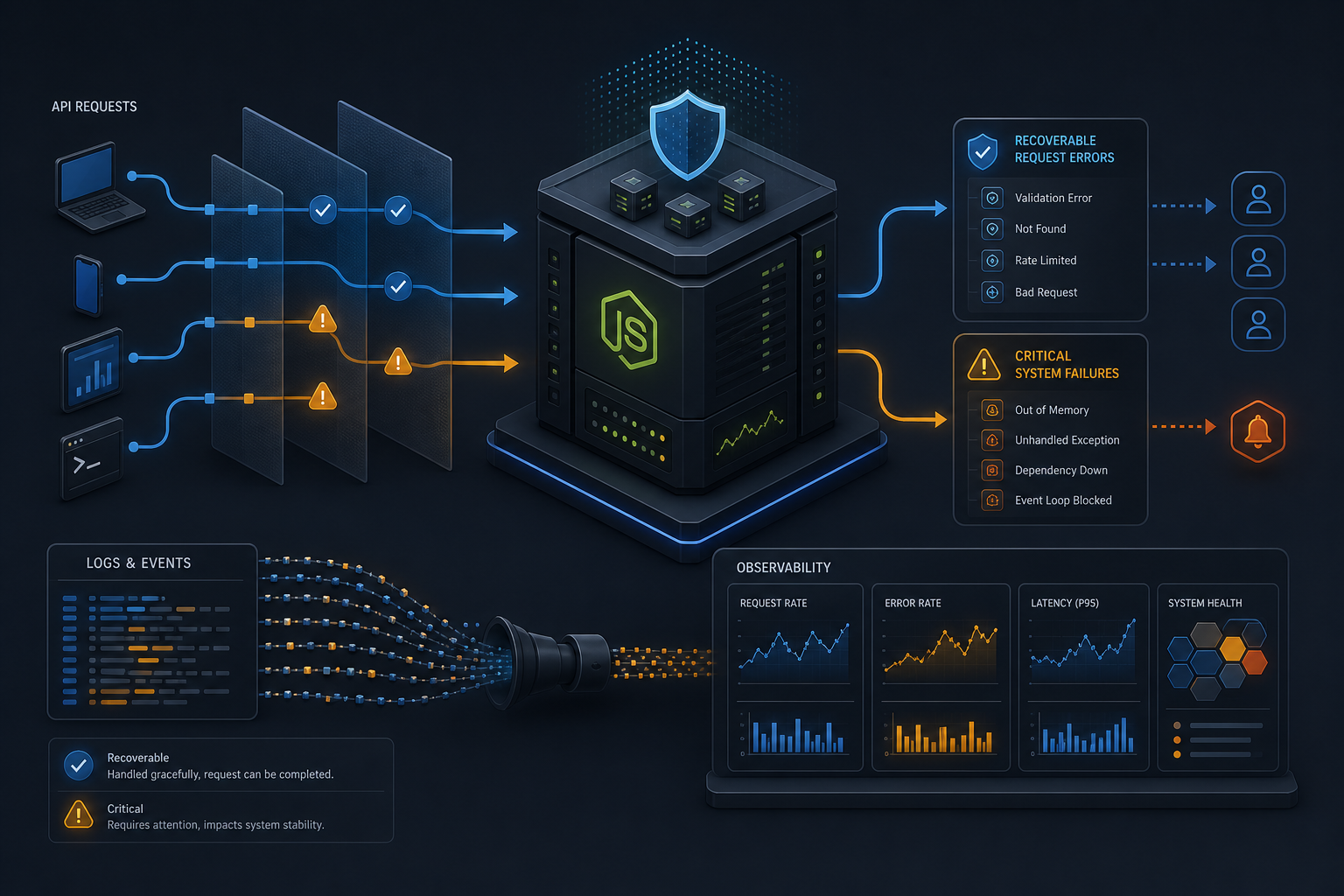

Why JWT authentication matters for Node.js APIs
The practical problem is simple: an API needs a reliable way to prove that a caller is authenticated without forcing the server to store session state for every request. In Node.js services, JSON Web Tokens (JWTs) are often used for that purpose because they are compact, portable, and easy to validate at the edge of an API request.
That convenience creates risk if teams treat JWTs as a complete security model rather than one part of it. A signed token does not automatically mean the user is allowed to access a resource, the token is still within its intended lifetime, or the token was issued for the correct application. If you operate Node.js APIs in production, the relevant question is not just whether JWTs work, but whether they are validated and governed tightly enough to survive real traffic, partial compromise, and operational mistakes.
After reading this article, you should be able to decide whether JWT authentication fits your API, understand the validation flow, apply a compact implementation workflow, and verify the production controls that matter before trusting tokens in front of sensitive routes.
Key takeaways
JWT authentication works best when you treat the token as an assertion that must be verified on every request, not as a trust signal by itself. The most important checks are signature verification, issuer and audience validation, expiration enforcement, and claim-level authorization decisions.
The safest production patterns usually include short-lived access tokens, separate refresh handling, explicit key rotation planning, and a clear boundary between authentication and authorization. If any of those are missing, the implementation may still function, but it becomes harder to reason about risk during incidents or key compromise.
Operationally, JWTs reduce server-side session dependency, but they increase the importance of token design, key management, and middleware discipline. That trade-off is often worth it for stateless APIs, distributed services, and gateway-based architectures, but not for every use case.
How JWT authentication works in a Node.js API
A JWT is typically issued by an authentication service after a user signs in or a workload presents trusted credentials. The token contains claims such as subject, issuer, audience, and expiration, and it is cryptographically signed so the API can detect tampering.
In a Node.js API, the request flow usually looks like this: the client sends the token in the Authorization: Bearer <token> header, middleware extracts it, the API verifies the token using the expected algorithm and key, and route handlers use the validated claims to identify the caller and enforce permissions. The token should not be trusted before verification, even if it appears structurally valid.
A secure implementation must verify more than the signature. For example, a token signed by a valid key may still be wrong for your API if the issuer is unexpected, the audience does not match the resource server, or the token is expired. In systems with multiple services, those checks are what prevent a token minted for one path from being reused somewhere else.
For production APIs, it is also important to separate authentication from authorization. Authentication answers who the caller is; authorization answers what they can do. If route-level access decisions rely only on the presence of a token, you are probably under-checking claims.
Compact implementation workflow
A practical workflow for Node.js API authentication is below. This is not a full build guide; it is the minimum control flow that should exist in a production-ready implementation.
1. Client submits credentials or a trusted upstream identity assertion.
2. Authentication service issues a short-lived signed JWT.
3. API middleware extracts the Bearer token from the request.
4. Middleware verifies signature, issuer, audience, expiration, and algorithm.
5. Middleware maps claims to a normalized user or service identity.
6. Route authorization checks roles, scopes, or resource ownership.
7. API returns 401 for invalid authentication and 403 for insufficient authorization.
8. Logs capture token validation failures without storing secrets.
The value of this workflow is not its length; it is the separation of concerns. Each stage has a narrow responsibility, which makes failures easier to inspect and makes the security model easier to audit.
If your API already has complex error handling, align token validation failures with your existing Node.js error handling patterns for resilient production APIs. Authentication failures should be predictable, non-leaky, and distinct from application exceptions.
What to validate on every request
The most common security mistake is verifying only the signature and assuming the token is therefore acceptable. A more defensible validation set includes the following checks:
- Signature verification with the expected algorithm and key material.
- Issuer validation to confirm the token came from the right authority.
- Audience validation to confirm the token was minted for this API or service boundary.
- Expiration validation so stale tokens are rejected.
- Not-before validation if your tokens use delayed activation.
- Claim shape and type validation so downstream code does not trust malformed data.
These checks matter because tokens move easily across services. In a distributed environment, a structurally valid token can still be operationally wrong. If a gateway, microservice, or partner integration accepts any token that merely verifies cryptographically, you may unintentionally widen the trust boundary.
Another practical point is algorithm handling. The verifier should accept only the algorithms you explicitly expect. Do not rely on defaults you have not reviewed, especially when libraries support multiple signing modes.
Practical scenario: a gateway in front of internal APIs
Consider a common environment: a Node.js service sits behind an API gateway, and the gateway forwards requests from a web application, a mobile app, and a background job runner. The gateway checks that a JWT exists, but the downstream service still needs to decide whether the token is valid for its own resource boundary.
This is where teams often overtrust the upstream layer. If the service only checks that a token was present, it may accept tokens with the wrong audience, old expiration windows, or claims meant for a different subsystem. If the service re-verifies the token and confirms the claims it depends on, the risk is lower even if the gateway logic changes later.
This pattern is also where operational discipline matters. If you rotate signing keys, the gateway and the service must agree on the current trust set. If you revoke access, you need to know whether the implementation depends on short token lifetime, a revocation list, or another control. If those decisions are unclear, incident response becomes guesswork.
For teams tuning the API under load, remember that JWT checks are usually not the bottleneck; unnecessary synchronous work and poor event loop control are more likely to hurt latency. If you are hardening a busy API, pair authentication design with Node.js event loop performance tuning for high-load apps so verification and request processing remain predictable under pressure.
Implementation trade-offs you need to decide on
JWT authentication is attractive because it reduces server-side session storage and works well across distributed systems, but that benefit comes with trade-offs.
The first trade-off is revocation. Stateless access tokens are harder to revoke immediately than server-stored sessions. If an access token is compromised, expiration is often the primary containment control unless you add a revocation mechanism or token introspection pattern. That means short-lived tokens are usually safer, but they also increase refresh complexity.
The second trade-off is claim design. More claims can reduce lookup calls, but they also increase token size and the risk of embedding data that should not be broadly visible. Sensitive data should not be placed in a JWT just because the token is signed; signing does not make disclosure safe if the token is exposed to clients.
The third trade-off is operational dependence on keys. As soon as an API trusts a signature, key rotation becomes a security and reliability concern. You need overlap during rotation, a plan for stale keys, and clear ownership of the private signing material.
The fourth trade-off is implementation complexity versus ecosystem simplicity. JWTs are easy to adopt in Node.js, which is useful, but easy adoption can hide mistakes. A simple session-based system may be a better fit if you need hard revocation, very short access windows, or minimal token exposure.
What this means in practice
In practice, a secure Node.js JWT implementation should make three things obvious: what the token proves, what it does not prove, and what the API will refuse to do when validation fails.
A valid token proves that the bearer presented a token the API accepts, that the token was issued by a trusted authority, and that the token still fits its defined lifetime and audience. It does not prove the caller should get every action the API exposes. Authorization still needs to be evaluated against scopes, roles, or resource ownership.
A secure implementation also makes failure modes consistent. Invalid signatures, wrong issuers, expired tokens, and missing tokens should not trigger different noisy behaviors that reveal internal details. Return 401 Unauthorized when authentication fails, 403 Forbidden when the caller is authenticated but not permitted, and keep internal error output out of the response body.
If your service already tracks incident response signals, JWT validation failures should be observable without becoming a source of secret leakage. Log enough to identify the pattern, but avoid logging the raw token. If you are building production API observability, this fits naturally with robust error classification, bounded log content, and clear correlation identifiers.
Decision guidance: when JWT is the right choice
JWT authentication is a strong fit when your API needs stateless verification, your services are distributed, and your trust boundary includes multiple consumers or gateways. It is also a good fit when you want to minimize server-side session storage and the operational model can tolerate short-lived token revocation.
JWT is usually less attractive when you need immediate logout semantics, strong central revocation, or extremely simple security operations. If your access model changes frequently and every token needs live policy evaluation, a stateful session design or token introspection approach may be easier to control.
A useful decision rule is this: if you can clearly answer how tokens are issued, verified, rotated, expired, and revoked, JWT may be a good operational fit. If any of those answers depend on assumptions spread across multiple teams, the implementation may be functional but fragile.
Common mistakes that weaken JWT security
One common mistake is accepting tokens without validating the audience. That allows a token intended for one service to be used by another service that should not trust it.
Another mistake is relying on long-lived access tokens to avoid refresh complexity. Longer lifetimes reduce authentication traffic, but they also increase the exposure window if a token is stolen.
A third mistake is mixing authentication and authorization logic until route handlers become difficult to reason about. If every handler independently interprets claims in its own way, subtle access-control drift can appear over time.
Teams also sometimes assume that a signed token is safe to store or forward anywhere. That is not true. JWTs often contain readable claims, so they should be treated as sensitive artifacts even when they are not encrypted.
Finally, a common production error is failing to plan for key rotation. When signing keys change without overlap or rollout coordination, valid users suddenly look unauthenticated, which creates avoidable outages and confusing support cases.
Production readiness checklist
Before using JWT authentication in production, verify the following controls:
- The API verifies the token signature with an explicitly allowed algorithm.
- The API checks issuer, audience, expiration, and any required not-before claims.
- Authentication and authorization are handled as separate decisions.
- Access tokens are short-lived enough for your threat model.
- Refresh or re-authentication behavior is defined and tested.
- Signing key rotation has an overlap and rollback plan.
- Invalid tokens fail closed with consistent
401responses. - Forbidden actions return
403without exposing policy details. - Logs do not store raw tokens or other secrets.
- Middleware rejects malformed headers and unexpected token shapes.
- Claim usage is documented so route handlers do not invent their own rules.
If any item on that list is unresolved, the implementation is probably not ready for sensitive production traffic, even if the happy path appears to work.
Final takeaway
JWT authentication can secure a Node.js API effectively, but only when validation is strict, claims are used deliberately, and operational controls are built around token lifetime and key management. The safest implementations verify every token on every request, keep authentication separate from authorization, and define what happens before, during, and after key rotation. If you can validate those conditions in your own environment, JWT is a practical production option; if not, the security model is probably too loose to trust yet.
Use this guidance together with Kafka exactly-once processing and ASP.NET Core JWT authentication with refresh tokens to connect the workflow with related operational context already available on the site.
Part of the Programming: Node.js Insights content cluster.