
Key takeaways
Node.js API authentication is not just a matter of issuing a token and checking whether it exists. In production, the real problem is deciding which trust model fits your system, then enforcing it consistently across services, gateways, and middleware.
JWT and OAuth 2.0 solve different parts of that problem. JWT is a token format often used to carry signed claims between a client and an API. OAuth 2.0 is an authorization framework that defines how clients obtain and use access tokens. In many systems, they are used together, but they are not interchangeable.
After reading this article, you should be able to determine whether JWT-only authentication is sufficient, when OAuth 2.0 adds the right control points, what the validation workflow should look like, and what to check before shipping to production.
Why this matters operationally
API authentication failures usually do not appear as obvious breakages. They show up as data exposure, privilege escalation, token replay, confusing logout behavior, or outages caused by overly strict validation. In Node.js, those risks are amplified when applications are distributed, scaled horizontally, or split into API gateway, authentication service, and resource server roles.
The operational question is not whether a token-based design is modern. It is whether the design gives you reliable identity, bounded access, revocation options, and enough observability to detect abuse without creating brittle middleware.
If you already use JWT in Node.js, How to Secure Node.js APIs with JWT Authentication is a useful companion for claim design, validation, and key management. This article focuses on the decision between JWT and OAuth 2.0 and on the production checks that make either approach defensible.
How the two approaches differ
JWT describes the structure of a token, not the full authentication protocol. A JWT is typically a compact, signed blob containing claims such as subject, issuer, audience, scope, and expiration. A Node.js API can validate those claims locally as long as it has the right public key or shared secret.
OAuth 2.0 is broader. It defines how a client obtains an access token and how that token is presented to a resource server. In most real deployments, OAuth 2.0 also brings in an identity layer such as OpenID Connect when user authentication is required. That separation matters because OAuth 2.0 is usually the control plane for authorization, while JWT is often the data format carried on the wire.
A practical way to think about it is this: JWT answers, “Can this API trust the token?” OAuth 2.0 answers, “How did the client get the token, under what grant, and what access should it represent?”
A compact workflow for production validation
Client authenticates or authorizes
        ↓
Authorization server issues access token
        ↓
Node.js API receives request with token
        ↓
Middleware verifies signature, issuer, audience, expiry, and scope
        ↓
API maps claims to permissions and user context
        ↓
Request is allowed, denied, or challenged
This workflow is simple on paper but only reliable if every validation step is explicit. Missing checks are usually the root cause of token acceptance that should have failed.
When JWT is enough, and when it is not
JWT-only authentication can be a good fit when you control both the client and the API, access boundaries are simple, and you can tolerate stateless verification with limited revocation. Internal services, machine-to-machine calls, and smaller deployments often fit this model well.
JWT-only becomes less attractive when you need delegated access, third-party clients, consent tracking, token exchange, or a central authorization server with policy control. Those are situations where OAuth 2.0 typically provides better structure.
A useful decision rule is this: if the main concern is verifying a signed identity or service token at the API boundary, JWT may be sufficient. If the main concern is who is allowed to obtain access, on behalf of whom, and with what scope, OAuth 2.0 belongs in the design.
How OAuth 2.0 changes the security model
OAuth 2.0 adds an authorization server between the client and the resource server. That extra hop creates more moving parts, but it also creates better control over client registration, consent, scopes, token lifetime, and revocation strategy.
For a Node.js API, the important operational effect is that the API should not assume anything about the client application itself. It should trust only validated access tokens and the claims or introspection results that come with them. The API remains a resource server, not the place where login logic or token issuance rules are improvised.
This separation is especially valuable in environments where multiple clients consume the same API. A mobile app, a backend job, and a partner integration may all need different authorization rules even if they reach the same endpoints.
What this means in practice
The practical value of JWT and OAuth 2.0 is that they let you separate authentication concerns from business logic, but only if your Node.js middleware stays disciplined.
In practice, that means the API should validate more than token presence. It should verify issuer, audience, signature algorithm, expiration, not-before time if used, and any scope or role claims that are relevant to the endpoint. It should also reject tokens that look structurally valid but do not belong to the current trust domain.
It also means you should treat authorization as an endpoint-specific decision, not a global “authenticated equals allowed” rule. A valid token for one API or audience should not be accepted everywhere.
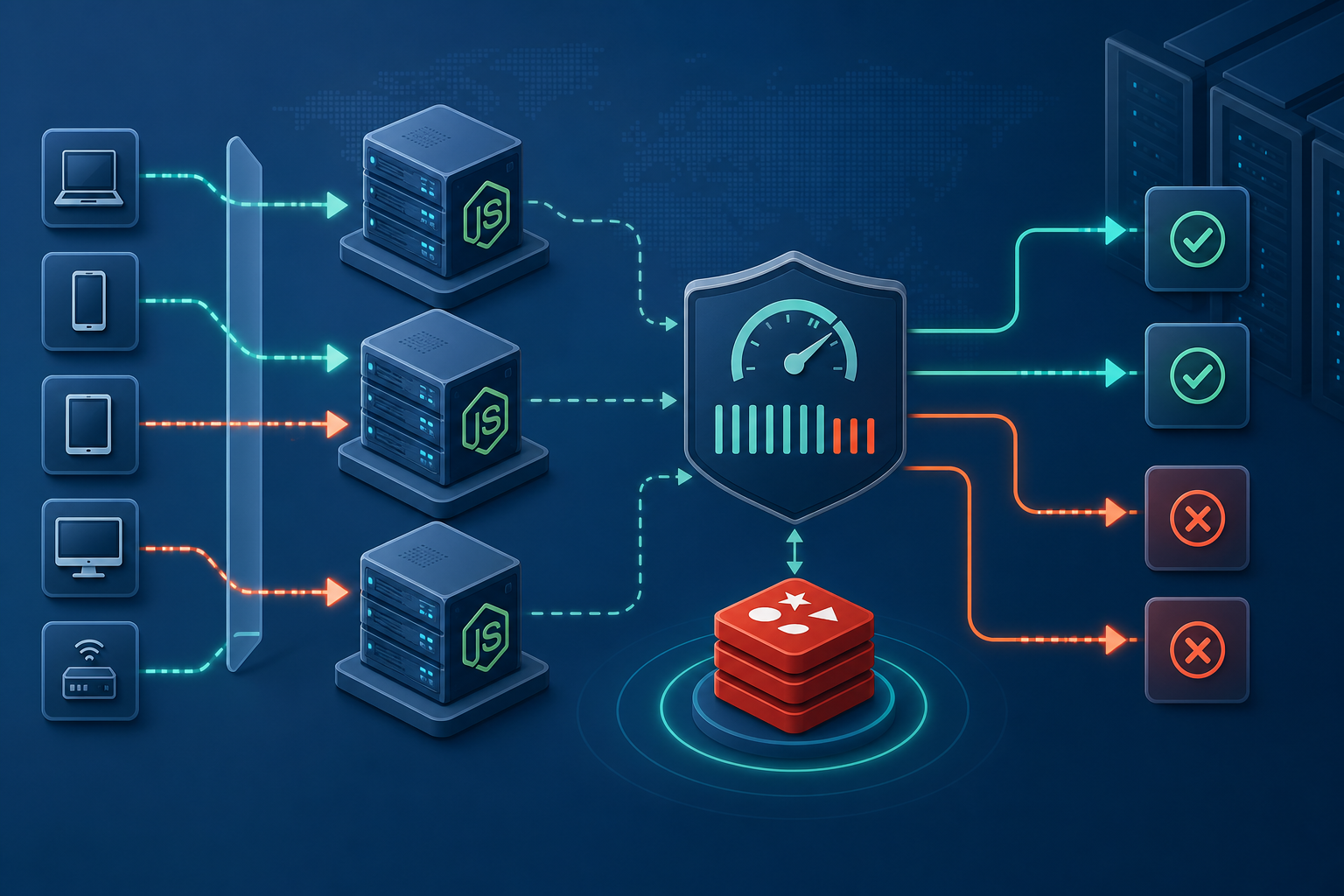
For teams already operating token-based APIs, rate controls often belong in the same security conversation because authentication alone does not stop abuse. In distributed deployments, Node.js Rate Limiting with Redis: Secure API Throttling is often the next control to pair with token validation.
A practical scenario you can recognize
Consider a Node.js platform with three consumers: a web dashboard for employees, a background synchronization job, and an external partner integration. The dashboard uses user identity and delegated scopes. The job uses service credentials. The partner uses a separately registered client and only gets access to a narrow set of endpoints.
In this environment, a single homemade JWT scheme usually becomes awkward. You need user login, service-to-service trust, revocation handling, and client-specific permissions. OAuth 2.0 gives you a cleaner structure for those cases, while JWT remains the token format the APIs validate.
If, by contrast, you have a single internal service calling a narrow set of endpoints inside a trusted network, JWT validation alone may be enough. The operational cost of a full OAuth 2.0 deployment may not pay for itself if the access model is simple and revocation requirements are modest.
Validation checks that should be non-negotiable
A Node.js API should not accept a token simply because it is signed. Validation needs to be strict and environment-specific.
- Verify the signature against the expected key source, and verify that algorithm choices are not accepted dynamically.
- Confirm the issuer matches the expected authorization server or trust domain.
- Confirm the audience matches the API or resource server the token was issued for.
- Enforce expiration and reject tokens outside their valid time window.
- Check scopes, roles, or permissions at the endpoint level, not only at login time.
- Reject tokens with missing or malformed claims that your authorization logic depends on.
- Make sure key rotation is handled without creating gaps where old keys remain trusted too long.
If you use opaque tokens and introspection instead of local JWT validation, the same discipline applies, but the validation source becomes the authorization server rather than the local token signature. In either model, the API should have a defined fail-closed behavior when trust checks cannot be completed.
Implementation trade-offs to weigh
The biggest advantage of JWT is local verification. Your API can validate many requests without calling another service, which reduces latency and avoids central dependency on every request. The downside is that immediate revocation is harder, especially if access tokens are long-lived.
OAuth 2.0 improves policy control and supports richer client scenarios, but it increases architectural complexity. You now have to manage client registration, grant types, token lifetimes, consent flows, and the operational reliability of the authorization server.
There is also a maintenance trade-off. Stateless validation is convenient until the token design becomes overloaded with roles, tenant context, and application-specific claims. At that point, the JWT stops being simple and starts becoming a distributed policy document that must be governed carefully.
Decision guidance
Choose JWT-centric validation when the environment is small enough that local trust is enough, the API controls its own trust domain, and you can keep token lifetimes short enough to reduce exposure. This is often a good fit for service-to-service authentication and internal APIs.
Choose OAuth 2.0 when you need delegated access, multiple client types, external integrations, centralized authorization policy, or a clean separation between authentication and resource access. That is usually the safer choice for platforms with user-facing clients or third-party access.
Choose both when you need OAuth 2.0 for the authorization flow and JWT as the access token format. That combination is common, but it only works well if your Node.js resource server validates token claims rigorously and avoids assuming that the presence of a token is equivalent to authorization.
Common mistakes that weaken the design
A frequent mistake is accepting any validly signed JWT without checking issuer and audience. That opens the door to token reuse across systems that were never meant to trust one another.
Another mistake is treating OAuth 2.0 as an authentication protocol by itself. OAuth 2.0 controls access delegation; if you need identity assertions, you usually need an identity layer as well.
Teams also often put too much business logic into middleware. Middleware should validate and normalize trust signals, but endpoint-specific authorization should remain close to the resource it protects.
Finally, key rotation and revocation are often underplanned. If the production process for rotating keys, retiring clients, or invalidating compromised tokens is unclear, the authentication design is not complete.
Production readiness checklist
Use this as a compact pre-launch review for Node.js API authentication:
- Token issuer, audience, and lifetime are explicitly defined.
- Validation rejects unexpected algorithms and malformed claims.
- Scopes or permissions map cleanly to protected endpoints.
- Key rotation or token introspection behavior is documented.
- Revocation expectations are understood and tested.
- Fail-closed behavior is confirmed for network or trust-store failures.
- Logs capture enough context for incident response without exposing secrets.
- Rate limiting and abuse controls are in place where needed.
- Authorization decisions are covered by tests, not only happy-path token checks.
Final takeaway
Secure Node.js API authentication with JWT and OAuth 2.0 is mainly about matching the trust model to the operational problem. JWT gives you efficient token validation; OAuth 2.0 gives you a stronger authorization framework for delegated and multi-client access. The right design is the one that validates the token correctly, limits trust to the intended audience, and can be verified clearly before production use.
Use this guidance together with secure ML model deployment and Apache Spark Streaming to connect the workflow with related operational context already available on the site.
Part of the Programming: Node.js Insights content cluster.