
Why API throttling becomes a Node.js reliability issue
The practical problem is simple: an API that accepts too many requests too quickly can degrade for everyone else. In Node.js, that risk is amplified because a single process is sensitive to event-loop pressure, upstream dependency contention, and bursty traffic that is not evenly distributed across replicas. Rate limiting is the control that turns uncontrolled demand into predictable throughput.
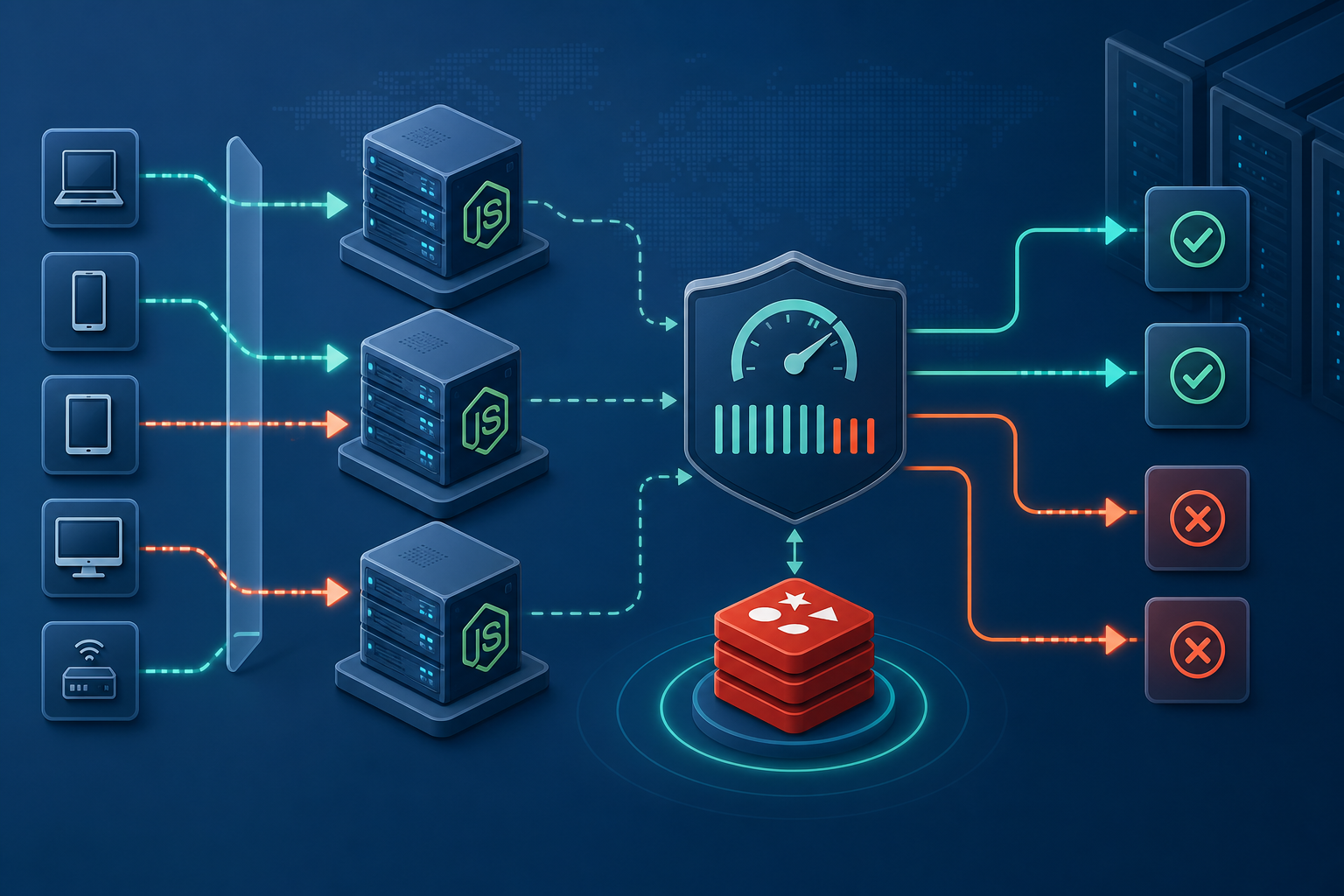
Node.js rate limiting with Redis is useful when you need shared enforcement across multiple application instances. Redis provides a fast, centralized counter or token store, which means one client cannot evade limits by bouncing across pods, containers, or load-balanced servers. After reading this article, you should be able to decide whether this approach fits your API, understand the moving parts, apply a compact validation workflow, and verify the setup before production use.
Key takeaways
- Rate limiting is not only an abuse-control feature; it is an operational safeguard for latency, fairness, and dependency protection.
- Redis works well as a shared state backend because it lets all Node.js instances enforce the same request budget.
- The design choice is not just “add a limiter”; it is “decide which identity, window, and failure mode you want to enforce.”
- A production-ready setup must define keys, scope, burst behavior, headers, and what happens if Redis is slow or unavailable.
- The safest implementation is the one you can explain to security, platform, and application teams in the same terms.
How Node.js rate limiting with Redis works
At a high level, the application evaluates each request against a quota. The quota may be based on IP address, authenticated user, API key, tenant, or a combination of these dimensions. The request path and method may also matter if you want different budgets for login, search, or write operations.
Redis stores the limiter state so that all application nodes observe the same counters or buckets. When a request arrives, the middleware checks the current allowance, updates the relevant key atomically, and either permits the request or returns a throttling response such as HTTP 429.
The important operational point is that the limiter and the application are not independent. If you use JWT-secured endpoints, rate limiting is often most effective after authentication has established identity and claim context. That said, unauthenticated endpoints still need IP-based controls, especially for login, password reset, and registration flows. If your API authentication design is still evolving, How to Secure Node.js APIs with JWT Authentication is relevant because limiter identity and auth identity often need to align.
Common limiter models
A fixed window counter is the easiest to reason about: allow N requests per time window, then reset at the boundary. It is simple and inexpensive, but can allow boundary bursts.
A sliding window smooths the boundary effect by tracking recent activity over a moving interval. It is more precise but can be more complex and slightly more expensive.
A token bucket or leaky bucket model supports bursts within a sustained long-term rate. That is often a better fit for user-facing APIs where short bursts are acceptable but sustained abuse is not.
The best model depends on whether you are trying to protect infrastructure, preserve fairness, or shape usage patterns.
Compact workflow for designing the limiter
Identify request identity -> choose enforcement point -> select window/model -> define Redis key and TTL -> decide fail-open or fail-closed -> emit headers and logs -> test burst, steady-state, and Redis failure behavior
This is intentionally compact because rate limiting fails most often at the boundaries: wrong identity, wrong scope, or unclear failure handling. If the workflow is sound, the implementation details become easier to verify.
Practical scenario: when this fits your environment
Imagine a Node.js API behind a load balancer with four replicas. Users authenticate with bearer tokens, but some endpoints remain public, including sign-up and password reset. A small number of clients occasionally trigger request storms through retries, and security wants a control that is enforceable across all instances.
In that environment, per-process memory counters are not enough. Each replica would see only part of the traffic, so a client could exceed the intended limit by distributing requests across servers. Redis solves that distributed state problem while keeping the limiter close to the application. It also gives operations a single place to inspect counters, TTLs, and limiter behavior during incidents.
This is also the kind of environment where rate limiting and authentication should be designed together. Public endpoints need IP- and route-based quotas, while authenticated endpoints should usually key off a stable user or API credential identity. For CPU-heavy workloads, keep in mind that rate limiting is not a substitute for workload isolation; if request handlers are expensive, Node.js Worker Threads: Offload CPU Tasks Safely may be part of the overall resilience plan.
What this means in practice
The main implementation decision is where the limiter key comes from. If you key only on IP, shared NATs and proxies can create false positives. If you key only on user ID, unauthenticated abuse is harder to control. If you key only on API key, a compromised key can consume the whole allowance without distinguishing client behavior.
A practical production design often combines identity dimensions. For example, you may rate limit login attempts by IP and username, authenticated API calls by user or client ID, and expensive report-generation endpoints by tenant. That makes the controls more precise and easier to justify when a customer hits a limit.
You also need to decide whether the limiter should fail open or fail closed if Redis cannot be reached. Fail open preserves availability but weakens protection. Fail closed protects the service but can block valid traffic during a cache outage. The right answer depends on the endpoint. Public authentication endpoints may need stricter protection, while read-heavy internal endpoints may prioritize availability. Whatever you choose, make sure the fallback is explicit and documented rather than accidental.
Implementation trade-offs to evaluate
A Redis-backed limiter adds a dependency to the request path, so latency and availability of Redis matter. The overhead is usually acceptable for APIs, but you should still verify connection pooling, timeouts, retry behavior, and the impact of Redis under load.
Atomicity is another important trade-off. A limiter that increments counters in multiple commands can produce race conditions. Prefer an approach that updates state atomically so concurrent requests do not over-admit traffic.
There is also a trade-off between strictness and usability. Very tight limits can frustrate legitimate clients, especially automation, mobile apps, or integrations that retry aggressively. Too-loose limits may not meaningfully reduce abuse. The limit should reflect observed traffic patterns, not just an arbitrary number.
Finally, think about observability. If you cannot see how often requests are being limited, you will not know whether the policy is protecting the service or simply annoying users. Metrics, logs, and response headers should make the limiter visible without exposing sensitive internals.
Decision guidance: when to use this approach
Use Redis-backed rate limiting when you have more than one Node.js instance, need consistent enforcement, or want limits to survive process restarts. It is also a strong choice when multiple services must share a common policy for the same traffic source.
Do not rely on it as the only control if your problem is application-layer abuse that changes identity frequently, if request volume is extremely high and Redis becomes a bottleneck, or if your organization cannot operate Redis with the required reliability. In those cases, combine it with upstream gateway controls, WAF rules, edge throttling, or identity-specific abuse detection.
A good rule is this: if the control must be consistent across nodes and visible to operators, Redis is a reasonable state backend; if the control is purely local and non-critical, a simple in-memory limiter may be enough.
Common mistakes
One common mistake is rate limiting by IP in environments where the source IP is not stable or not meaningful. Another is applying a single global limit to all routes, which treats a login attempt, a search query, and a billing update as if they had the same operational cost.
Another mistake is ignoring proxy behavior. If your API sits behind a load balancer or reverse proxy, you need a trustworthy source for client identity and real origin data. Incorrect trust configuration can make the limiter enforce the proxy address instead of the actual client.
Teams also sometimes forget to align the limiter with authentication and authorization. A user who has already authenticated successfully may deserve a different request budget than an anonymous client. Similarly, privileged administrative endpoints may warrant separate limits and stricter logging.
Finally, some implementations return 429 without any helpful headers or telemetry. That makes debugging harder for clients and operators. A useful limiter should communicate the remaining budget, reset timing, and correlation details where appropriate, without leaking sensitive state.
Compact production readiness checklist
- Identity source is defined for each protected route: IP, user, client ID, API key, tenant, or a combination.
- Rate limit model is chosen intentionally: fixed window, sliding window, token bucket, or another approved model.
- Redis keys include a clear namespace and TTL behavior.
- Atomic updates are used for counter or bucket changes.
- Failure mode is defined per route: fail open or fail closed.
- 429 responses include consistent headers and client-facing semantics.
- Logging and metrics capture throttle events, Redis errors, and high-cardinality abuse signals.
- Proxy and load balancer trust configuration is validated.
- Limits are tested under burst traffic, steady-state traffic, and Redis unavailability.
- Limits are reviewed against real traffic before broader rollout.
Validation checks before production use
Before you ship, verify that the limiter behaves the same way on every replica. Simulate requests through the load balancer and confirm that limits are shared rather than isolated per process. If you can send more traffic by rotating across instances, the design is not actually distributed.
Also confirm that the limit resets and response behavior match expectations. A well-behaved system should throttle at the documented threshold, recover when the window expires or tokens refill, and emit stable response metadata. Watch for edge cases around concurrent requests, clock assumptions, and route-specific overrides.
If you operate with both authenticated and unauthenticated traffic, test both paths separately. The correct limiter for a public endpoint may be wrong for a user-specific API. That distinction is part of the design, not a deployment detail.
Final takeaway
Node.js rate limiting with Redis is a practical way to enforce secure API throttling across distributed instances, but it only works well when the identity source, limiter model, failure mode, and observability are chosen deliberately. If you can explain those decisions clearly and validate them under real traffic conditions, you have a limiter that protects both the service and the users who depend on it.
Use this guidance together with JavaScript promise handling patterns to connect the workflow with related operational context already available on the site.
Part of the Programming: Node.js Insights content cluster.