
Key takeaways
Model drift detection is about deciding when production behavior has moved far enough from the validated baseline that trust is no longer justified. That decision should be based on monitored evidence, not intuition, and it should separate input drift, output drift, and performance drift so you know what changed and what did not.
A useful drift program combines statistical comparison, operational thresholds, and business impact checks. No single metric is sufficient on its own, because some changes are harmless while others are early signs of degraded decisions, data pipeline breakage, or adversarial manipulation.
The most practical production approach is to define a baseline, monitor a small set of stable features and outcomes, compare live data against that baseline on a fixed cadence, and require human review when multiple signals cross a threshold at the same time.
Why model drift detection matters in production
The practical problem behind model drift is simple: a model that was accurate in validation can become unreliable after deployment because the real world does not stay still. Customer behavior changes, upstream systems alter payloads, feature distributions shift, seasonality returns, labels arrive late, and adversaries may probe the system with malformed or unusual inputs. In production, that can translate into bad forecasts, incorrect risk scores, unstable automation, and hidden security exposure.
You need drift detection because model failure rarely announces itself with a single obvious crash. More often, it appears as a gradual quality decline, a change in confidence distribution, or a feature pipeline that still runs but now feeds the model a different population than the one it was trained on. If you can detect drift early, you can validate whether the model still fits the environment, limit damage, and choose between recalibration, retraining, or rollback.
This article shows how to detect model drift in a way that is operationally useful. By the end, you should be able to determine whether drift detection applies to your system, understand which signals are worth monitoring, use a practical validation workflow, and know what to verify before putting drift alerts into production.
What model drift detection is actually measuring
Model drift is not one thing. In practice, production teams usually care about three different questions.
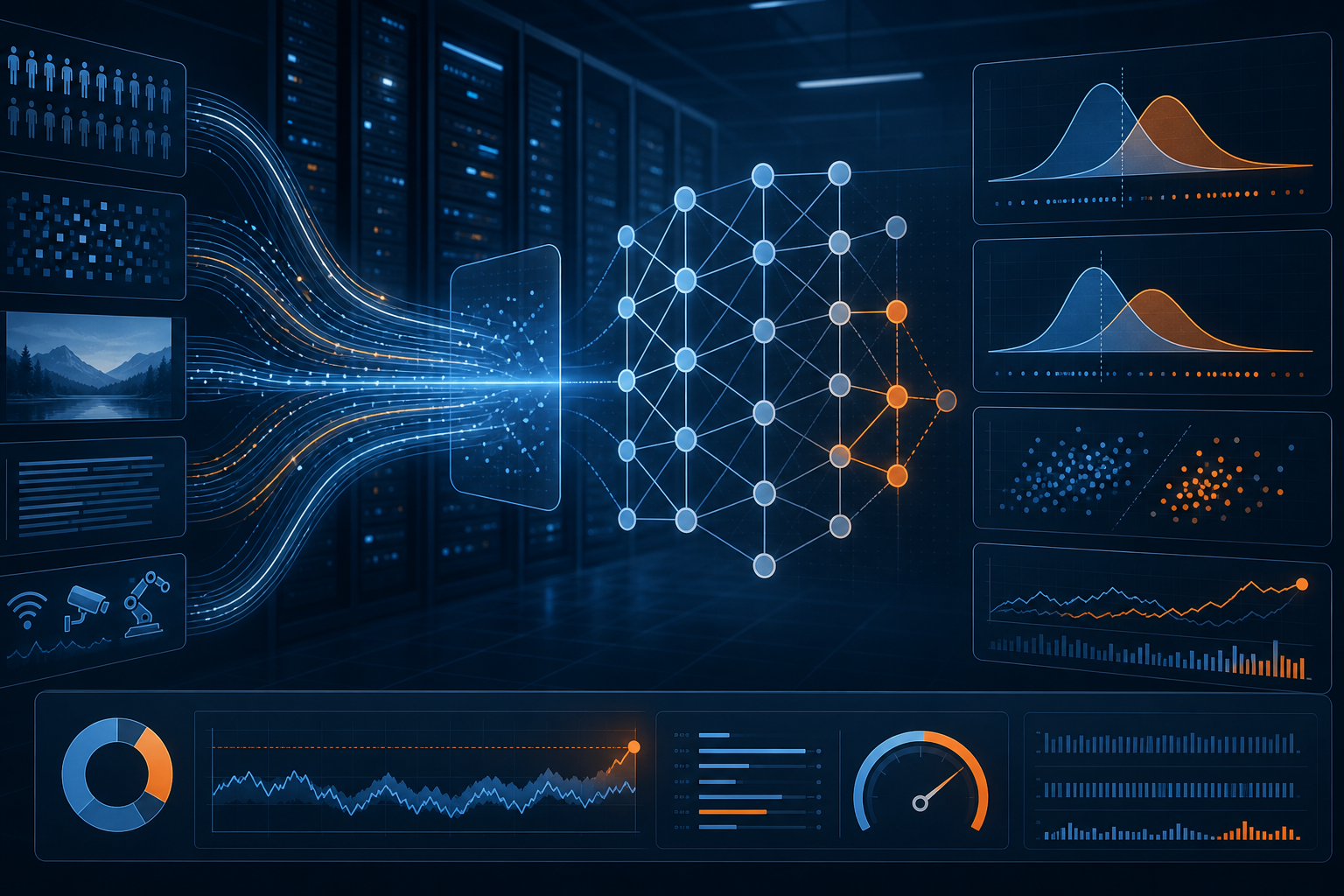
Input drift asks whether the live feature distribution differs from the training or validation baseline. A change in browser version mix, customer geography, packet size, transaction amount, or sensor range may indicate that the model is now operating in a different environment.
Output drift asks whether the model’s predictions have changed in aggregate. If the score distribution shifts significantly, that can mean the input population changed, preprocessing changed, or the model is no longer mapping features to outputs in the same way.
Performance drift asks whether the model is making more mistakes on real outcomes. This is the most important signal, but it is often delayed because labels may arrive hours, days, or weeks later. In many systems, performance drift is the final confirmation rather than the first warning.
These three signals should not be collapsed into one alert. A feature distribution shift might be benign if the business mix changed but the model remains accurate. A stable input distribution might still hide performance drift if the target definition changed or the label pipeline is wrong. Treat each signal as evidence, then combine them into an operational decision.
For a broader operational framing of detection logic and validation checks, see Model Drift Detection in Machine Learning Pipelines. For cases where drift may be caused or amplified by malformed inputs, Building Secure ML Models with Adversarial Training Techniques can help you think about threat assumptions and runtime controls.
How to detect drift without turning monitoring into noise
The most reliable approach is to compare live production data to a defined baseline using a small set of metrics that match the data type and the business risk.
For numeric features, compare summary statistics such as mean, median, variance, quantiles, and missing-value rate. These are easy to operationalize and often enough to show whether the population has moved. For categorical features, track category frequency, the appearance of new values, and the collapse of previously common classes. For model outputs, monitor score histograms, class proportions, and calibration indicators where labels are available.
Statistical distance measures can add useful rigor, but they are not magic. Population stability index, Kolmogorov-Smirnov style comparisons, Jensen-Shannon distance, and divergence-based measures can all be useful if applied consistently. What matters most is not the name of the metric but whether it is stable under normal variation and sensitive enough to catch meaningful shifts without alarming on every expected seasonal pattern.
The most practical production rule is to monitor drift at two levels. First, track feature-level movement so you can identify what changed. Second, track model-level movement so you can see whether the change is large enough to influence decisions. That separation makes the alert actionable: if the input change is real but the model behavior is stable, you may only need observation; if both move together, you probably need investigation.
Compact production workflow
Baseline definition -> live window collection -> feature/output comparison -> threshold evaluation -> label lag check -> human review or automated mitigation -> post-incident baseline update
This workflow is intentionally compact because drift detection should be repeatable, not complicated. The key is that every stage has an expected output. A baseline is not just a copy of training data; it is the reference period you have decided is representative of acceptable behavior. A live window is not just the latest batch; it is a time range wide enough to smooth random noise but short enough to react quickly. Threshold evaluation should combine statistics and business rules, and any mitigation should be tied to a documented decision path.
A practical scenario you can recognize
Consider a production fraud model that scores card-not-present transactions. For months, the model behaves normally. Then a new payment flow rolls out, and mobile wallet traffic increases while desktop traffic decreases. At first, the feature drift looks alarming: device type frequencies shift, transaction timing changes, and merchant category patterns move. But the actual fraud capture rate remains stable after labels mature.
In this case, the right conclusion is not “drift equals retrain.” It is “drift exists, but the model may still be fit for purpose.” The team may decide to keep monitoring while validating whether the new traffic pattern is expected, whether the score calibration is still valid, and whether the business wants a new baseline. If, however, the same traffic shift coincides with a rise in false positives, then the drift evidence becomes operationally significant and warrants intervention.
That distinction matters in real environments because many production models sit in systems that change for legitimate reasons. New releases, new customer segments, seasonal load, regional expansion, and upstream ETL changes can all alter the input distribution without necessarily degrading model quality. Drift detection should help you tell those cases apart.
What this means in practice
In practice, drift monitoring works best when you define what “normal change” looks like before you need to respond to it. That means establishing a baseline window, documenting which features are critical, and deciding how much movement is acceptable for each signal. A model serving a high-impact security workflow should usually tolerate less unexplained drift than a low-risk recommendation model.
You also need to account for label latency. If you only monitor performance drift, you may learn about failure too late. If you only monitor feature drift, you may overreact to harmless shifts. The production answer is usually a layered approach: feature drift for early warning, output drift for model-behavior confirmation, and delayed performance drift for final verification.
For systems with security relevance, drift monitoring can also help identify suspicious data conditions. Unusual feature values, sudden concentration in specific categories, or distribution changes that do not match business events may indicate data poisoning attempts, scraper activity, or malformed inputs. In those cases, drift alerts should feed into security triage rather than only ML operations.
How to decide whether drift is actionable
A drift signal is actionable when it passes three tests: it is statistically unusual, it is operationally meaningful, and it is consistent with a plausible cause.
Statistical unusualness means the live window is meaningfully different from the baseline according to the metric you chose. Operational meaning means the change affects features or outputs that matter to the model’s decision path, not just auxiliary fields. A plausible cause means you can connect the change to a deployment, upstream data change, seasonality event, traffic mix change, or suspicious activity.
This decision rule prevents two common errors. The first is panic-retraining: rebuilding the model every time a distribution shifts even when business outcomes are fine. The second is drift blindness: ignoring real movement because the alert volume is too high or the metric is too abstract. Good drift programs make it easy to classify alerts into investigate, observe, recalibrate, or retrain.
Common detection methods and their trade-offs
No drift method is universally best. The right method depends on the feature type, label availability, and the cost of false positives.
Simple summary comparisons are easy to explain and cheap to run, which makes them a good default for high-cardinality monitoring and dashboards. Their weakness is that they can miss structural shifts that do not change the mean very much.
Distribution-distance methods are better at comparing entire shapes, but they can be sensitive to sample size and window choice. Small windows may produce unstable results; very large windows may delay detection.
Performance-based monitoring is the most directly relevant to business outcomes, but it suffers from label delay and can be difficult when feedback loops affect the target itself. In some systems, a stable score distribution with worsening performance indicates label drift or concept drift rather than pure input drift.
Explainability methods can help you understand why drift matters, especially when a subset of features appears to drive the shift. If you need to debug model behavior and reduce operational risk, Explainable AI for Model Debugging and Risk Control can complement drift analysis by showing whether the model is leaning on unstable inputs.
The trade-off to remember is that more sensitivity usually means more alert noise. If your team cannot act on frequent low-confidence alerts, the monitoring system becomes a liability. A slightly delayed but reliable signal is often more useful than a hyper-sensitive one that is constantly ignored.
Common mistakes when detecting drift
A frequent mistake is using the training set as the only baseline. Training data may contain artifacts, sampling bias, or data cleaning steps that no longer reflect the true operating environment. A better baseline is usually a recent, validated, representative production window.
Another mistake is monitoring too many features at once without a ranking strategy. If every column triggers alerts, no alert is useful. Prioritize the features that materially influence decisions, are known to move under business change, or are historically fragile in the pipeline.
Teams also misclassify label delay as model stability. If the truth arrives late, a model may appear healthy for weeks even as it degrades. You need explicit handling for delayed outcomes so that the absence of performance data is not mistaken for evidence of quality.
A final mistake is assuming drift automatically means retraining. Sometimes the right response is recalibration, threshold adjustment, feature normalization review, or a data contract fix. Retraining a model that is already well-calibrated against a new but legitimate population can make things worse.
Production readiness checklist
Use this compact checklist before relying on drift alerts in production:
- Baseline window is documented and representative of acceptable behavior.
- Monitored features are tied to model risk, not chosen only because they are easy to log.
- Numeric, categorical, output, and performance signals are handled according to data type and label latency.
- Thresholds are justified, versioned, and tested against known good and known changed periods.
- Alert routing distinguishes investigation, recalibration, retraining, and pipeline incident paths.
- Sample windows and aggregation intervals are consistent across environments.
- Missing values, schema changes, and new categories are explicitly tracked.
- Human reviewers know what evidence is required before declaring a drift incident.
- Baseline refresh rules are defined so the monitor does not drift into obsolescence.
Validation before production use
Before you trust drift detection in a live system, validate it against at least one historical period where you know a real change occurred and one where the system remained stable. The goal is not perfect precision; it is to confirm that the monitor behaves sensibly and produces decisions your team can defend.
Check whether the alert is stable when the same data is re-windowed, whether the metric reacts to the shifts you care about, and whether a legitimate business change is distinguishable from a broken pipeline. If the monitor cannot separate those cases, it needs refinement before it becomes operationally important.
It is also worth verifying the data collection path itself. Drift monitoring depends on the same ingest, schema, and feature computation surfaces as the model. If those surfaces are inconsistent, the monitor may report drift that is actually just a telemetry defect. In that sense, model drift detection is both an ML problem and a systems reliability problem.
A drift alert is useful only when it leads to a clear decision. If your team can look at the evidence, explain the change, and choose a response with confidence, then the detector is doing its job. If it only creates uncertainty, reduce the noise, narrow the scope, and revalidate the baseline until the signal is operationally meaningful.
Final takeaway
To detect model drift in production, monitor the relationship between your live data, your model outputs, and your delayed outcomes against a well-defined baseline. Treat drift as evidence, not as an automatic failure, and require a clear operational decision before changing the model. The best drift system is the one your team can trust enough to act on.
Use this guidance together with secure dependency management to connect the workflow with related operational context already available on the site.
Part of the Programming: AI / Machine Learning Insights content cluster.