
Why model validation belongs in the security path
The operational problem is simple: an ML pipeline can produce a model that is technically valid, but still unsafe to deploy. A model may be trained on poisoned data, behave inconsistently across environments, expose privacy-sensitive outputs, or fail under input patterns that were not covered by testing. In production, those failures become security incidents, reliability incidents, or both.
Model validation checks are the gate that keeps those bad artifacts out of downstream systems. They do more than confirm that a file exists or that metrics improved on a held-out set. In a secure ML pipeline, validation checks verify provenance, data quality, reproducibility, security expectations, and deployment compatibility before the model is promoted.
After reading this article, you will be able to decide whether model validation checks are enough for your pipeline, apply a practical validation workflow, and know what evidence to verify before a model is accepted for production use.
Key takeaways
Model validation checks should answer one question: is this model safe enough to trust in the next environment? That means checking more than accuracy.
A useful validation layer typically covers:
- input schema and feature contract checks
- training and inference data integrity checks
- performance thresholds against approved baselines
- security-sensitive behavior such as leakage, overconfidence, or unstable outputs
- reproducibility of the training artifact and its dependencies
- deployment constraints such as runtime format, resource bounds, and version compatibility
The main design rule is to make validation fail closed. If the model or its metadata cannot be verified, promotion should stop until the issue is explained and resolved.
Why this matters operationally
A model is not just a statistical artifact; it is a live dependency in a production system. Once deployed, it often influences access decisions, routing, fraud scoring, prioritization, or automation. If the validation stage is weak, a bad artifact can move through CI/CD as easily as any ordinary build output.
That creates several concrete risks. Data drift can make a previously acceptable model behave unpredictably. Inadequate feature checks can allow malformed inputs to reach inference. Training data tampering can introduce hidden bias or backdoors. A dependency mismatch can cause silent degradation when the model is loaded in a new runtime. If the pipeline does not validate these conditions explicitly, operations teams learn about the problem only after the model is live.
For threat-focused teams, this is closely related to adversarial robustness and model integrity controls. If you are also evaluating attack surface reduction, How to Secure Machine Learning Models Against Adversarial Attacks is a useful companion topic because validation and robustness testing often overlap in the same release gate.
What model validation checks actually verify
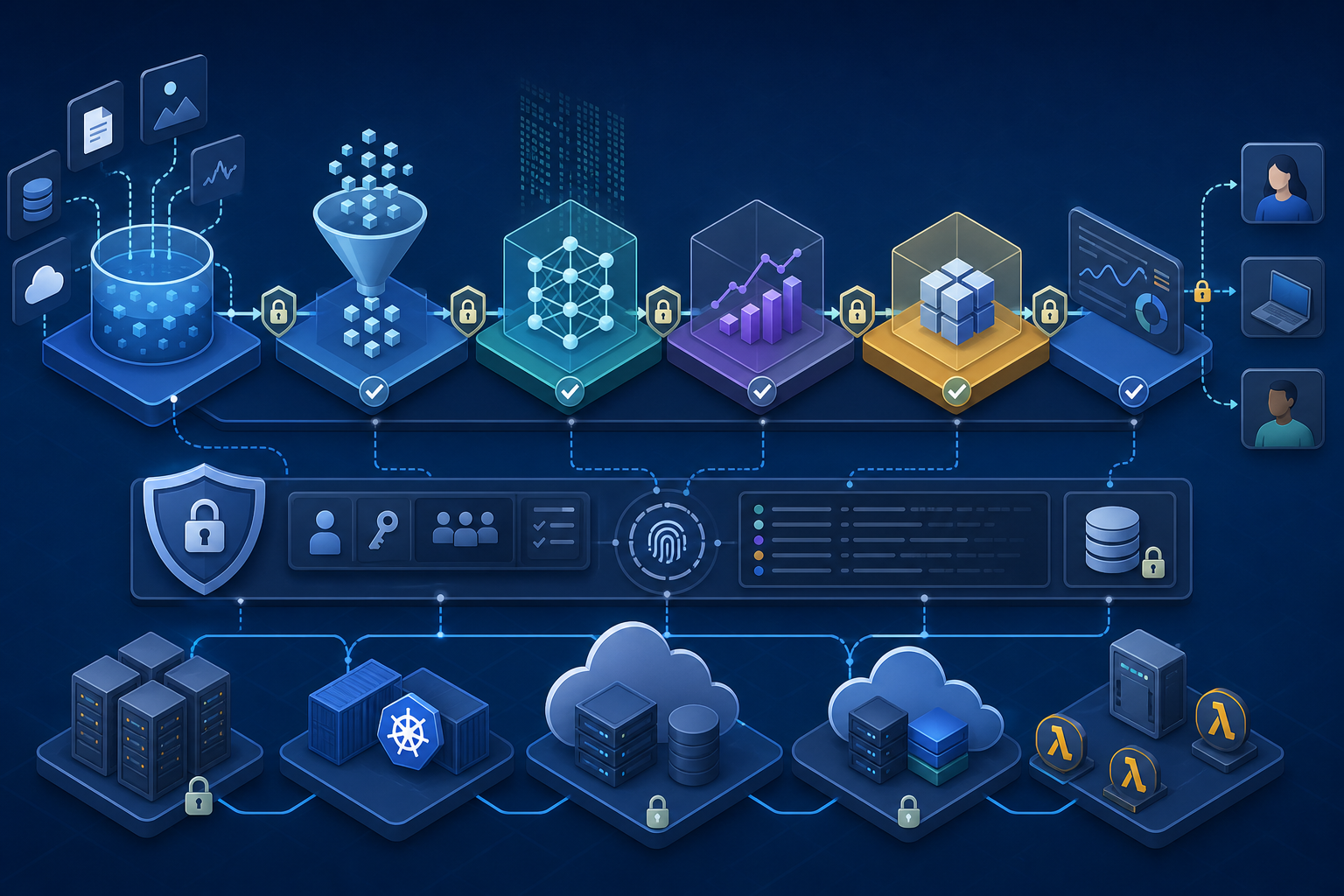
A secure validation layer is usually a set of tests and evidence checks rather than a single score threshold. The strongest implementations verify the model artifact, the data, the environment, and the expected behavior as a unit.
1) Data and feature integrity
The first question is whether the data used to train and evaluate the model is trustworthy enough for release. Validation should confirm that the dataset version is known, the source is approved, and the selected features match the intended contract. This includes checking for missing columns, unexpected categorical values, broken joins, duplicated records, and impossible ranges.
If your model consumes a schema that can change upstream, the validation layer should compare the incoming features to an approved contract rather than relying on a human review of training notebooks. This is especially important where pipeline code accepts external inputs or where multiple teams own different parts of the data flow.
2) Training and artifact provenance
A secure pipeline should be able to answer where the model came from, what code built it, which data produced it, and which dependencies were present at build time. Validation checks should verify immutable identifiers for code, data, and artifact versions. The goal is not just traceability for audits; it is also to ensure that a later release can be reproduced or rolled back safely.
If the training job cannot produce a consistent artifact from the same inputs, that is a reliability problem and a security problem. It makes it harder to detect tampering, harder to compare releases, and harder to diagnose regressions.
3) Performance against an approved baseline
Validation should confirm that the model performs at or above a predefined baseline on the metrics that matter for the use case. Accuracy is often only one piece. Depending on the system, validation may need to inspect precision, recall, calibration, false-positive rate, false-negative rate, latency, or class-specific thresholds.
The important point is that the baseline must be selected before the model is trained or at least before release approval. If thresholds are chosen after the fact, the validation gate becomes a reporting exercise instead of a control.
4) Security-sensitive behavior
A secure ML pipeline should test for behaviors that can expose the system to abuse. That may include unusual confidence on out-of-distribution inputs, unstable predictions for near-identical records, label leakage in feature selection, or outputs that reveal too much about the training set. In sensitive domains, you may also need checks for fairness, privacy, and resistance to manipulation.
For teams building end-to-end pipelines, How to Build and Secure a Machine Learning Model Pipeline provides useful context on where these checks sit relative to training, packaging, and deployment controls.
5) Runtime compatibility and deployability
A model can pass metric checks and still fail in production because the serialized format, dependency set, or inference runtime is incompatible with the target environment. Validation should confirm that the model can be loaded in the approved runtime, that required libraries are present, and that the artifact stays within expected memory, CPU, and latency envelopes.
This is especially important when build and deployment environments are separated by different base images, OS packages, hardware types, or managed service versions. If compatibility depends on a particular version or feature flag, verify that explicitly before promotion.
A compact validation workflow
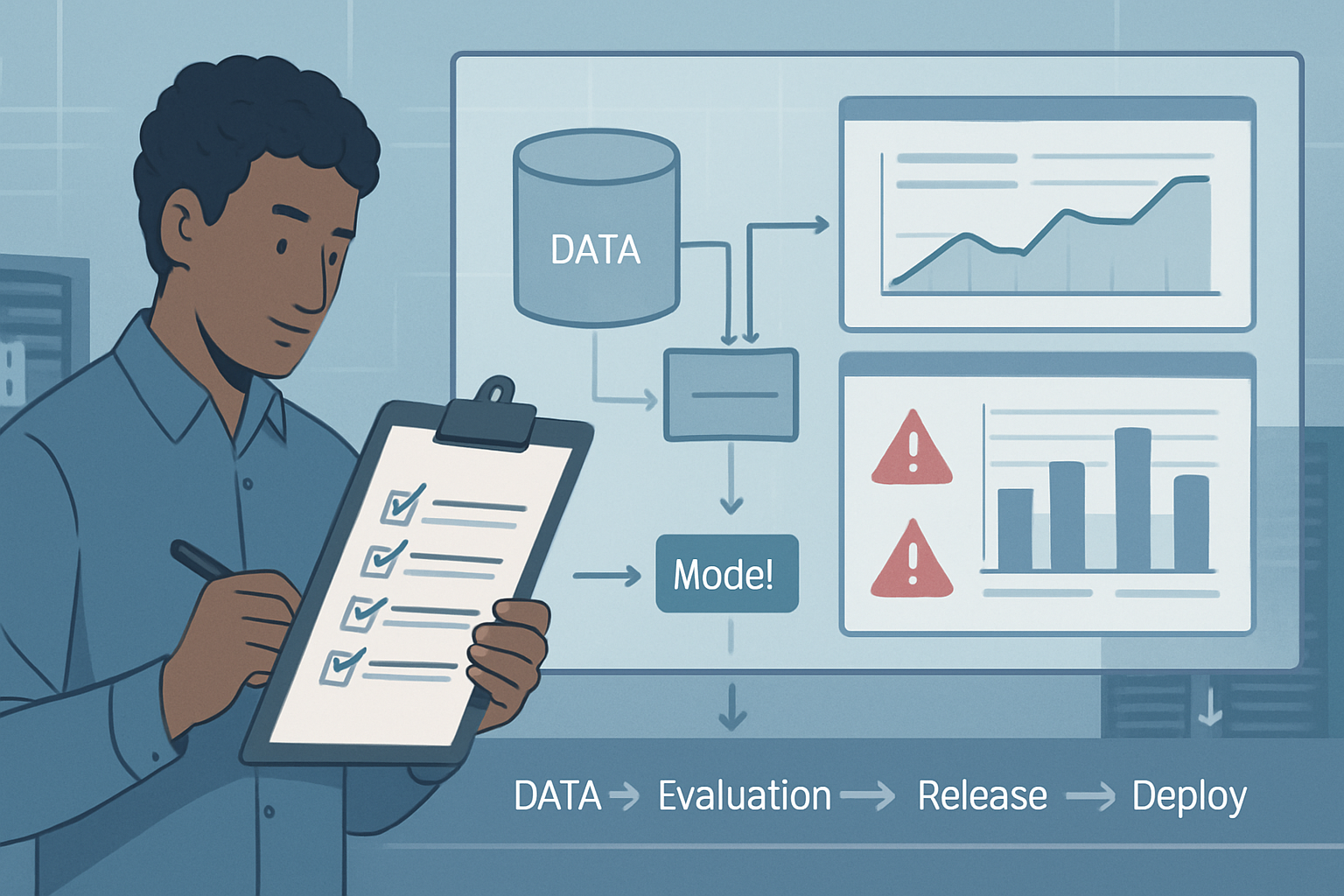
A practical secure validation workflow is usually short and repeatable:
1. Ingest signed or versioned model artifact
2. Verify source, code commit, training data version, and dependency lockfile
3. Validate schema, feature ranges, null rules, and allowed categories
4. Run baseline metric checks and stability checks
5. Execute security-focused checks: leakage, abnormal confidence, adversarial or drift probes where applicable
6. Confirm runtime compatibility and resource budgets
7. Record evidence and approve or fail closed
This workflow is useful because it separates “does it work?” from “is it safe to trust?” A model should not be promoted merely because one metric improved. It should be promoted only when each required control has produced acceptable evidence.
A scenario you will recognize
Consider a team running a fraud detection model in a payment workflow. The data science team ships a new version because offline precision looks better on recent data. In staging, the service starts accepting requests normally, but a validation rule later detects that one high-cardinality merchant feature has a new encoding not seen during training. The same release also shows a small but meaningful increase in confidence on empty or near-empty payloads.
Without validation checks, that model could move to production and create silent failure modes: false positives that disrupt real customers, or false negatives that allow suspicious activity through. With validation checks, the pipeline blocks promotion, surfaces the schema mismatch, and forces the team to either retrain or remap the feature contract before release.
That is the practical value of model validation checks: they catch operational mismatches before the model becomes an incident ticket.
What this means in practice
In practice, model validation checks are a policy decision encoded as automation. They are not a substitute for model testing, and they are not the same as a general code review. They are the approval boundary that determines whether a model is trustworthy enough for a specific environment.
If your environment is low risk and the model only supports internal decisioning, the validation layer may focus on schema, provenance, and a small set of metrics. If the model influences customer-facing actions, financial decisions, or security controls, the gate should be stricter and include adversarial or abuse-oriented tests.
A useful mental model is this: training produces a candidate, validation determines whether that candidate is admissible, and deployment decides whether the admissible candidate is appropriate for the target environment. The stronger your validation evidence, the smaller the chance that downstream systems inherit an unsafe artifact.
Decision guidance: when model validation checks are enough
Model validation checks are appropriate when you need a reproducible, policy-driven release gate that can be enforced in automation. They work best when the model, data, and inference environment are all measurable and versioned.
They are usually sufficient if:
- the feature set is stable and well-defined
- the training data source is controlled
- the deployment environment is known in advance
- the model’s output can be measured against clear acceptance criteria
- the release process can fail closed without manual exception handling
They are not enough on their own if the system has weak data provenance, highly dynamic inputs, or severe adversarial exposure. In those cases, validation must be paired with stronger upstream controls such as signed artifacts, restricted data access, sandboxed training jobs, human approval for high-impact releases, or continuous post-deployment monitoring.
A simple decision rule is this: if you cannot explain what would make a model fail validation before it is trained, then the validation policy is too vague to protect production.
Implementation trade-offs
There is always tension between strictness and delivery speed. More checks improve safety, but they also increase pipeline complexity and may block otherwise acceptable releases when data or infrastructure change faster than the controls.
A few trade-offs matter most:
- Strict schema checks vs. flexibility: strict contracts reduce bad inputs but can slow teams when feature evolution is frequent.
- High metric thresholds vs. release velocity: aggressive baselines reduce risk but can prevent deployment of genuinely better models in early stages.
- Automated gating vs. manual approval: automation is faster and more consistent, but high-risk use cases may still need human review for exceptions.
- Broad adversarial testing vs. cost: wider security tests improve coverage, but they can be expensive and may need to be scoped to the attack surface that matters most.
- Reproducibility vs. dependency agility: pinning versions improves traceability, but it can make upgrades slower if your environment changes often.
The right balance depends on the business impact of model failure. For a recommendation model, a narrower gate may be acceptable. For access control, fraud, or safety-related decisions, the cost of a false approval is much higher than the cost of a delayed release.
Common mistakes
The most common mistake is treating validation as a single accuracy threshold. That misses schema drift, runtime incompatibility, and security-relevant behavior.
Another frequent error is validating against the wrong baseline. If the validation set is outdated or the acceptance threshold is adjusted after results are known, the control no longer means much.
Teams also often forget to validate the artifact chain. If the model file is approved but the code, dependency graph, or training data version is not recorded, you cannot reliably reproduce or investigate it later.
A third mistake is assuming staging proves readiness. Staging usually confirms that the service can run, not that the model is secure against malformed inputs, data anomalies, or policy violations.
Finally, teams sometimes allow manual overrides without logging evidence. That undermines the whole gate because exceptions become invisible and unreproducible.
Production readiness checklist
Before a model is promoted, verify that you can answer yes to these checks:
- The model artifact is versioned and traceable to approved code and data.
- The input schema, feature ranges, and allowed categories are validated.
- Required performance metrics meet preapproved thresholds.
- Security-sensitive behaviors have been tested for the relevant threat model.
- The runtime can load the artifact in the target environment.
- Resource usage stays within defined limits.
- Validation failures block promotion by default.
- Evidence is stored in a form that operations and audit teams can inspect later.
- Any manual exception has an owner, reason, and expiry.
If even one of these items is missing, the pipeline is not fully secure enough to treat validation as a trustworthy release gate.
A practical validation pattern to adopt
The most reliable pattern is to define model validation checks as a policy object, not as scattered notebook logic. That policy should be owned by the platform or ML operations team, versioned with the pipeline, and reviewed like other release-critical infrastructure code.
A good policy usually includes three things: the required checks, the acceptance thresholds, and the evidence format. That keeps the process consistent across teams and makes it easier to reason about exceptions.
You do not need a perfect validation framework to start. You need one that is explicit, repeatable, and strict enough to stop unsafe models from moving forward. Over time, you can add more checks as the threat model matures and the cost of failure becomes clearer.
The operational goal is straightforward: make it hard for a model to enter production unless it has passed the checks that matter for your environment. When model validation checks are designed that way, they become a practical control rather than a ceremonial approval.
Use this guidance together with ASP.NET Core rate limiting to connect the workflow with related operational context already available on the site.
Part of the Programming: AI / Machine Learning Insights content cluster.