
Key takeaways
Model drift is the operational signal that your deployed machine learning system is no longer behaving like it did at validation time. In practice, that can mean the input distribution changed, the relationship between inputs and labels shifted, or the model’s outputs no longer align with business outcomes. Detecting drift early helps prevent silent degradation, unstable automation, and false confidence in a model that appears healthy at the infrastructure layer.
The most useful drift detection strategy is not a single metric. It combines feature-level monitoring, prediction monitoring, and outcome-based validation when labels arrive late enough to be useful. The goal is to distinguish real change from expected noise, seasonal patterns, and sampling effects.
A production-ready drift workflow should tell you three things: whether a change is happening, whether it is large enough to matter, and whether it affects the model’s decisions or downstream risk. That is what makes drift detection actionable instead of merely descriptive.
Why model drift matters operationally
A machine learning pipeline can remain technically “up” while the model quietly becomes less reliable. In a security context, that can mean a classifier misses new attack patterns. In a system engineering context, it can mean anomaly detection starts flagging normal traffic as suspicious after an infrastructure change. In a business workflow, it can mean automated decisions gradually diverge from the conditions the model was trained on.
The operational problem is that model failure often arrives before hard incidents. You may see higher manual review rates, more override actions, changed score distributions, or inconsistent confidence calibration long before performance metrics collapse. If your monitoring only covers service health, latency, and error rates, you will miss the failure mode that matters most for ML systems: semantic degradation.
This is why drift detection should be treated as part of pipeline reliability, not just model governance. It needs to be designed with alert quality, data latency, and retraining triggers in mind. For teams that are building broader observability around AI systems, the same operational discipline used for anomaly detection in distributed data workflows also applies here; the difference is that the signals are model-centric rather than pipeline-centric.
What model drift actually means
Model drift is an umbrella term, but the distinction between different drift types matters because each one requires a different response.
Data drift occurs when the input feature distribution changes compared with the training or baseline period. Examples include new user segments, shifted traffic patterns, seasonal behavior, schema changes, or upstream data quality issues.
Prediction drift occurs when the distribution of model outputs changes. This may happen because the inputs changed, but it can also result from a model update, a calibration issue, or a change in how the model is being used.
Concept drift occurs when the relationship between inputs and the target variable changes. This is the most operationally important form, because even if the features look familiar, the target behavior has changed and the model can no longer map inputs to outcomes correctly.
In practice, many teams first detect data drift because it is easier to measure. That is useful, but incomplete. Data drift is a leading indicator, not proof of model failure. A drift alert becomes meaningful only when you can connect it to model behavior or downstream outcomes.
How to detect drift in a production pipeline
The most reliable detection design compares current data and outputs against a stable baseline, then measures whether differences exceed expected variation. The baseline should reflect the same feature definitions, preprocessing logic, and business context used when the model was validated. If your training pipeline includes feature normalization, categorical encoding, or time-window aggregation, drift checks should operate on the same transformed view or on raw inputs with a documented mapping.
A practical workflow usually uses three layers of signal:
- Input feature monitoring to detect distribution change.
- Prediction monitoring to detect output shift and calibration changes.
- Delayed outcome monitoring to validate whether the change affected model quality.
This layered approach is more robust than relying on one statistic such as the population stability index or a single distance metric. It gives you a faster early warning while still requiring downstream evidence before you retrain or roll back a model.
A compact operating model looks like this:
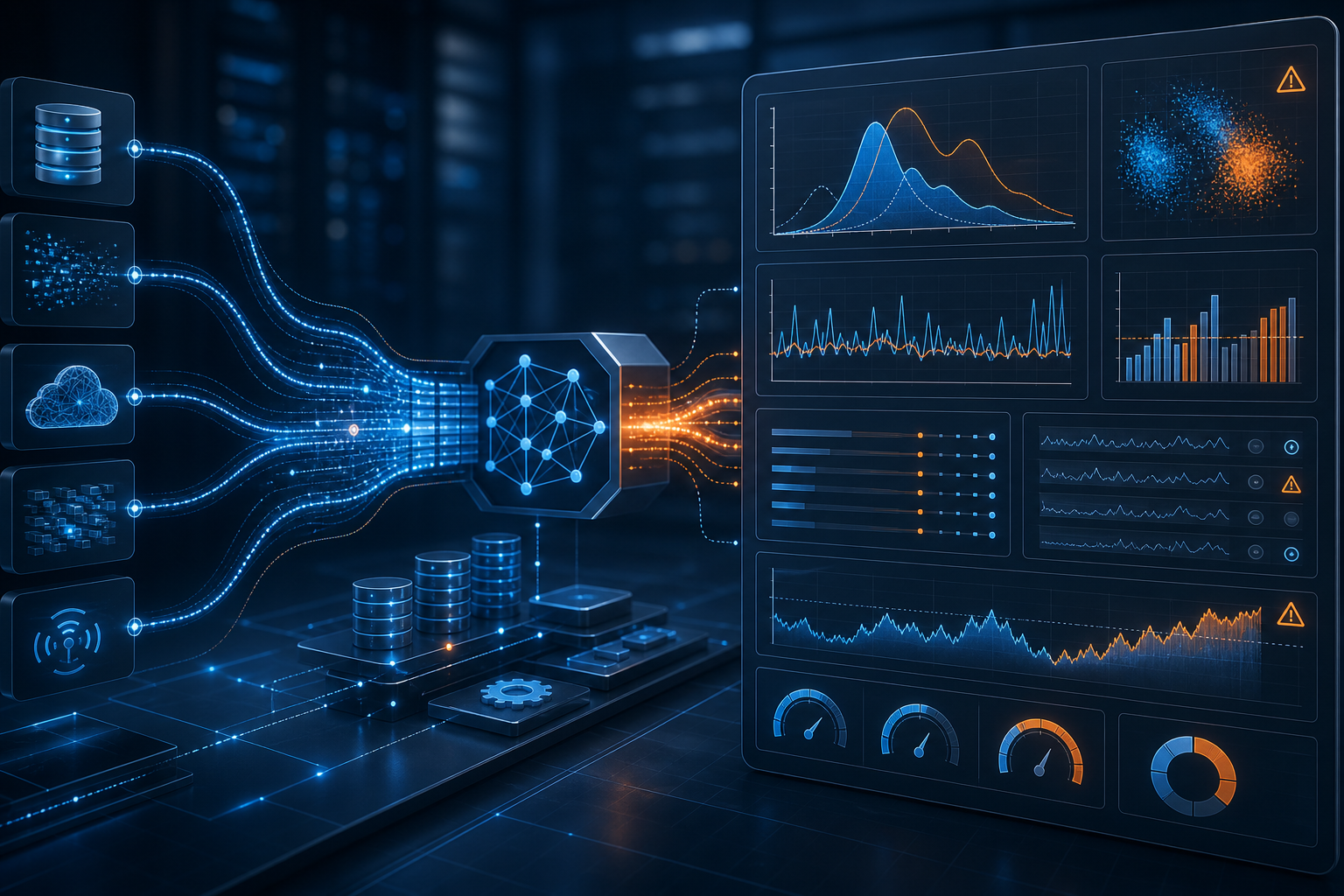
Baseline reference -> current window -> compare feature/prediction distributions -> score drift severity -> check business impact / delayed labels -> alert, investigate, retrain, or suppress
The important part is that the last two steps are decision-oriented. Drift should not trigger automatic retraining unless you have already defined the conditions under which retraining is safe and likely to help.
If you need a deeper operational framing for production ML monitoring, Detecting AI Model Drift in Production Machine Learning Systems goes further into separating true drift from natural variability.
Signals that are useful in real systems
Different signals are useful at different points in the lifecycle. The most dependable ones are the ones you can explain to an on-call engineer, not just a data scientist.
Feature distribution checks are the starting point. For numeric fields, you can compare summary statistics, quantiles, histograms, or distribution distances between the baseline and the current window. For categorical fields, you can compare category frequencies, unseen category rates, and missing-value patterns. For text or embedding-based features, you usually need higher-level summary checks because raw token drift is too granular to interpret directly.
Prediction checks are equally important. A sudden rise in average score, a collapse in score variance, or a shift in class balance can reveal changes even when input data looks stable. Prediction drift is often the first sign that preprocessing, thresholding, or calibration has changed.
Outcome checks are the strongest evidence, but they are usually delayed. Once labels arrive, compare recent performance against a reference slice using metrics that fit the problem: precision, recall, AUC, calibration error, MAE, or false positive rate. For security or abuse detection, false positive drift can be just as important as overall accuracy because it affects analyst workload and user friction.
A useful rule is this: if the input drift is large but the outcome is stable, investigate but do not assume failure. If the input drift is small but outcome quality has dropped, you likely have concept drift or a hidden pipeline issue. If both move together, the case for intervention becomes stronger.
Practical scenario: a normal-looking model that is starting to fail
Consider a fraud detection pipeline in which transaction features, device attributes, and geolocation signals feed a binary classifier. Over several weeks, the infrastructure team migrates traffic to a new edge provider, which changes the distribution of IP metadata and geographic resolution. At the same time, fraudsters adapt their behavior and begin using cleaner transaction patterns.
At first, service health looks fine. Latency stays within SLO, the API returns successful responses, and the model score distribution changes only slightly. But analysts begin seeing more manual reviews, and the approval rate for suspicious activity starts slipping. A feature-level drift check highlights a rise in unknown geolocation values and a shift in device consistency features. Prediction drift shows more scores clustered near the decision threshold. Once delayed labels arrive, precision drops while recall remains misleadingly stable.
This is the kind of environment where drift detection pays off. The issue is not just that the input changed; it is that the model’s operating boundary no longer matches the active traffic mix. Without drift monitoring, the team might mistake the change for random variation and continue trusting the same threshold settings.
Validation methods that reduce false alarms
Drift detection becomes useful only when alerts are credible. Otherwise, teams ignore them.
The first validation principle is to use a baseline that is representative of the production state you want to preserve. A training set may be a poor baseline if the model was trained on a sample that no longer reflects the live population. In some systems, a recent stable production window is a better reference than the original training slice.
The second principle is to use windowing carefully. Short windows detect faster but are noisy; long windows reduce noise but may hide rapid incidents. For bursty traffic, compare current windows to time-aligned historical windows so you do not confuse seasonality with drift. For low-volume systems, aggregate more conservatively and avoid overreacting to a handful of samples.
The third principle is to validate drift thresholds against known changes. Use historical incidents, controlled traffic shifts, or backtests on older periods to see whether the chosen thresholds would have caught meaningful change without firing constantly. A threshold that is statistically significant but operationally meaningless adds noise, not protection.
The fourth principle is to separate alerting from response. A drift alert should start an investigation, not automatically trigger retraining unless the downstream controls are mature enough to support that behavior.
Decision guidance: when drift detection is worth the effort
Not every ML pipeline needs the same level of drift monitoring. The decision depends on exposure, label latency, and the cost of error.
Drift detection is usually justified when the model is used in production decisions, the data environment changes over time, or model mistakes have measurable operational, financial, or security impact. It is especially important when labels arrive late, because by the time offline evaluation shows a problem, the system may already have caused damage.
It is less urgent when the model is low-risk, retrained very frequently with strong feedback loops, or used only for exploratory ranking where manual review catches mistakes quickly. Even then, basic input and output monitoring is still useful as a safety net.
A practical decision rule is simple: if a human would be surprised by a model change only after users or downstream systems complain, you need drift detection. If the model’s output directly affects access, approvals, incident triage, or automated remediation, you need it even more.
For teams operating mixed ML and data pipeline estates, the same mindset used for detecting anomalies in batch and streaming systems can help structure evidence collection. Drift detection should sit alongside lineage, freshness, and schema validation, not replace them.
What this means in practice
In production, drift detection works best as a controlled evidence system. You define what “normal” looks like, compare live windows to that reference, and require enough evidence before changing the model or threshold.
That means your monitoring should answer operational questions, not just statistical ones. Is the change concentrated in one feature or spread across several? Did the score distribution move before or after the data quality alert? Are the affected segments concentrated in one region, tenant, customer class, or traffic source? Do delayed labels confirm a quality drop, or is the model still behaving acceptably despite the shift?
In practice, a good drift signal should help you choose among three actions: observe, investigate, or intervene. Observe when change is present but impact is unclear. Investigate when drift is meaningful but the root cause is not obvious. Intervene when the change is large, persistent, and correlated with degraded outcomes.
This is also where monitoring maturity matters. A team with no threshold governance will create noisy alerts and unreliable retraining cycles. A team with structured severity levels, baseline management, and delayed label review can turn drift into a managed operational input.
Common mistakes teams make
The most common mistake is treating drift as a single universal metric. One number cannot tell you whether the input schema changed, the prediction distribution shifted, or model quality deteriorated.
Another mistake is comparing live data to the wrong baseline. If the baseline includes a temporary launch event, an incident period, or a one-time promotion, the model may appear stable against a distorted reference.
Teams also overreact to small sample windows. This is especially problematic in low-volume or highly seasonal systems where random variance is expected. If you page on every small shift, the alert loses value.
A related mistake is ignoring delayed labels. Feature drift without performance validation is only a hypothesis. Conversely, performance degradation without feature drift usually points to concept drift, label issues, preprocessing bugs, or threshold mismatch.
Finally, some teams retrain too quickly. Retraining in response to every drift signal can make the system unstable, because the new model may chase noise instead of learning durable change.
Production readiness checklist
Use this compact checklist before treating drift detection as production-ready:
- The baseline window is documented and representative of the desired operating state.
- Feature, prediction, and outcome signals are monitored separately.
- Time windows are chosen to balance noise, seasonality, and detection delay.
- Thresholds are validated against historical examples or replayed data.
- Missing values, schema shifts, and unseen categories are tracked explicitly.
- Delayed labels are incorporated into post-alert review.
- Alert severity distinguishes between investigate and intervene states.
- Retraining, rollback, and suppression criteria are defined in advance.
- Ownership is clear for investigation, model updates, and business sign-off.
If any of these are missing, the system may still detect change, but it will not reliably support production decisions.
Final takeaway
Detecting model drift in machine learning pipelines is about proving that a live model still matches the environment it is operating in. The strongest setup combines baseline comparison, feature drift, prediction drift, and delayed outcome validation so you can tell real degradation from normal variation. If your model drives meaningful decisions, the right question is not whether drift will happen, but how quickly you will recognize it and how confidently you will respond when it does.
Use this guidance together with secure code review automation to connect the workflow with related operational context already available on the site.
Use this guidance together with ASP.NET Core Identity hardening to connect the workflow with related operational context already available on the site.