
Key takeaways
Adversarial attacks on machine learning models exploit the gap between what a model learns statistically and what an attacker can manipulate operationally. The practical goal is not to make a model impossible to attack; it is to reduce attacker leverage, detect abnormal inputs early, limit blast radius, and ensure the system fails safely when the model is uncertain or under pressure.
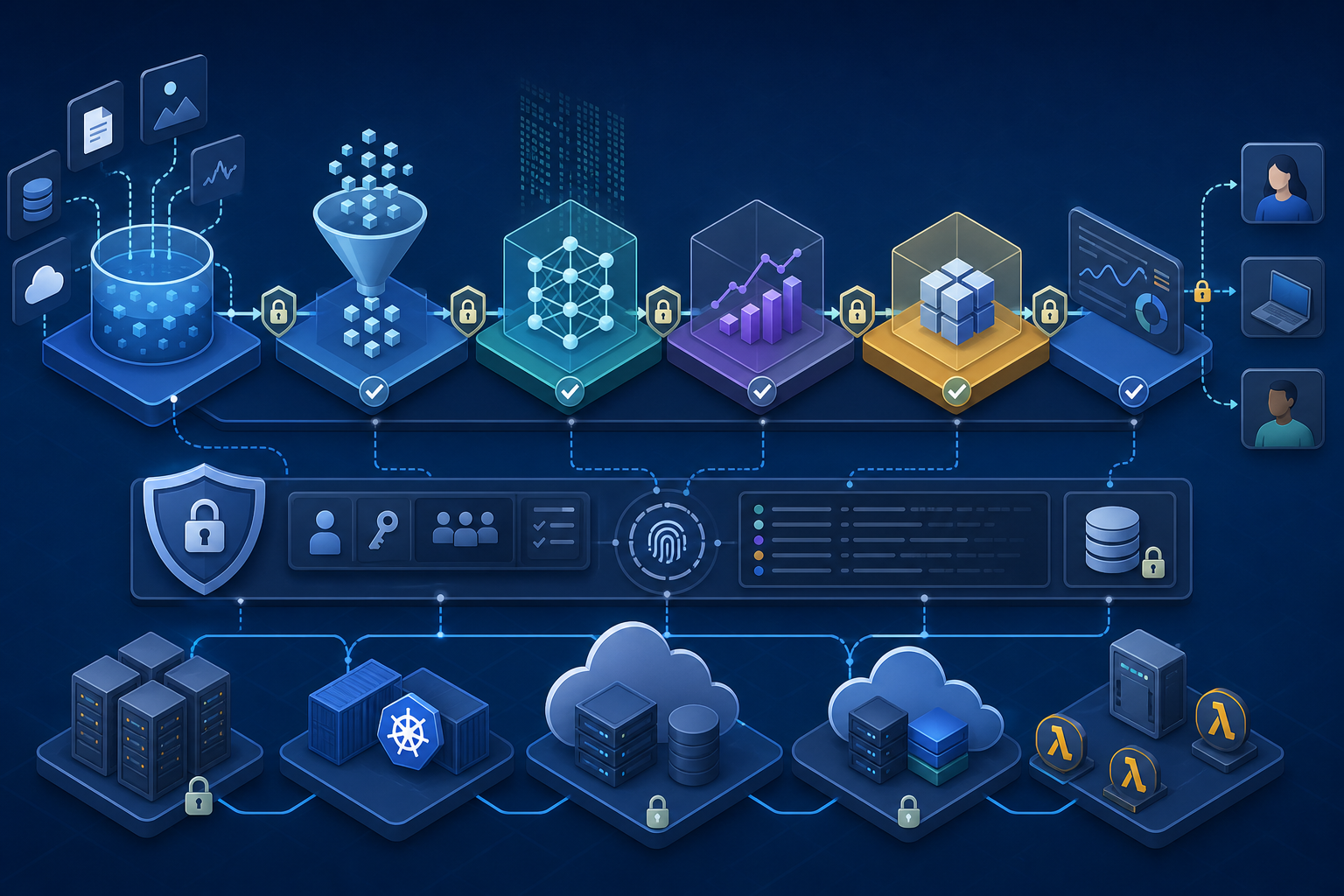
A secure ML model is usually the result of layered controls rather than one technique. Data validation, robust training, input sanitization, confidence thresholds, rate limiting, monitoring, and rollback boundaries all matter. In many environments, the most effective control is not a more complex model but a more defensible pipeline, as described in How to Build and Secure a Machine Learning Model Pipeline.
You should expect some trade-off between accuracy, latency, false positives, and operational complexity. The right balance depends on whether the model is used for fraud screening, classification, recommendation, anomaly detection, or a safety-sensitive decision path.
Why adversarial attacks matter operationally
The practical problem is simple: a model can appear stable in offline evaluation and still behave badly when a real attacker shapes the input. In production, that can mean a spam filter being bypassed, an image classifier misreading manipulated content, a fraud model missing obvious abuse patterns, or a downstream automation system acting on a low-confidence prediction as if it were trusted truth.
This matters operationally because ML failures are often amplified by integration. A weak prediction does not stay isolated inside the model; it propagates into alerts, access decisions, triage queues, recommendation logic, or auto-remediation workflows. If the control plane assumes model output is reliable, an attacker does not need to compromise the model itself to cause damage.
If you are still clarifying where coding, feature engineering, and operational controls sit in the ML lifecycle, What Is Programming in AI and Machine Learning? Operational Insights for Technical Teams is a useful context reference. For adversarial resilience, the important point is that secure ML is an engineering property, not just a modeling property.
What adversarial attacks typically target
Adversarial attacks are not one thing. In practice, they usually target one of four layers: the input, the training data, the model behavior, or the surrounding system.
At the input layer, an attacker may craft a sample that looks normal to a human but pushes the model across a decision boundary. In text systems, that could involve synonym substitution, character obfuscation, or prompt-like payloads in fields the model should treat as data. In vision systems, it may involve imperceptible perturbations, occlusion, or physical-world changes like stickers or lighting.
At the training-data layer, poisoning attacks aim to bias the model before it is deployed. This is especially relevant when training data comes from user submissions, logs, partner feeds, or weakly controlled pipelines. A poisoned dataset can create hidden backdoors, degrade calibration, or teach the model that malicious patterns are benign.
At the model-behavior layer, attackers may probe confidence scores, threshold behavior, or output explanations to infer how to manipulate the decision path. Overly informative responses can leak useful signals even if the core model is not directly exposed.
At the system layer, the problem may not be the model at all. Weak authentication, missing rate limits, poor tenant isolation, unvalidated feature joins, and non-deterministic preprocessing often create attack paths that look like model failures but are really pipeline failures.
How to harden a model against adversarial pressure
The most reliable defense is defense in depth. A secure design assumes some malicious input will get through and makes sure that one successful input does not become a full compromise.
1. Reduce attack surface before the model sees the input
Validate and normalize inputs as early as possible. Enforce schema checks, type checks, range checks, allowed encodings, maximum lengths, and consistent preprocessing. If the model expects a bounded numeric feature, do not allow raw unbounded values to reach the inference path. If the model consumes text, treat control characters, malformed unicode, and suspicious token patterns as data quality signals rather than harmless edge cases.
The point is not to “sanitize away” every possible adversarial pattern. It is to make input manipulation more expensive and more visible. In many systems, the best first defense is a strict contract for what the model is allowed to consume.
2. Train for robustness, not just average-case accuracy
Standard training often over-optimizes the training distribution and under-prepares the model for inputs near the decision boundary. Robustness-oriented training can include adversarial training, augmentation, noise injection, feature dropout, and calibration-aware evaluation. These approaches do not guarantee immunity, but they can make small perturbations less effective.
The trade-off is real. Robust training can increase training cost, slow iteration, and sometimes reduce clean accuracy. That is acceptable only if the model’s threat model justifies it. A low-risk internal ranking model does not need the same hardening as a public-facing abuse-detection or access-control model.
3. Limit the model’s authority
Treat model output as advisory unless the use case clearly demands automation. For security-sensitive workflows, require secondary verification, human review, or a second control before irreversible action. If the model detects fraud, malware, or policy abuse, the downstream system should use confidence bands and corroborating signals rather than a single score.
This is especially important where false negatives are expensive. A model with a known blind spot should not be the only thing preventing a risky action.
4. Monitor for input drift and attack patterns
Adversarial behavior often shows up first as unusual distribution shifts. Monitor feature distributions, score distributions, rejection rates, and confidence histograms. Watch for sudden changes in token shape, length, entropy, missing-value patterns, or class imbalance. If your model is exposed through an API, also watch request rate, retry patterns, and repeated near-duplicate probes.
Monitoring is not just for diagnosis after an incident. It is an early-warning control that can reveal reconnaissance, probing, and slow-burn poisoning before the model’s behavior visibly degrades.
5. Design for safe fallback
When the model is uncertain, unavailable, or behaving suspiciously, the system should degrade gracefully. Fallback can mean a rules-based path, a manual queue, a conservative threshold, or a “do not automate” decision. The safe fallback must be defined before production, not invented during an incident.
If the fallback itself depends on the same corrupted features or the same untrusted source, it will not be a real fallback.
A compact operational workflow
A practical workflow for adversarial resilience usually looks like this:
Threat model the use case -> validate and normalize inputs -> train with robustness controls -> evaluate on clean and perturbed samples -> set confidence and fallback rules -> monitor drift and probing -> rehearse rollback and incident handling
This is intentionally compact because the value comes from the control points, not from complexity. If your team cannot explain where inputs are checked, how uncertainty is handled, and what happens when the model misbehaves, the system is not ready.
Practical scenario: a fraud model behind an API
Consider a payment-fraud model used by a platform engineering team. The model receives transaction metadata, device attributes, historical velocity features, and merchant context. On paper, offline metrics look strong. In production, however, the model sits behind an API that external applications can call indirectly through customer actions.
A realistic adversary does not need to reverse engineer the full model. They can test boundary behavior by changing fields one at a time, repeating near-identical requests, or probing how the score changes when one suspicious feature is altered. If the model returns highly granular scores, the attacker learns quickly which combinations move the decision toward approval.
In this environment, the right defensive posture is layered. Input validation should reject impossible values and normalize known formatting issues. Rate limits should constrain probing. Score exposure should be limited to the minimum necessary precision. Monitoring should flag repeated near-boundary transactions, abnormal retry patterns, and shifts in feature entropy. If the confidence is low or the request pattern looks exploratory, the system should route to manual review rather than auto-approve.
This is the kind of environment where operational discipline matters as much as model quality. A secure pipeline with strict validation, review gates, and clear rollback boundaries is much harder to abuse than a highly accurate but brittle model.
Trade-offs you need to account for
Hardening a model against adversarial attacks usually costs something. The question is whether you are paying in the right place.
More aggressive input filtering can reduce attacks, but it can also increase false positives or block legitimate edge-case users. Robust training can improve resilience, but it may lower raw accuracy or slow model updates. Additional monitoring can detect abuse earlier, but it can create alert fatigue if the thresholds are not tuned carefully. Human review reduces the impact of adversarial inputs, but it adds latency and staffing overhead.
The right trade-off depends on the business function of the model. For a marketing recommender, some adversarial noise may be acceptable. For authentication, fraud, abuse prevention, or safety-related classification, resilience and observability should outweigh marginal accuracy gains.
If you need a practical way to decide whether a model pipeline is ready for operational use, Learning Best Practices for MSPs: A Practical Operational Workflow offers a useful decision framework for validation and rollback boundaries.
What this means in practice
In practice, securing ML models means treating the model as one component in a controlled system. A model is not secure because it has high benchmark accuracy. It is secure when the surrounding pipeline constrains what it can see, detects when the input environment changes, and prevents one bad prediction from turning into an incident.
This changes how teams should work. Data science owns robustness and calibration. Platform teams own input contracts, rate limits, deployment boundaries, and telemetry. Security teams own threat modeling, abuse detection, and incident response assumptions. Product owners decide where automation is acceptable and where the system must fail closed or defer to review.
The most important operational question is not “Can the model be attacked?” because the answer is always yes. The better question is “How much leverage does an attacker gain if they try, and what happens next?” If the answer includes alerting, fallback, and controlled impact, the model is much closer to production-ready.
Decision guidance: does adversarial hardening apply here?
Use adversarial hardening when the model is externally reachable, influences security-sensitive decisions, or processes attacker-controlled input. That includes public APIs, fraud systems, abuse detection, identity signals, content moderation, access scoring, and any workflow where a prediction can trigger an automated side effect.
Use lighter-weight controls when the model is internal, low impact, and not decision-making on its own. In those cases, strict input validation, monitoring, and rollback boundaries may be enough without full adversarial training.
A good rule of thumb is this: if someone can repeatedly query the model, observe outputs, and profit from a stable decision boundary, the model deserves explicit adversarial controls. If a bad prediction can directly authorize, deny, block, or spend money, it should also have a conservative fallback path.
Common mistakes that weaken protection
One common mistake is assuming offline validation covers hostile conditions. Clean test data rarely represents deliberate manipulation, and models that are strong on benchmark splits can still fail near boundaries that an attacker will explore.
Another mistake is exposing rich confidence or probability information without need. Fine-grained outputs can help attackers tune their inputs. If the consumer only needs a decision, do not reveal more than the consumer needs.
Teams also often over-trust preprocessing. If normalization, feature joins, or tokenization happen outside a controlled pipeline, those same steps can become an attack surface. The model may be robust while the feature assembly layer is not.
A fourth mistake is lacking an operational fallback. If the model starts producing suspicious outputs and the only response is “investigate later,” the system is already on the wrong side of the control boundary.
Compact production readiness checklist
Before production use, verify the following:
- The threat model identifies likely adversaries, reachable interfaces, and abuse paths.
- Input validation enforces schema, type, range, encoding, and length constraints.
- Preprocessing is deterministic, versioned, and tested against malformed input.
- The model has been evaluated on clean and perturbed samples relevant to the use case.
- Output precision is limited to what downstream systems actually need.
- Confidence thresholds and fallback behavior are defined and tested.
- Monitoring covers drift, probing, rejection rates, and score distribution shifts.
- Rate limits, authentication, and tenant isolation are in place where exposure exists.
- Rollback and manual review paths are documented and operational.
- Ownership is clear across data, platform, security, and application teams.
Final takeaway
Securing machine learning models against adversarial attacks is less about finding a single defense and more about controlling the environment in which the model operates. If you validate inputs, train for robustness, limit authority, monitor for attack patterns, and define safe fallback behavior, you can reduce attacker leverage enough for the system to be trusted in production. The goal is not perfection; it is a model that can be attacked, observed, and contained without turning one manipulated input into a broader operational failure.
Use this guidance together with Node.js memory leak debugging with heap snapshots and Python multiprocessing deadlocks to connect the workflow with related operational context already available on the site.