
Introduction
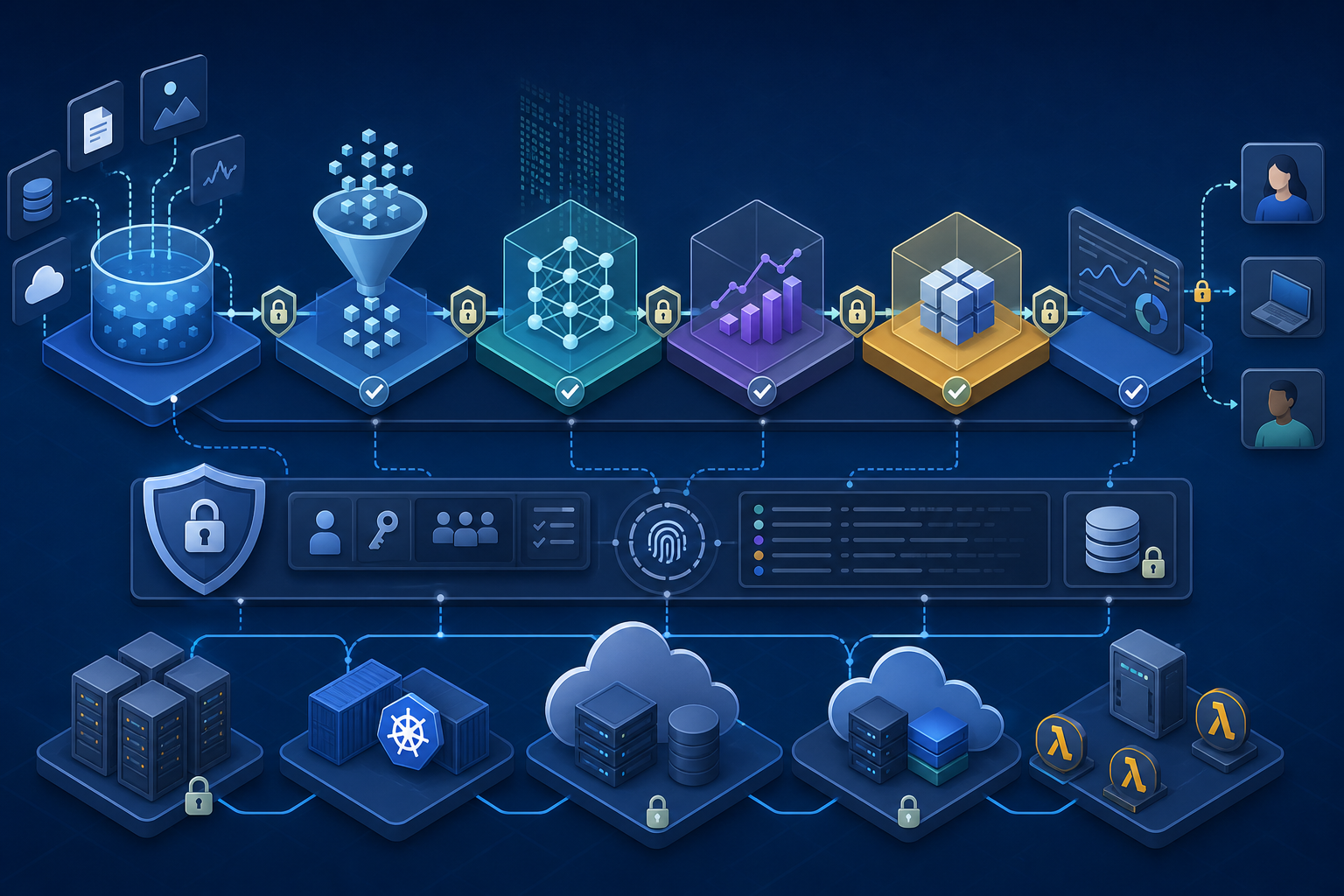
A machine learning model pipeline is useful only if it can reliably move from data ingestion to training, validation, deployment, and monitoring without creating operational or security blind spots. In practice, most failures happen not in the model itself, but at the boundaries: untrusted data sources, inconsistent preprocessing, weak artifact controls, missing validation gates, or deployments that cannot be rolled back safely.
This tutorial shows how to build a practical machine learning model pipeline and secure it for operational use. By the end, you will be able to define the pipeline stages, implement a reproducible build-and-release flow, add validation and approval gates, and verify what must be true before production deployment.
What you will build
You will build a pipeline with five controlled stages:
- Data ingestion from approved sources.
- Data validation and feature preparation.
- Model training with reproducible inputs.
- Model evaluation and approval gates.
- Deployment, monitoring, and rollback boundaries.
The finished state should produce versioned datasets, a traceable model artifact, logged evaluation results, and a deployment path that only promotes models that pass policy checks. If your environment cannot support those controls, do not treat it as production-ready.
Prerequisites and stop-here warnings
Before implementing the pipeline, confirm the following prerequisites.
Required prerequisites
- A defined use case with a measurable target metric.
- A controlled training dataset with ownership and access approval.
- A separate evaluation dataset that was not used during training.
- An artifact store or equivalent location for datasets, models, and metadata.
- A secrets management approach for credentials and tokens.
- A CI/CD or orchestration system that can run jobs in sequence.
Stop-here-if warnings
Stop here if any of the following are true:
- You do not know where the data came from or who owns it.
- Training and evaluation data are mixed together.
- The team cannot reproduce the same model from the same inputs.
- Secrets are stored in scripts, notebooks, or shared environment files.
- No one can explain how a bad model is blocked or rolled back.
These are not minor process gaps. They are signs that the pipeline is not ready for operational use.
Validation at this stage
You should be able to answer these questions before writing pipeline code:
- Which datasets are approved for training and which are reserved for evaluation?
- Which environments may read data, write artifacts, or deploy models?
- What conditions must a model satisfy before promotion?
- Who can approve a model release, and what evidence do they need?
A practical workflow for establishing those boundaries is similar to the approach described in How to Measure Learning Maturity because the same discipline applies: define what counts as acceptable evidence, score it consistently, and decide whether it is ready for operational use.
Step 1: Define pipeline boundaries and control points
A secure pipeline begins with explicit boundaries. Without them, it is easy for a training job to access data it should not see or for a deployment job to publish an unverified artifact.
Goal
Define exactly what each stage is allowed to read, write, and promote.
Action
Map the pipeline into discrete control points:
- Ingestion: read raw input from approved locations only.
- Validation: check schema, freshness, completeness, and basic quality rules.
- Training: consume approved, versioned training data only.
- Evaluation: run against a separate holdout set or a fixed test set.
- Registry or artifact store: publish only signed or versioned artifacts.
- Deployment: promote only artifacts that passed policy checks.
- Monitoring: record drift, latency, error rates, and prediction quality where labels exist.
Use least privilege for each stage. A training job should not need deployment credentials. A deployment job should not need write access to raw data.
Expected output
A documented pipeline contract that lists inputs, outputs, owners, credentials, and approval criteria for each stage.
Validation
Review the permissions for each job or service account. Confirm that the pipeline cannot bypass validation or publish directly from training to production.
Common failure
The most common failure is a shared service account with broad permissions. It simplifies setup but removes accountability and makes containment harder if a job is compromised.
Step 2: Prepare data with reproducibility and trust controls
The pipeline is only as trustworthy as the data it consumes. Data preparation should be reproducible, versioned, and validated before training begins.
Goal
Create a repeatable data preparation process that prevents silent changes from reaching training.
Action
Use versioned input data and deterministic transformations. Record the source, extraction time, filter logic, and transformation code for each dataset snapshot. If the feature pipeline uses joins, aggregations, or encoding steps, keep them in code rather than manual notebooks.
At minimum, verify:
- Schema consistency: required columns exist and types match expectations.
- Data freshness: the dataset reflects the intended time window.
- Completeness: missing values are within acceptable thresholds.
- Label integrity: labels are present, correctly aligned, and not leaking future information.
- Duplication rules: duplicate rows or entities are handled consistently.
If your use case depends on a learning or reporting artifact to explain decisions, make the evidence capture explicit. A structured template can help teams document inputs, gaps, and outcomes consistently, similar to the approach in Learning Reporting Template FAQ: What It Is, What to Capture, and How to Verify It.
Expected output
A versioned dataset snapshot and a reproducible transformation job that can be rerun with the same inputs.
Validation
Re-run the preparation job from the same source data and compare the resulting checksum, row counts, and feature distribution summaries. Small differences should be explainable; unexplained drift is a red flag.
Common failure
The most common failure is allowing ad hoc preprocessing in notebooks or manual exports. That makes training irreproducible and makes security review much harder.
Step 3: Train the model in a controlled environment
Training should be deterministic enough to reproduce and secure enough to isolate secrets, data, and compute.
Goal
Train the model using approved inputs while keeping the environment isolated and auditable.
Action
Run training in a dedicated environment with controlled network and filesystem access. Use pinned library versions where possible, and record the full training configuration:
- dataset version
- feature pipeline version
- model algorithm and hyperparameters
- random seed or other deterministic controls
- hardware or runtime details that may affect reproducibility
Keep credentials out of the training code. If training needs access to object storage, metadata services, or a model registry, inject short-lived credentials through the orchestration layer rather than embedding secrets in the repository.
Expected output
A trained model artifact, training metadata, and logs that identify exactly which inputs and parameters produced the artifact.
Validation
Confirm that you can rerun the training job and obtain a model that is functionally consistent within the expected tolerance. The exact byte-for-byte output may vary for some algorithms, but the evaluation results should be explainable and stable enough for your use case.
Common failure
The common failure here is using an environment that has broad internet access, persistent secrets, or uncontrolled package installation. That creates both supply-chain and data-exfiltration risk.
Step 4: Add evaluation gates before promotion
A secure model pipeline should never promote a model just because training completed successfully. Promotion requires evidence.
Goal
Block deployment unless the model passes predefined quality, safety, and operational checks.
Action
Evaluate the model against a separate test set and compare it to a baseline or current production model. Use metrics that match the operational objective. For example:
- classification: precision, recall, false positive rate, calibration
- regression: error metrics, residual behavior, outlier sensitivity
- ranking or retrieval: top-k relevance and stability
Add non-performance checks as well:
- data leakage review
- fairness or subgroup checks if relevant to the use case
- robustness tests against malformed or edge-case inputs
- latency and memory checks for the target runtime
Set promotion thresholds before the run, not after seeing the results.
Expected output
An evaluation report that includes metric values, baseline comparison, threshold pass/fail status, and known limitations.
Validation
Verify that the model promotion step is automatically blocked when thresholds are not met. A manual override should require explicit approval and leave an auditable trail.
Common failure
The most common failure is overfitting the decision to a single metric. A model that slightly improves accuracy but significantly increases false positives or latency may be worse operationally.
Step 5: Package and register the approved artifact
Once a model passes evaluation, it needs a controlled release path. The goal is to make every artifact traceable and every promotion reversible.
Goal
Create a versioned, signed, and traceable model release package.
Action
Store the following together:
- model binary or serialized artifact
- preprocessing or feature pipeline version
- evaluation report
- training configuration
- metadata such as owner, build time, and source dataset version
If your platform supports artifact signing or checksum validation, use it. If not, store hashes and verify them at deployment time. The release package should be immutable after approval.
Expected output
A model registry entry or equivalent release record with complete lineage from raw data to approved artifact.
Validation
Confirm that the deployed job can resolve the exact artifact by version, not by mutable tag alone. Verify that the artifact hash matches the approved record.
Common failure
A frequent failure is promoting a model by name rather than by immutable version. That makes rollback and auditability unreliable.
Step 6: Deploy with least privilege and rollback boundaries
Deployment is where model security becomes operational security. A model that cannot be rolled back safely is not operationally mature.
Goal
Deploy the approved model in a way that limits blast radius and supports fast rollback.
Action
Use a deployment strategy appropriate to your risk tolerance:
- shadow deployment to observe predictions without affecting users
- canary release to expose the model to a limited slice of traffic
- blue-green or versioned deployment with a clear rollback target
Restrict deployment permissions to a small set of automated jobs or operators. The runtime should only have the secrets and network access needed to serve predictions and emit telemetry.
Expected output
A live model endpoint or batch scoring job that uses the approved version and emits operational metrics.
Validation
Test rollback before production use. Confirm you can route traffic back to the previous version and that the previous artifact remains available. Validate startup behavior, schema handling, and failure mode when the model is unavailable.
Common failure
The common failure is treating rollback as a manual emergency task. If rollback has not been rehearsed, it is not a real control.
Step 7: Monitor for drift, abuse, and operational regressions
Production does not end at deployment. A secure pipeline needs continuous evidence that the model is still behaving as expected.
Goal
Detect changes in data, model behavior, and service health early enough to respond safely.
Action
Monitor the following classes of signals:
- input schema and validation failures
- data drift and feature distribution shifts
- latency, timeouts, and error rates
- prediction distribution changes
- label-based quality metrics where delayed ground truth exists
- abnormal access patterns or unexpected call volume
Set alert thresholds based on operational risk. For example, a sudden feature spike may indicate upstream change, bad input, or abuse.
Expected output
Dashboards, alerts, and incident procedures that show whether the model remains within expected bounds.
Validation
Run a controlled input anomaly test or replay a known edge case to confirm the monitoring stack captures the event and routes it to the right responder.
Common failure
The most common failure is monitoring only infrastructure health while ignoring model behavior. A healthy service can still produce unsafe or degraded predictions.
Step 8: Secure the pipeline as a system
A machine learning model pipeline should be secured like any other production system, not as a special exception.
Goal
Reduce supply-chain, data-access, and credential risk across the entire workflow.
Action
Apply these controls consistently:
- store code and configuration in version control with review requirements
- pin dependencies or otherwise control package sources
- scan images, libraries, and pipeline dependencies where your environment supports it
- separate training, staging, and production credentials
- protect raw data, labels, and artifacts with access controls and audit logs
- avoid embedding secrets in notebooks, scripts, or environment files
- review who can approve promotion and who can alter evaluation thresholds
If your process includes readiness checks or governance approvals, make them evidence-based rather than informal. A practical operational workflow for deciding readiness is similar to Learning Best Practices for MSPs: A Practical Operational Workflow: establish prerequisites, validate them, define rollback boundaries, and do not advance when those controls are missing.
Expected output
A pipeline that is not only functional, but also reviewable, auditable, and partitioned by trust boundary.
Validation
Perform an access review. Confirm that each job, service account, and human operator has only the minimum privileges needed for its role.
Common failure
The common failure is assuming that model security is separate from platform security. In reality, the model pipeline inherits the weaknesses of the surrounding build and deployment system.
Operational follow-up
After the pipeline is live, keep the controls tight and the evidence fresh. Re-check dataset ownership when sources change. Re-validate thresholds when business requirements shift. Rehearse rollback after any deployment change that affects routing, artifact storage, or runtime dependencies.
A finished pipeline should leave behind a clear audit trail: approved data, reproducible training inputs, evaluated and versioned artifacts, controlled deployment, and monitoring that can prove when the model is healthy or failing. If any of those pieces are missing, the pipeline may still run, but it is not yet secure enough for production use.
Use this guidance together with distributed log processing Python script and async errors with Promises to connect the workflow with related operational context already available on the site.
Part of the Programming: AI / Machine Learning Insights content cluster.