
Quick answer
Learning maturity is the degree to which an AI or machine learning effort can produce reliable, repeatable, and operationally useful learning evidence. In practice, you measure it by checking whether the team can show consistent data quality, documented experiments, reproducible results, clear ownership, and a verified path from learning findings to system change.
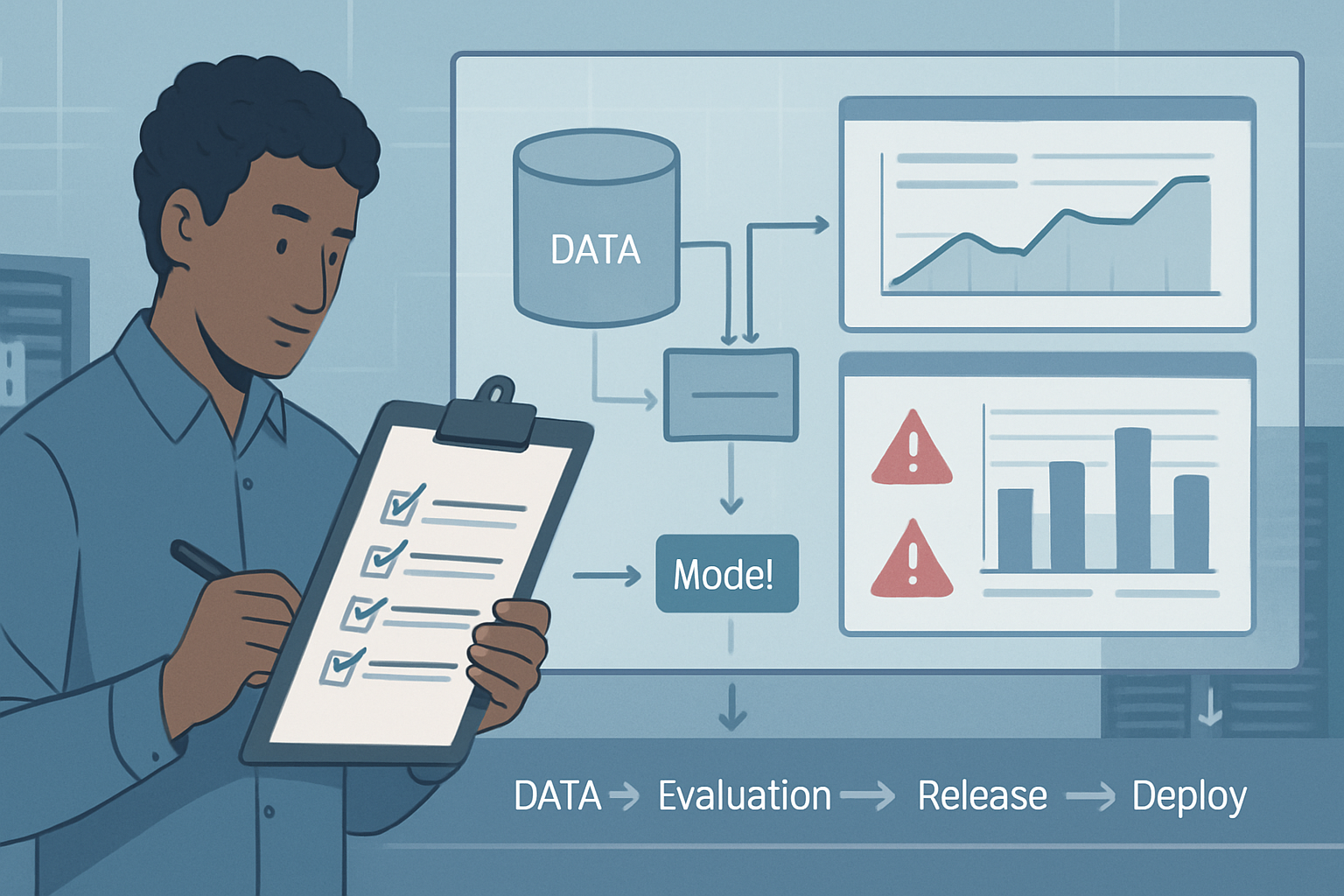
If you need a fast operational method, use a simple five-part scorecard: define the learning objective, capture evidence, validate the evidence, score the maturity dimensions, and decide whether the result is strong enough for production use. That gives technical teams a defensible way to tell the difference between "we trained a model" and "we can safely learn from model behavior in a controlled way."
This guide shows how to do that with a practical workflow, what to verify, and where the approach should stop before production.
When this measurement applies
Measure learning maturity when a system changes based on data, experiments, feedback loops, or model retraining, and you need to know whether those learning activities are operationally trustworthy. That includes early-stage prototypes, internal tools, ML pipelines, and security-sensitive automation where bad learning signals can create drift, false positives, or unsafe changes.
This is not a measure of model accuracy alone. A model can score well on a benchmark and still have low learning maturity if the surrounding process cannot explain, reproduce, or govern how the model learned. For teams already mapping AI work into engineering practice, the distinction described in What Is Programming in AI and Machine Learning? Operational Insights for Technical Teams is useful: learning maturity is about whether the code, data, and operating process together support dependable learning.
Prerequisites
Before you measure learning maturity, make sure you have the following:
- A specific learning objective, such as reducing false positives, improving recall on a class, or identifying drift earlier.
- Access to the evidence needed to judge the objective: datasets, feature definitions, training runs, evaluation results, change logs, and incident records.
- A person or team responsible for the learning process and its approval criteria.
- A stable enough workflow that you can repeat the same measurement later.
If these basics are missing, your score will mostly reflect process gaps, not learning maturity. In that case, the safest result is usually "not yet measurable" rather than forcing a number.
A practical way to measure learning maturity
Use a scorecard with four dimensions:
- Evidence quality — Can you trust the inputs and outputs?
- Reproducibility — Can the same process be repeated and explained?
- Operational control — Are there guardrails, approvals, and rollback paths?
- Learning impact — Does the learning activity produce measurable system improvement?
Score each dimension from 0 to 3:
- 0 = absent or unknown
- 1 = ad hoc or partial
- 2 = defined and repeatable
- 3 = validated and consistently operated
A simple total score gives you a maturity signal:
- 0–4: immature, do not treat the learning process as reliable
- 5–8: developing, useful for controlled environments only
- 9–12: mature enough for operational use with routine review
The point is not the exact number. The point is to create a repeatable decision method that teams can defend during review, audit, or incident analysis.
Step 1: Define the learning boundary
Start by stating exactly what is being learned and what is outside scope. A learning system becomes hard to measure when the scope is vague.
Write down:
- The business or technical outcome being optimized
- The signals used as learning input
- The model, rule set, or adaptive component being updated
- The environments where learning is allowed
- The conditions that block learning changes
For example, a fraud detector might be allowed to learn from confirmed analyst labels in staging, but not from user-reported complaints in production unless those reports are validated. That boundary matters because unverified signals can inflate the appearance of learning maturity while reducing actual reliability.
Expected output: a short scope statement that defines the learning loop and the approved inputs.
Validation check: if two engineers would describe the learning loop differently, the boundary is still too vague.
Step 2: Collect evidence for each maturity dimension
Learning maturity should be evidence-based. If you cannot point to artifacts, the score is not operationally useful.
For each dimension, gather the minimum evidence set.
Evidence quality
Look for:
- Dataset lineage or source description
- Labeling rules or ground-truth definition
- Missing-data handling
- Train/validation/test separation or equivalent control
- Data quality checks and exceptions
Reproducibility
Look for:
- Versioned code and configuration
- Deterministic or controlled training settings where possible
- Run logs, seeds, and environment details
- Model lineage from input data to output artifact
- A documented way to rerun the same learning job
Operational control
Look for:
- Change approval or promotion criteria
- Monitoring for drift, error rate, or feedback quality
- Rollback or disable procedures
- Access controls for who can retrain, approve, or deploy
- Separation between experimental and production paths
Learning impact
Look for:
- A measurable before/after comparison
- A baseline or control group where possible
- Evidence that the change improved the target outcome
- Negative results and failed experiments, not only successes
- A decision record showing what changed because of the learning outcome
If your team already uses structured evidence capture, the format in Learning Reporting Template FAQ: What It Is, What to Capture, and How to Verify It can help standardize what gets recorded. Consistent records make maturity scoring much less subjective.
Expected output: a folder, ticket set, or report with the artifacts needed to justify each score.
Step 3: Score each dimension consistently
Assign each dimension a score from 0 to 3 using the same criteria every time. Consistency matters more than perfect precision.
A practical scoring rule is:
- 0 when there is no evidence or the process is unsafe to trust
- 1 when evidence exists but is incomplete, manual, or inconsistent
- 2 when the process is documented and repeatable
- 3 when the process is validated, monitored, and regularly reviewed
Use short justification notes for each score. For example:
- Evidence quality: 2 — input data is documented, but label review is manual and not sampled
- Reproducibility: 1 — runs are logged, but environment is not pinned
- Operational control: 3 — approval, rollback, and monitoring are defined and tested
- Learning impact: 2 — improvement is visible against baseline, but only in one segment
This creates a score that is useful in security reviews and engineering discussions because it explains the number instead of hiding behind it.
Validation check: if the scoring notes cannot be understood by another engineer without extra meetings, the scorecard is too vague.
Step 4: Compare the score to the operational boundary
A maturity score only matters if it is tied to a decision.
Use the result to choose one of three operational states:
- Not ready: score is low, or one critical dimension is 0
- Controlled use only: score is moderate, but learning changes stay in limited environments
- Operationally acceptable: score is high enough for normal use with monitoring and review
Pay attention to the weakest dimension, not just the total score. A system with strong evidence and weak rollback is still risky. In security-sensitive environments, operational control is often the gating factor because an unsafe learning path can create both reliability issues and exposure to adversarial input.
If a dimension is weak because the team has not defined acceptance criteria, stop and fix that first. Do not compensate for missing controls with more model tuning.
Step 5: Validate the measurement before you trust it
The maturity score itself should be testable. Before you use it for production decisions, validate it in one of three ways:
- Repeat the assessment with a different reviewer and compare results.
- Re-score after a small change such as adding versioned data or a rollback procedure and verify that the score changes in the expected direction.
- Compare against an incident or change record to see whether low-scoring areas align with known failures or review gaps.
Validation is important because maturity measurement can become a paper exercise. The score should correlate with how safely the team can operate the learning loop.
Expected output: two independent assessments that are close enough to be useful, plus documented differences where reviewers disagree.
Step 6: Decide what to do with the result
Use the score to drive a concrete operational action.
Common decisions include:
- Keep the learning loop in a sandbox or staging environment
- Add controls before any production change
- Require human approval for retraining or deployment
- Increase monitoring on the weakest dimension
- Freeze automated learning until evidence quality improves
A good decision record includes the score, the reasons, and the required follow-up. That makes the maturity measurement actionable rather than descriptive.
For example, if learning impact is strong but evidence quality is weak, the right action may be to preserve the idea but stop treating the current result as trustworthy until the labels and lineage are fixed.
A simple worksheet you can reuse
You can use the following structure as a lightweight maturity review.
Learning objective:
Scope boundary:
Reviewer:
Date:

Evidence quality: 0/1/2/3
Notes:

Reproducibility: 0/1/2/3
Notes:

Operational control: 0/1/2/3
Notes:

Learning impact: 0/1/2/3
Notes:

Total score:
Operational decision:
Required follow-up:
This works well in tickets, runbooks, or change records. Keep the notes short, factual, and tied to evidence.
What good looks like in practice
A mature learning process usually has the following traits:
- Inputs are known, versioned, and accepted by the team
- Results can be reproduced or at least explained with bounded variance
- Changes follow an approval path and can be reversed or disabled
- Metrics show that learning improves the target outcome over time
- Failures and anomalies are recorded, not hidden
In contrast, an immature process often has one or more of these problems:
- No clear definition of what counts as learning
- Untracked data changes
- Manual experiments with no environment control
- Model updates deployed without a rollback path
- Success judged by anecdote instead of measured impact
These patterns are useful because they tell you where to invest effort. In many teams, the fastest improvement comes from better evidence capture and operational control, not from changing the model architecture.
Safe operational boundaries
Do not use a maturity score as a substitute for security review, data governance, or model risk review. A high score means the learning process is more controlled; it does not mean the system is safe in all conditions.
Before production use, verify at least the following:
- Inputs are authorized and appropriate for the learning purpose
- Sensitive data is handled according to policy
- Retraining cannot silently change behavior without review
- Monitoring covers both accuracy and abnormal feedback patterns
- Rollback is possible if the learning change causes regressions
If the system can be influenced by untrusted input, include adversarial or poisoned data considerations in the review. Learning maturity is lower when the process cannot detect or contain manipulated signals.
Rollback and cleanup considerations
Any learning measurement that leads to a change should also define how to undo it.
Document:
- How to revert to the previous model, rule set, or configuration
- Which logs or artifacts must be preserved for audit or incident review
- How to clean up temporary datasets or experimental branches
- Who approves re-enabling learning after a rollback
Cleanup matters because temporary data and experimental outputs often become de facto production dependencies. If they are left in place, future measurements can become contaminated and the maturity score may look better than the actual operational state.
Common mistakes to avoid
A few errors show up repeatedly in learning maturity assessments:
- Scoring the model instead of the learning process
- Using only one metric, such as accuracy or loss
- Treating undocumented manual judgment as validated control
- Ignoring reproducibility because "the result is good enough"
- Forgetting that a strong score can still hide a bad rollback process
If you avoid those mistakes, the measurement becomes much more useful for engineering and security review.
Final takeaway
To measure learning maturity, focus on evidence, reproducibility, operational control, and learning impact. Score each area consistently, tie the score to an operational decision, and validate that the measurement itself is repeatable. When the weakest dimension is still unproven, treat the system as not ready for broader production use. When the process is documented, reviewed, and reversible, you have a practical signal that the learning loop is mature enough to trust.