
Purpose
An AI or machine learning initiative often fails because the implementation roadmap looks complete on paper but leaves gaps in data readiness, validation, security, or operational ownership. That becomes a production risk quickly: the model may train successfully, but the system may still fail under real traffic, expose sensitive data, or lack rollback procedures when quality drops.
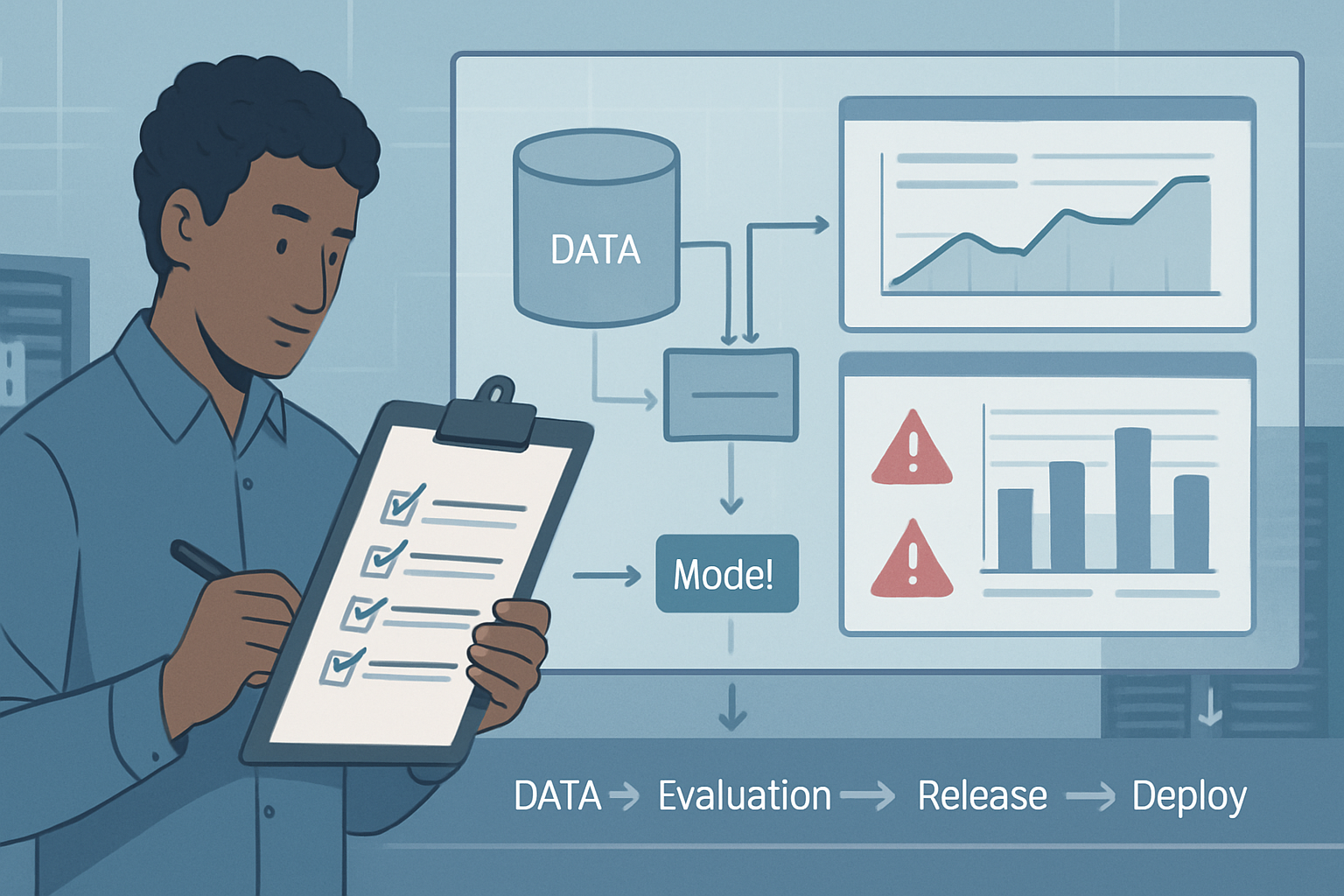
This learning implementation roadmap checklist is designed to help technical professionals verify whether an implementation plan is ready to move from experimentation into controlled production use. After using it, you should be able to decide whether the approach applies, apply a practical validation workflow, and verify what must be in place before release.
How to use this checklist
Use this checklist as a review tool during planning, design review, model approval, and pre-production signoff. Work phase by phase, capture evidence for every check, and mark each item as pass, fail, or blocked.
If a check fails, do not treat it as cosmetic. A failed item usually means the roadmap is missing a control, an owner, a test, or a documented acceptance criterion. When that happens, revise the roadmap before proceeding.
Phase 1: Scope and problem definition
This phase confirms that the implementation roadmap solves a clearly defined operational problem and that the learning task matches the intended use case.
Checklist items
- Confirm the business or operational problem is written as a measurable outcome, not a vague aspiration.
- Review the target users, upstream systems, and downstream actions that will consume the model output.
- Validate that the learning task type matches the use case, such as classification, regression, ranking, forecasting, or anomaly detection.
- Document the exact decision the system will support and the decision that remains under human control.
- Assign a named owner for scope approval and change control.
- Review whether the roadmap includes explicit non-goals to prevent scope creep.
Evidence to capture
Record the problem statement, use-case diagram, decision boundaries, and owner signoff. If the implementation affects regulated or security-sensitive workflows, capture the approval path and any control requirements that apply.
Acceptance criteria
The roadmap passes this phase only if the objective is measurable, the model task is appropriate, and the human/system boundary is clear. A pass should leave no ambiguity about what success looks like or who is responsible for changes.
Owner and review cadence
Owner: product, platform, or system owner. Review cadence: at kickoff and after any scope change.
Common mistakes
A common failure is describing the roadmap in technical terms without stating the operational decision it supports. Another is allowing multiple target outcomes to share one model plan, which makes validation and acceptance criteria too vague.
Phase 2: Data readiness and lineage
This phase verifies that the roadmap accounts for data availability, quality, provenance, and access controls before training starts. If the data foundation is weak, the rest of the implementation plan will be unreliable.
Checklist items
- Confirm all required data sources are identified and mapped to their owners.
- Review data freshness, completeness, and known quality defects for each source.
- Validate that training data and inference data are representative of the expected production population.
- Document where labels come from, how they are generated, and whether label quality has been reviewed.
- Assign access controls for sensitive or restricted fields used in training or evaluation.
- Review whether data retention, masking, and deletion requirements are documented.
- Validate lineage from source to feature to training set to evaluation set.
Evidence to capture
Capture schema descriptions, sample extracts, data quality reports, lineage diagrams, label definitions, and access review evidence. If the data includes personal or confidential information, record the handling controls and approvals.
Acceptance criteria
This phase passes only when the roadmap shows that the data is available, lawful or authorized for use, sufficiently stable, and traceable end to end. If lineage cannot be explained, the implementation is not ready for production planning.
Owner and review cadence
Owner: data engineering or data platform lead. Review cadence: before dataset creation and whenever source systems change.
Common mistakes
Teams often assume training data quality is sufficient because the sample notebook ran successfully. Another frequent mistake is ignoring population drift risk when the data source feeding production differs from the historical dataset.
Phase 3: Baseline, model approach, and experiment plan
This phase confirms that the roadmap specifies a realistic model strategy and a baseline for comparison. It also ensures the learning plan can be evaluated against something measurable.
Checklist items
- Confirm the roadmap defines a baseline approach, such as rules, heuristics, or a simpler statistical model.
- Review the candidate model family and document why it fits the data shape, latency needs, and operational constraints.
- Validate that the experiment plan includes reproducible training inputs, hyperparameter controls, and version tracking.
- Document assumptions about feature availability at inference time.
- Assign ownership for experiment tracking, model artifact storage, and version promotion.
- Review whether the plan avoids features that would leak future information or unavailable context.
Evidence to capture
Keep the baseline definition, experiment matrix, configuration snapshots, feature list, and model version identifiers. If external libraries or managed services are involved, capture the dependency version or service setting that affects behavior.
Acceptance criteria
The roadmap passes when the proposed approach is justified against the baseline and the experiment plan is reproducible. The model must not depend on training-only features or undocumented assumptions about runtime inputs.
Owner and review cadence
Owner: ML engineer or model developer. Review cadence: at experiment design and before every major retraining cycle.
Common mistakes
A common mistake is treating the first model that improves a metric as production-ready. Another is failing to document which features are unavailable in production, which can create silent training-serving skew.
Phase 4: Validation, metrics, and signoff rules
This phase ensures the roadmap defines how quality will be measured and what conditions allow release. If validation is weak, the team cannot distinguish a real improvement from a misleading result.
Checklist items
- Confirm the roadmap defines primary and secondary metrics aligned to the business outcome.
- Review threshold values for acceptance, including minimum performance and maximum allowed error or false-positive rate.
- Validate that evaluation data is separate from training data unless an alternate validation method is explicitly justified.
- Document any segment-level checks needed for important user groups, regions, classes, or traffic patterns.
- Assign a reviewer for metric interpretation and release recommendation.
- Review whether the plan includes robustness checks for missing data, edge cases, and adversarial or malformed inputs where relevant.
- Validate that the roadmap defines a fail condition, not just a target score.
Evidence to capture
Store evaluation reports, confusion matrices or equivalent outputs, threshold justification, and segment analysis. If the use case is safety- or security-relevant, capture the review notes that explain why the selected acceptance criteria are sufficient.
Acceptance criteria
The roadmap passes only if metrics map directly to the operational objective, thresholds are explicit, and failure conditions are written in advance. Release approval should be possible without interpretation debates.
Owner and review cadence
Owner: model owner or validation lead. Review cadence: after each evaluation cycle and before production approval.
Common mistakes
Teams often rely on one aggregate metric and miss poor performance on a critical segment. Another mistake is setting a target score without defining what happens if the model misses it by a small margin.
Phase 5: Security, privacy, and misuse controls
This phase verifies that the implementation roadmap accounts for the risks introduced by data access, model behavior, and integration points. It is especially important when sensitive data, internal APIs, or privileged workflows are involved.
Checklist items
- Confirm the roadmap identifies sensitive data classes and the controls applied to them.
- Review whether access to training data, evaluation data, and model artifacts is restricted by role.
- Validate that prompt injection, data poisoning, model extraction, or unauthorized output use are considered where relevant.
- Document logging boundaries so secrets, personal data, and restricted content are not exposed in telemetry.
- Assign a security reviewer for threat modeling and control approval.
- Review whether the model output can trigger privileged actions without explicit authorization checks.
- Validate that privacy requirements, retention limits, and deletion workflows are documented.
Evidence to capture
Capture the threat model, access review, logging policy, and any control test results. If the roadmap depends on a specific deployment mode or vendor setting, note that the security posture must be verified for that configuration.
Acceptance criteria
This phase passes when security and privacy risks are identified, controls are documented, and no sensitive path is left implicit. If the model can influence privileged or irreversible actions, the approval bar should be higher and explicitly recorded.
Owner and review cadence
Owner: security engineering or privacy lead. Review cadence: before design approval and after any change to data handling or integration points.
Common mistakes
A common mistake is protecting the training pipeline but ignoring the output channel. Another is logging too much detail during debugging and then leaving those logs in production.
Phase 6: Deployment, integration, and rollback
This phase checks that the roadmap describes how the model will be delivered, monitored, and safely reversed if quality degrades.
Checklist items
- Confirm the deployment pattern is documented, such as batch scoring, real-time inference, or hybrid routing.
- Review integration points, dependencies, and latency or throughput expectations.
- Validate that rollout is staged, can be limited by tenant, environment, segment, or percentage, and has an approval gate.
- Document rollback conditions and the mechanism used to revert to a previous model or fallback logic.
- Assign an operations owner for deployment, monitoring, and rollback execution.
- Review whether infrastructure, runtime, and model dependencies are versioned and reproducible.
- Validate that health checks and smoke tests are defined for pre- and post-deployment verification.
Evidence to capture
Record the deployment architecture, release plan, rollback procedure, health check results, and dependency versions. If behavior depends on environment settings, capture those settings as part of the release record.
Acceptance criteria
The roadmap passes only if the deployment can be staged, observed, and reversed without improvisation. A production deployment must not depend on manual tribal knowledge.
Owner and review cadence
Owner: DevOps or platform operations. Review cadence: before release and after any change to the runtime or integration path.
Common mistakes
Teams often assume rollback is just a version switch, but that is only true if state, dependencies, and routing are also reversible. Another common issue is releasing without smoke tests that verify the live path.
Phase 7: Monitoring, retraining, and operational ownership
This phase ensures the roadmap defines how model performance will be tracked after release and who responds when behavior changes.
Checklist items
- Confirm the roadmap defines monitoring for quality, drift, latency, errors, and data distribution changes.
- Review alert thresholds and escalation paths for metric degradation or pipeline failure.
- Validate that retraining triggers are documented, including time-based, drift-based, or event-based triggers.
- Document who reviews monitoring outputs and who has authority to pause or rollback the system.
- Assign ownership for post-deployment maintenance, incident response, and periodic review.
- Review whether monitoring data is retained long enough to support investigations and audits.
- Validate that incident handling is integrated with the broader operational runbook.
Evidence to capture
Keep monitoring definitions, alert thresholds, on-call assignments, retraining criteria, and incident workflows. If the roadmap includes automated retraining, capture the approval rule that prevents silent promotion of degraded models.
Acceptance criteria
This phase passes when operational monitoring is actionable and ownership is explicit. If no one is accountable for model degradation, the roadmap is not production-ready.
Owner and review cadence
Owner: service owner or operations lead. Review cadence: continuously, with scheduled review after release and after incidents.
Common mistakes
A typical mistake is monitoring system uptime but not model quality. Another is defining retraining as a calendar task without checking whether the model actually needs it.
Readiness scoring
Use a simple 0 to 2 score for each phase:
- 0 = missing or undocumented
- 1 = partially defined but incomplete or unverified
- 2 = complete, evidenced, and approved
Score each of the seven phases for a maximum of 14 points.
Interpreting the score
- 12 to 14: Ready for production approval, assuming no critical control gaps remain.
- 9 to 11: Conditionally ready; close the gaps and repeat review before release.
- 6 to 8: Not ready; the roadmap needs material revision.
- 0 to 5: Unfit for production planning; restart the implementation design review.
A high score should not override a critical failure in security, data access, rollback, or validation. One failed control in those areas can outweigh several lower-risk passes.
Pass/fail decision rule
Use this rule to avoid subjective signoff:
- Pass only if every phase has at least one named owner, acceptance criteria, and evidence captured.
- Fail if any phase lacks measurable acceptance criteria, a rollback path, or a security/privacy control where required.
- Block release if the validation evidence is incomplete, unreviewed, or not reproducible.
For a stricter control view, pair this checklist with the Learning Checklist for AI and Machine Learning Projects so evidence, ownership, and readiness scoring stay aligned across review stages.
Final validation questions
Before approving the roadmap, ask these practical questions:
- Confirm the roadmap answers a real operational problem.
- Validate that the data, model, and deployment plan can be reproduced from the recorded evidence.
- Review whether security, privacy, and rollback controls are strong enough for the intended impact.
- Document who can approve release, who can halt it, and who owns ongoing monitoring.
- Confirm the acceptance criteria are specific enough that two reviewers would reach the same decision.
If any of these questions produce a hesitant answer, the roadmap still needs work. A credible implementation plan is one that can be defended with evidence, operated under pressure, and reversed safely if reality does not match the test results.
Use this guidance together with learning best practices for MSPs to connect the workflow with related operational context already available on the site.
Part of the Programming: AI / Machine Learning Insights content cluster.