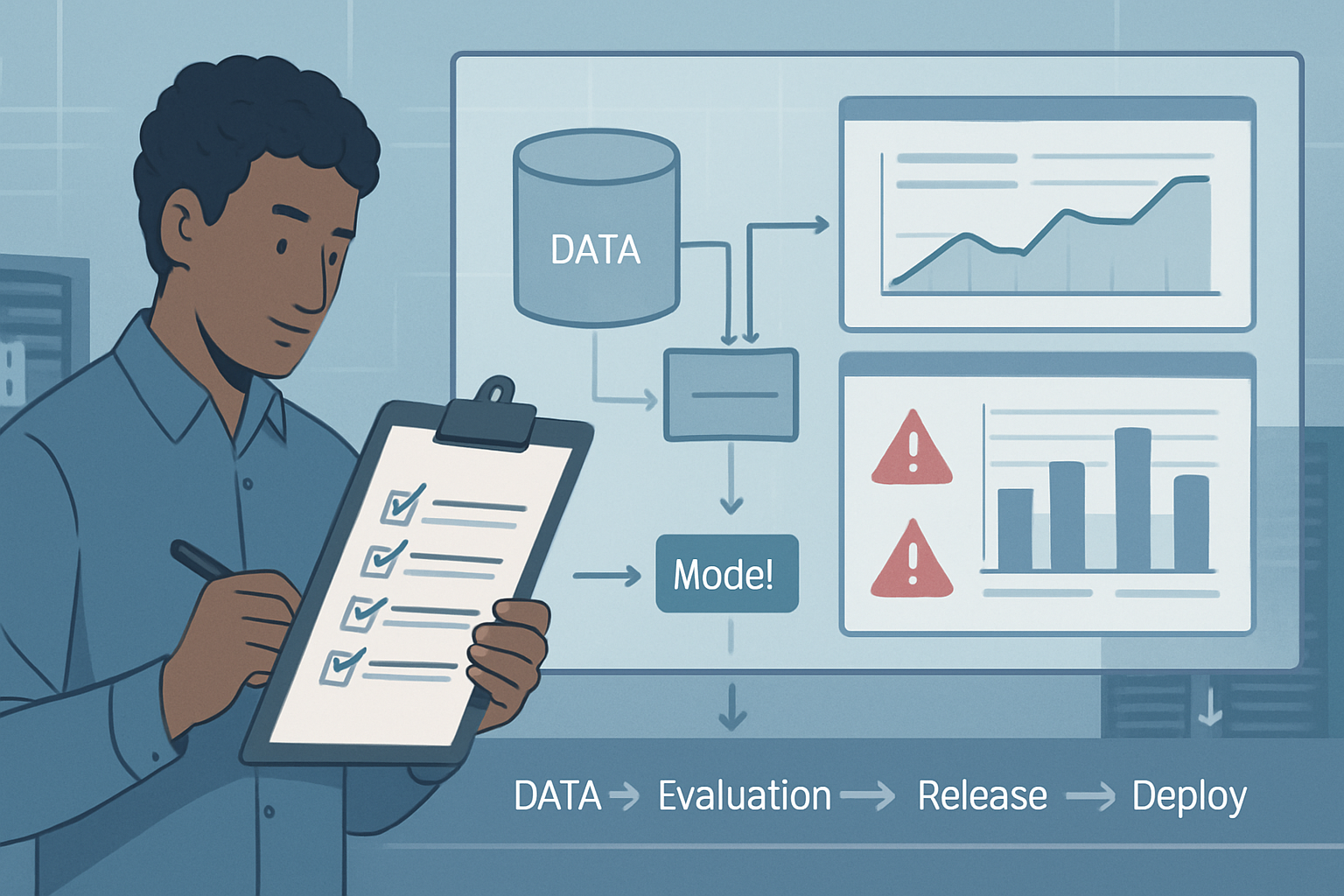

A learning reporting template solves a common operational problem: teams finish AI and machine learning work, but the evidence is scattered across tickets, notebooks, chat threads, and ad hoc notes. That makes it hard to review what was learned, what changed, what remains uncertain, and whether the work is ready to move forward. In practice, a good template turns that information into a repeatable record that engineers, reviewers, and security stakeholders can use without reconstructing the project from scratch.
This FAQ explains what a learning reporting template should contain, how detailed it needs to be, and how to verify that it is actually useful before you rely on it in production workflows. After reading, you should be able to decide whether the template fits your process, capture the right evidence, validate the output, and check the remaining risks before sign-off.
What is a learning reporting template?
A learning reporting template is a structured record for documenting what an AI or machine learning effort has learned, how those findings were validated, and what the operational implications are. It is not just a status update; it is a controlled summary of evidence, decisions, gaps, and next actions.
The practical value is consistency. If every project reports the same core information, technical reviewers can compare work across teams, spot missing validation, and decide whether the result is ready for deployment, more experimentation, or rejection. A useful template usually includes the problem statement, data scope, methods used, evaluation results, limitations, and a clear readiness decision.
For example, a team training a classifier for log triage can use the template to record the dataset version, label quality concerns, false-positive behavior, and the threshold chosen for release. That gives security and operations teams enough context to judge whether the model should be used automatically or only as a recommendation.
What should a learning reporting template capture?
It should capture the minimum evidence needed to understand what was done, what was learned, and what remains unresolved. The template should be detailed enough to support review, but not so large that contributors stop filling it in accurately.
A practical template often includes these fields:
- Objective or problem statement
- Dataset scope, source, and date range
- Assumptions and known data quality issues
- Model, method, or approach used
- Training and validation setup
- Evaluation metrics and acceptance criteria
- Security, privacy, or compliance constraints
- Risks, limitations, and failure modes
- Decision, owner, and follow-up actions
The key decision rule is simple: if a reviewer cannot determine why the work was done, what evidence supports the result, and what could break in production, the template is missing something important. If the template starts collecting trivia that does not affect the decision, it is probably too verbose.
For a forecasting task, for instance, the report should show the forecast horizon, baseline comparison, error metric, and the business threshold for acceptable drift. For an anomaly detection model, it should emphasize false-positive cost, alert volume, and the conditions under which the model becomes unreliable.
How detailed should the reporting be?
It should be detailed enough to support a decision, not to reproduce the full research log. In most technical environments, that means summarizing the evidence and linking to the underlying artifacts rather than copying every notebook output into the template.
This distinction matters operationally. A concise report is easier to review and less likely to become stale, while a bloated report often hides the important points. The best practice is to include a short summary in the template and reference the source artifacts that hold the detailed results, such as experiment logs, code commits, data snapshots, or review tickets. This is similar to the discipline used in a Learning Checklist for AI and Machine Learning Projects, where the goal is to verify evidence rather than document everything.
A good validation point is whether a new reviewer can answer three questions from the template alone: what changed, how it was checked, and why the current result is acceptable or not. If the answer requires searching multiple systems, the report is too thin.
What is the difference between a learning report and a project status report?
A learning report explains evidence and interpretation; a project status report tracks delivery progress. They can overlap, but they are not interchangeable.
Status reports answer whether a task is on schedule, blocked, or complete. Learning reports answer what the team discovered, how confident it is in the result, and what risk remains. In machine learning work, that difference is important because a project can be “done” from a delivery perspective and still be unsuitable for production use due to weak validation, data leakage, or unstable model behavior.
A simple example is a model that meets the deadline but fails under a new data distribution. A status report may mark the task complete, while the learning report should note that the model passed offline checks but has not been validated against the expected production drift. That nuance is what makes the report useful to engineering and security reviewers.
What evidence should back up the claims in the template?
The claims should be backed by traceable artifacts, not just summary statements. If the template says the model improved accuracy, the reader should be able to see where that number came from and under what test conditions it was measured.
Useful evidence usually includes the following:
- Versioned data snapshot or dataset identifier
- Experiment identifier or run record
- Metric definitions and thresholds
- Comparison against a baseline
- Error analysis or failure examples
- Review notes for data quality or labeling concerns
For example, if the report states that a model reduced manual triage time, it should also show the sample size, evaluation window, and the rule used to classify an item as correctly triaged. Without those details, the conclusion may be directionally correct but not trustworthy enough for production decisions.
When behavior depends on environment, version, or tenant configuration, the template should say so explicitly. That is especially important for security-sensitive workflows, where a result that holds in one dataset or deployment setting may not generalize to another.
How do you validate a completed learning reporting template?
You validate it by checking completeness, traceability, and decision readiness. A completed template is useful only if it contains enough information for a reviewer to make a safe, informed decision without chasing missing context.
A practical validation workflow is:
- Confirm the objective is specific and measurable.
- Verify the data scope and version are stated.
- Check that the evaluation method matches the objective.
- Confirm the result includes both success criteria and limitations.
- Ensure the final decision is explicit, with owner and follow-up actions.
A useful caveat is that a report can be internally consistent and still be wrong if the evaluation design is weak. For example, a model evaluated only on the same distribution used for tuning may appear stable while failing in production. A reviewer should therefore verify that the template records not just results, but the conditions under which those results were obtained.
If you need a stronger operational gate, align the report with the same discipline used for code or pipeline readiness. The report should make it obvious whether the work is acceptable to merge, deploy, monitor, or reject.
How should a learning reporting template handle security and compliance concerns?
It should call out security and compliance risks explicitly, even if they are not the main focus of the experiment. AI and machine learning work often introduces data handling, retention, access control, and model leakage issues that become invisible if the report only tracks performance.
At minimum, the template should note whether sensitive data was used, whether access was limited, whether any redaction or masking was applied, and whether the output could expose confidential information. If the use case involves regulated data or security controls, the report should also state which requirements were checked and which ones still need formal review.
A practical example is a support automation model trained on incident tickets. The learning report should say whether tickets were de-identified, whether privileged content was excluded, and whether the model might reveal sensitive patterns through generated summaries or recommendations. That lets security reviewers assess residual risk instead of assuming the model is safe because it performs well.
When is a learning reporting template ready for production use?
It is ready when the template consistently produces decisions that reviewers trust and act on. The goal is not aesthetic completeness; it is operational usefulness.
A production-ready template usually has three signs. First, teams can complete it without ambiguity. Second, reviewers can use it to approve, reject, or request more evidence. Third, the template makes gaps visible early enough to avoid last-minute surprises. If any of those are missing, the template still needs refinement.
In practice, one useful check is to run the template on a small, real project and ask a reviewer who was not involved in the work to make a decision based only on the completed report and linked artifacts. If they cannot do that confidently, the template needs better prompts, clearer fields, or stronger validation rules. That same operational mindset is reinforced by What Is Programming in AI and Machine Learning? Operational Insights for Technical Teams, where the emphasis is on code, data, and model integration as part of a controlled system rather than an isolated experiment.
What is a practical way to implement the template?
The simplest way is to start with a short fixed structure, then enforce it in the workflow where the learning decision is made. A template that lives outside the normal review path is often ignored, so it should be attached to the same ticket, pull request, experiment record, or approval gate used by the team.
A practical implementation can look like this:
- Add required fields for objective, evidence, result, and decision.
- Link the report to the dataset, code, and experiment record.
- Require reviewer sign-off before promotion to the next stage.
- Capture exceptions when a field is not applicable, rather than leaving it blank.
For example, a DevOps team can attach the report to a model deployment request and require it before a canary rollout. If the report states that offline accuracy improved but latency and drift were not tested in the target environment, the deployment should pause until those checks are complete. That prevents a false sense of readiness created by a single strong metric.
What should you verify before relying on the report in production?
You should verify that the report reflects the real operating conditions, not just the development environment. This includes the dataset version, evaluation method, decision criteria, security constraints, and any known limitations that would matter after deployment.
The most important validation point is whether the report supports the actual operational decision you need to make. If you are deciding whether to automate an action, the report should show acceptable error rates and failure handling. If you are deciding whether to expand a pilot, it should show reproducible results and a documented rollback or fallback path. If the report cannot support the decision, it is not ready, even if the underlying experiment looked promising.
In other words, the template is effective when it helps teams move from experiment output to trustworthy operational judgment. If it does not do that, simplify it, tighten the required evidence, and test it again on a real case before using it broadly.
A learning reporting template is most valuable when it is treated as a decision tool, not a documentation exercise. Keep it focused on evidence, validation, and operational risk, and it will help technical teams review machine learning work with far less ambiguity and far better traceability.