
Key takeaways
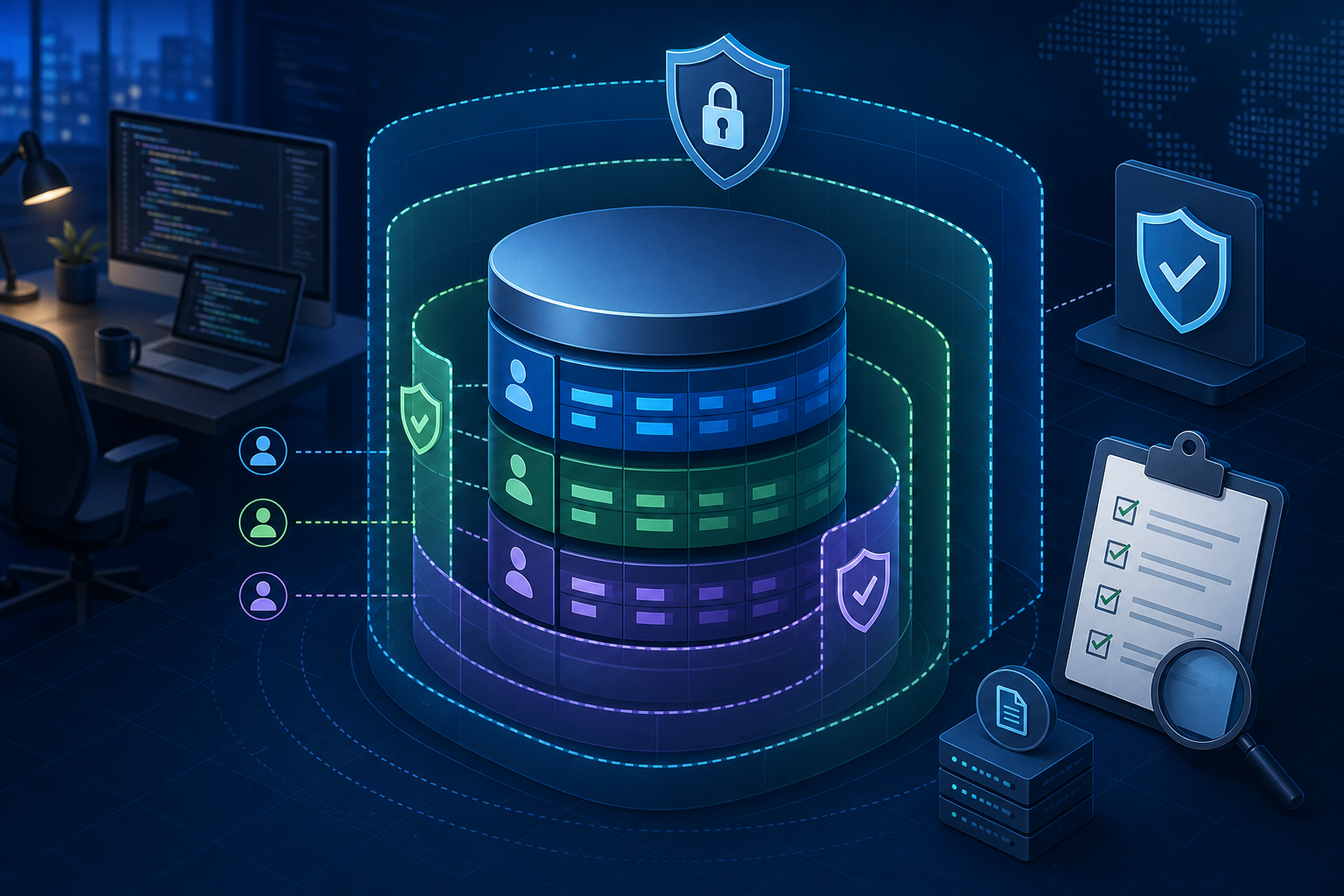
PostgreSQL row-level security lets you attach access policies to a table so each query only sees rows the current role is allowed to access. It is most useful when application-side filtering is not enough, when multiple tenants share the same table, or when privileged users still need controlled access boundaries. The main operational benefit is that authorization moves closer to the data, where it is harder to bypass accidentally.
RLS is not a replacement for good role design, secure application context handling, or tenant-aware queries. It works best when the application sets a trustworthy session context, policies are simple enough to audit, and you validate both the allowed and denied paths before rollout. If you need a deeper tenant-isolation pattern, see PostgreSQL Row-Level Security for Secure Multi-Tenant Access.
Why row-level security matters
The practical problem behind row-level security is straightforward: a table may contain records for many users, teams, customers, or tenants, but most sessions should only see a subset of those rows. Without database-enforced controls, access depends on every query, view, stored procedure, and application code path remembering to add the right filter. That is fragile in real systems, especially when teams ship new services, add reporting jobs, or expose ad hoc SQL access to operators.
RLS matters operationally because it gives you a central enforcement point. If a developer forgets a WHERE tenant_id = ... clause, or a service accidentally reuses the wrong identifier, the database can still suppress rows that do not match the policy. That reduces the blast radius of application bugs and makes policy review part of the database change process instead of scattered across codebases.
The other reason it matters is auditability. A policy attached to a table is easier to reason about than repeated access logic hidden in application code. For security-sensitive environments, that clarity can be the difference between a system that is merely intended to isolate data and one that is actually enforced to do so.
How PostgreSQL row-level security works
RLS is policy-based filtering at the table level. When RLS is enabled on a table, PostgreSQL evaluates policies against each row during SELECT, UPDATE, DELETE, and, in policy-dependent ways, INSERT operations. Policies can allow access, deny access, or restrict which rows can be modified.
A policy usually depends on one of three things:
- the current database role
- a session value such as a tenant identifier
- row attributes such as owner, department, or classification
The database applies the policy before returning rows to the client. That means the application does not get a chance to see rows the policy rejects. In practice, this is much stronger than a view-only approach when you need protection from direct table access, background jobs, or secondary query paths.
There is an important distinction between enabling RLS and actually enforcing it. A table can have RLS enabled, but privileged roles may still bypass it unless you design roles carefully and verify which roles have bypass capability. That is why RLS is a control system, not a checkbox.
For organizations also trying to improve transport security, RLS complements but does not replace encrypted sessions. If connection trust is part of your control plane, make sure the transport layer is validated too; How to Secure PostgreSQL Connections with SSL/TLS is relevant here.
A compact implementation workflow
The following workflow is intentionally compact because the operational question is not how to memorize syntax, but how to decide whether your setup is safe to trust.
1. Identify the access boundary: tenant, owner, team, or classification.
2. Choose a session signal the application can set reliably.
3. Create a table policy that reads only trusted session context and row data.
4. Enable RLS and review which roles can bypass it.
5. Test allow/deny cases from ordinary and privileged sessions.
6. Confirm writes, not just reads, obey the policy.
7. Document fallback behavior for admin, support, and migration roles.
That workflow is small, but each step prevents a common failure mode: weak context, overbroad roles, or policies that look correct for reads but fail for writes.
Practical implementation pattern
A common pattern is multi-tenant access where each row has a tenant_id column and the application sets a session variable after authentication. The policy compares the row value to the session value, so the database only returns rows for the active tenant.
A simplified example looks like this:
ALTER TABLE invoices ENABLE ROW LEVEL SECURITY;

CREATE POLICY tenant_isolation_select
ON invoices
FOR SELECT
USING (
  tenant_id = current_setting('app.tenant_id', true)::uuid
);

CREATE POLICY tenant_isolation_modify
ON invoices
FOR UPDATE, DELETE
USING (
  tenant_id = current_setting('app.tenant_id', true)::uuid
)
WITH CHECK (
  tenant_id = current_setting('app.tenant_id', true)::uuid
);
This pattern is operationally attractive because it separates identity from row ownership. The session state represents the authenticated tenant, and the policy enforces that state against each row. It also scales better than hand-coding tenant filters in every service query, especially when multiple teams work against the same schema.
The key assumption is trust in the session signal. If any client can set app.tenant_id arbitrarily, the policy is only as strong as that assumption. In production, the application must set the session value from authenticated context, not from user input.
What this means in practice
In practice, RLS changes how you think about database access. Instead of asking, “Did this query remember to filter rows?”, you ask, “Can this role ever reach rows it should not see?” That is a stronger and more testable question.
For developers, this often means fewer conditional filters in application code and less duplication across services. For operators, it means database access reviews become more meaningful because the policy is visible in schema metadata. For security teams, it creates a measurable control that can be validated with direct database tests rather than inferred from application behavior.
The trade-off is operational discipline. RLS adds policy management overhead, and the more dynamic your authorization model is, the more careful you must be about policy complexity. A simple tenant match is easy to reason about. A policy that combines tenant, environment, ownership, exception groups, and time-based conditions can become difficult to test and easy to misconfigure.
Decision guidance: when RLS is a good fit
RLS is usually a good fit when one or more of the following are true:
- multiple tenants or business units share tables
- direct SQL access exists for reporting or support
- application code is split across teams or services
- data exposure would be costly if a filter is missed
- you need database-level enforcement that survives query mistakes
RLS is often a weaker fit when access rules are highly volatile, depend on external authorization systems that are hard to trust inside the database, or vary so much that policy logic becomes more complex than the application logic it replaces. In those cases, a view layer, separate schemas, or even separate databases may be easier to operate.
The useful decision rule is this: if the boundary can be expressed clearly in terms of row attributes and trusted session context, RLS is worth serious consideration. If the boundary depends on frequent exception handling or opaque business logic, expect the policy design and testing burden to grow quickly.
Common mistakes
The most common mistake is assuming that enabling RLS automatically protects every role. In reality, some roles may still bypass policies depending on how they are configured and what privileges they hold. Always verify which roles can see unrestricted data.
Another mistake is using untrusted session input. If the application or user can spoof the value used in the policy, RLS becomes a weak filter instead of a control. The session context must come from authenticated state and be set in a controlled place in the connection flow.
A third mistake is testing only successful reads. Real policies must also be validated for INSERT, UPDATE, and DELETE, because write paths can leak data or break tenant boundaries in ways read tests do not catch.
A fourth mistake is making policy logic too clever. Nested conditions, exception lists, and many-to-many authorization joins can be valid, but they are much harder to audit. If the policy cannot be explained in one sentence, it is probably too complicated for first-line operational use.
For some environments, performance tuning around access patterns also matters. If RLS increases the cost of common access paths, make sure the supporting indexes are still efficient and not already suffering from storage or maintenance issues. If you are reviewing broader table health, PostgreSQL Index Bloat Detection and Reindexing Strategies can help you separate security controls from unrelated performance degradation.
Validation checks before production
Before production use, verify the policy from both authorized and unauthorized sessions. That means checking at least one accepted role, one denied role, and one elevated role that should still be constrained. The goal is to confirm that the policy behaves the way you intended, not only that it returns the rows you expect during happy-path testing.
You should also verify session-context handling. Confirm the application sets the expected tenant or ownership value after authentication and that the value cannot be manipulated by the client layer. If the policy relies on a custom setting, make sure the connection lifecycle consistently initializes it.
Finally, test operational edge cases: migration jobs, support scripts, backups, and bulk maintenance tasks. Many policy problems only appear when a nonstandard role runs a maintenance operation or when a background process reuses a connection with stale session state.
Production readiness checklist
Use this compact checklist before rollout:
- The protected tables and access boundaries are identified.
- Every RLS-relevant role has been reviewed for bypass capability.
- The application sets trusted session context after authentication.
- Read and write policies have both been tested.
- Denied cases have been verified from at least one ordinary role.
- Admin, support, and migration roles have documented behavior.
- The policy logic is simple enough to explain and audit.
- Connection handling prevents stale session state from leaking between requests.
- Monitoring or test queries exist to validate policy behavior after schema changes.
Final takeaway
PostgreSQL row-level security is a strong fit when you need the database itself to enforce fine-grained access control. It works best when the access boundary is clear, the session context is trustworthy, and the policy stays simple enough to verify under operational pressure. If you can express the rule in row attributes and authenticated session state, RLS can meaningfully reduce data exposure risk; if you cannot, the design may be better handled elsewhere.
Use this guidance together with secure ETL pipelines to connect the workflow with related operational context already available on the site.