
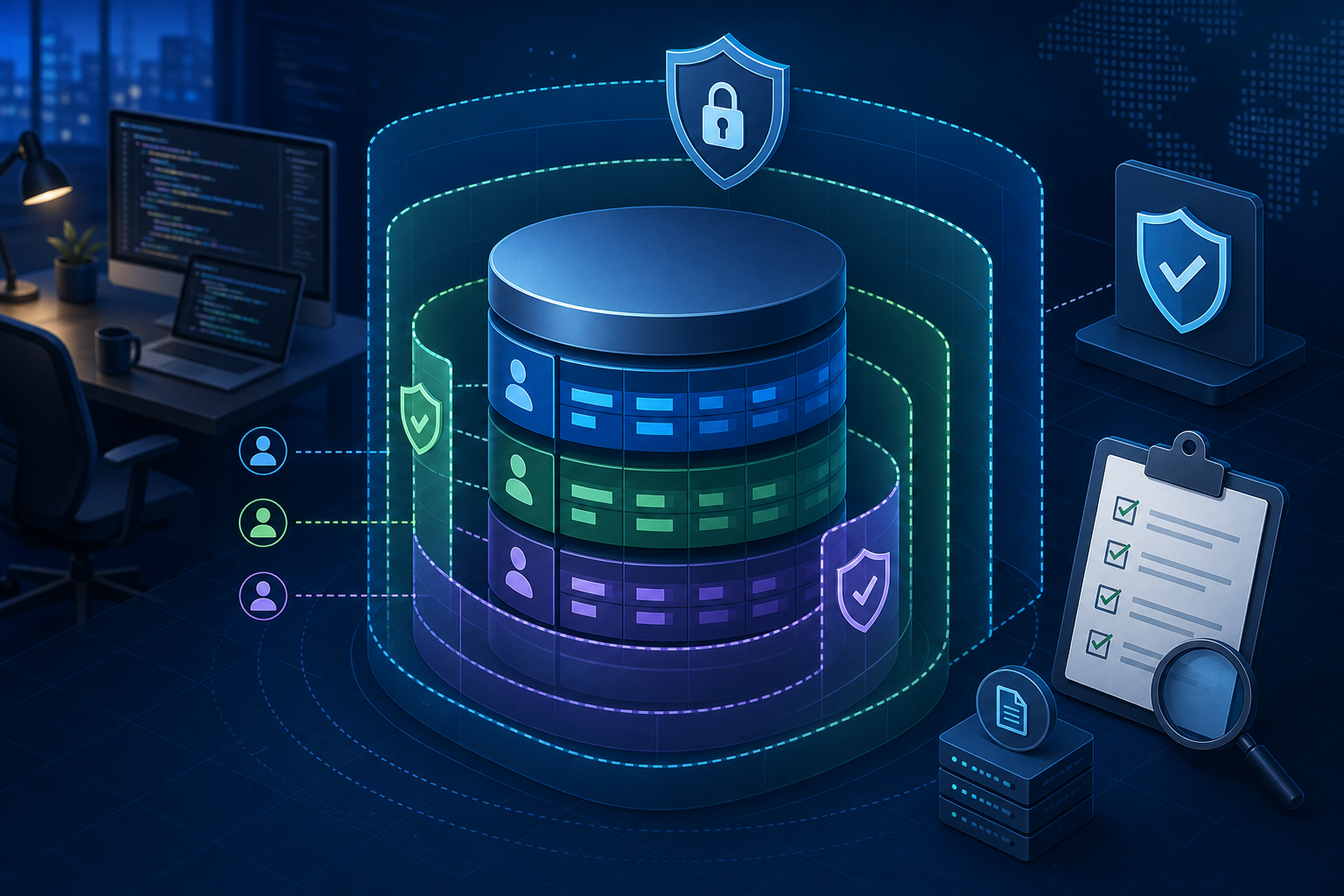
Why row-level security matters operationally
The practical problem with PostgreSQL row-level security is not whether it can hide rows, but whether it can reliably enforce the right access boundary when applications, roles, and data ownership patterns become complex. If your database serves multiple tenants, internal teams, or scoped service accounts, application-side filtering alone is easy to bypass and difficult to audit. Row-level security (RLS) moves that boundary into the database engine, where it can be applied consistently across queries, including direct SQL access, provided you configure it correctly.
This matters because policy mistakes are usually silent. A policy that is too broad exposes data. A policy that is too narrow breaks legitimate workflows in ways that are easy to misdiagnose as application bugs. After reading this article, you should be able to decide whether RLS is the right control for your environment, understand how PostgreSQL evaluates policies, validate policy behavior with practical checks, and know what to verify before production use.
Key takeaways
PostgreSQL row-level security is most effective when you treat it as an enforcement layer, not just a filtering convenience. A well-designed policy should align with a clear ownership model, use stable predicates that the planner can evaluate predictably, and be audited with explicit test cases for both allowed and denied access.
The biggest operational risks are policy creep, privileged bypass, assumptions about application identity, and missing coverage for writes as well as reads. If you are already using scoped roles or database-side tenant isolation, RLS can strengthen that model. If your access rules depend on highly dynamic business logic or cross-row aggregations, you may need additional controls beyond RLS.
How PostgreSQL row-level security works
RLS applies table-specific policies to rows returned or modified by a role. When RLS is enabled on a table, PostgreSQL evaluates policy conditions for each relevant command type, such as SELECT, INSERT, UPDATE, and DELETE. A policy can allow access only when a row matches a predicate based on the current session role, a tenant identifier, a session variable, or another trusted attribute available to the database.
Conceptually, you design two parts: the rule that enables RLS on the table, and the policies that define who can see or change which rows. This is important because enabling RLS without a policy model, or relying on a single permissive policy, often creates a false sense of protection.
At a high level, PostgreSQL evaluates access in this order: table privilege checks, RLS policy checks, and then normal query processing. Superusers and certain privileged roles can bypass RLS, so you must confirm whether your operational model includes any roles with bypass capability. If your architecture uses application proxies or database replication, review how privileged paths are controlled; secure data movement patterns such as How to Configure PostgreSQL Streaming Replication Securely become relevant when replicas or maintenance roles exist outside the main application trust boundary.
A compact workflow for designing a policy
1. Define the ownership boundary: tenant, team, environment, or data owner.
2. Choose the authoritative session attribute: role, tenant claim, or session variable.
3. Write the smallest policy that permits only the intended rows.
4. Add separate rules for reads and writes if the rules differ.
5. Test allowed access, denied access, and privileged bypass paths.
6. Audit the policy after schema or role changes.
This workflow is intentionally compact because RLS design usually fails at the boundary definition, not in syntax. If the boundary is unclear, the policy will be either brittle or permissive.
Designing policies that hold up in production
The best RLS policies are easy to reason about from the data model. A tenant-scoped table is a good candidate when each row belongs to exactly one tenant and the application can reliably set tenant context at session start. A team-scoped or project-scoped table can also work, but only if membership lookup is stable and fast enough for routine query paths.
The most common design choice is whether to key policies off the authenticated database role or off a session context value. Role-based policies are simpler to audit when one database role maps cleanly to one trust domain. Session-based policies are more flexible for shared application roles, but they depend on a trustworthy method of setting and resetting session state. In multi-tenant systems, the latter is often necessary, but it should be paired with strict connection handling so one request cannot inherit another request’s context.
A practical design rule is to keep policy predicates narrow and deterministic. Avoid embedding fragile business logic directly into policy expressions. If the policy needs to check membership, prefer a stable lookup path that is indexed and easy to review. If the policy depends on a helper function, confirm that the function is marked and implemented in a way that preserves security expectations, and verify that it cannot be manipulated through search path or privilege escalation issues.
Practical scenario: shared application roles in a multi-tenant service
Consider a service where many customers share the same accounts table, and all requests connect through a small set of application roles. Each row contains a tenant_id, and the application sets the active tenant for the session at login or request start. The business requirement is simple: one tenant must never read another tenant’s rows, even if a developer makes an application query mistake.
This is a classic RLS fit because the database can enforce the tenant boundary even when the query layer is wrong. But it also shows the main risk: if session context is not isolated correctly, the policy can be bypassed indirectly. In practice, you would validate not only the policy expression but also the connection pool behavior, session reset behavior, and any helper function used to expose tenant context.
This is also where access-control design intersects with schema and index design. A tenant predicate that is correct but slow can become a production risk under load, especially if it is used on every query path. In environments that already separate data by ownership or scope, the thinking is similar to Designing Secure NoSQL Data Models for Access Control: the boundary is safest when it is reflected in the data model, not bolted on afterward.
Example policy pattern
The following example illustrates a simple tenant-scoped model. It is intentionally minimal, because the goal is to show the shape of the control rather than a complete framework.
ALTER TABLE public.orders ENABLE ROW LEVEL SECURITY;

CREATE POLICY orders_tenant_read
ON public.orders
FOR SELECT
USING (tenant_id = current_setting('app.tenant_id', true)::uuid);

CREATE POLICY orders_tenant_write
ON public.orders
FOR UPDATE, DELETE
USING (tenant_id = current_setting('app.tenant_id', true)::uuid)
WITH CHECK (tenant_id = current_setting('app.tenant_id', true)::uuid);
This pattern demonstrates two important points. First, read access and write access can use the same boundary but still need separate consideration. Second, WITH CHECK matters for writes because it prevents a user from changing a row so that it escapes the intended boundary.
The example also assumes that the application sets app.tenant_id safely and consistently. If the variable is missing, malformed, or left behind by connection reuse, the policy may deny legitimate access or, depending on the expression, allow unintended access. That is why policy syntax alone is never enough for auditing.
What this means in practice
In operational terms, RLS should be treated as a control that sits between application authorization and database privileges. Application code may still decide what a user is allowed to request, but the database becomes the final enforcement point for row visibility. This is valuable because it reduces reliance on every query being written perfectly, yet it also means that failures in role management or session hygiene can have broader consequences than a single broken endpoint.
For teams running mixed workloads, the practical value of RLS is strongest when you have a clear trust boundary: one tenant per request, one user per role, one environment per schema, or one service per access pattern. The less stable those boundaries are, the more careful you must be with context propagation and exception handling.
If your environment includes replication, background jobs, migration tooling, or admin utilities, you should assume there are multiple execution paths that can touch the same tables. Each path must be reviewed separately. A migration role may need elevated access for schema work, but that same privilege should not exist in routine application paths. That separation is also why production safeguards around database transport and role design matter, as in secure replication architectures.
Audit checks that reveal policy gaps
Auditing RLS is more than confirming that a policy exists. You need evidence that it behaves correctly for real roles and real statements. A useful audit starts with positive and negative tests: a request that should succeed, a request that should fail, and a request that attempts to cross boundaries through a modified predicate or stale session state.
A compact audit checklist looks like this:
- Confirm RLS is enabled on every table that stores scoped data.
- Confirm there is no unintended bypass path for privileged roles.
- Test
SELECT,INSERT,UPDATE, andDELETEseparately. - Verify that writes cannot move rows into another tenant or scope.
- Check that connection pooling resets session context between requests.
- Review helper functions, views, and foreign-key relationships that may expose rows indirectly.
- Confirm policy behavior after schema changes, new indexes, and role changes.
You should also validate the policy under the exact execution path used in production. A query that works in a psql session may behave differently through a pooler, ORM, or service account because the session state and default role may not match.
Decision guidance: when RLS is the right control
Use PostgreSQL row-level security when the access boundary can be expressed as a row predicate and when the database is part of the trust boundary you want to enforce. Typical fits include tenant isolation, delegated administration, per-team data access, and service accounts that should only operate on a scoped subset of data.
RLS is less suitable when access depends heavily on complex approval workflows, row relationships that change in real time, or policies that require repeated joins to large external tables on every query. In those cases, you may still use RLS, but you should expect more testing, more indexing work, and more operational scrutiny.
A useful decision rule is this: if you cannot explain the access boundary in one sentence, the policy is probably not ready. If you can explain it clearly but cannot validate it with a small set of deterministic tests, it is still not production-ready.
Common mistakes
One common mistake is assuming that enabling RLS automatically locks down the table for everyone. In reality, existing privileges and privileged roles still matter, and bypass behavior must be understood explicitly.
Another frequent issue is using a policy that only covers reads. Teams validate that users cannot see other tenants’ rows, then overlook update paths that can mutate row ownership or insert invalid rows. Write policies should be reviewed with at least the same rigor as read policies.
A third mistake is relying on session variables without confirming connection lifecycle behavior. If a pool reuses sessions, any tenant or role context must be reset reliably. This is a control-plane problem, not a SQL syntax problem.
A fourth mistake is making policies so complex that no one can audit them later. If a policy requires multiple helper functions, nested joins, and exception branches, it may be functionally correct but operationally fragile. Simpler policies are easier to test, reason about, and maintain.
Production readiness checklist
Before you treat an RLS policy as production-ready, verify the following:
- The data boundary is explicit and documented.
- RLS is enabled on every scoped table.
- Separate read and write behaviors have been tested.
- Session context is set, reset, and validated reliably.
- Privileged bypass roles are known and justified.
- Helper functions and views do not undermine the boundary.
- The policy has been tested through the real application path.
- Negative tests confirm that cross-scope access is denied.
- Schema changes and new roles have an audit process.
- The operational team knows how to diagnose denied-access errors.
If any of these items is unclear, the issue is usually not the syntax of the policy. It is the mismatch between the access model, the session model, and the production execution path.
Final takeaway
PostgreSQL row-level security is a strong control when you need the database itself to enforce tenant or scope boundaries, but its value depends on disciplined policy design and real auditing. The safest approach is to keep the boundary simple, separate read and write checks, validate the actual runtime path, and treat bypass roles and session state as first-class security concerns. When those pieces are in place, RLS becomes a practical and auditable part of a defense-in-depth strategy rather than an isolated SQL feature.
Use this guidance together with Oracle database vulnerability assessment and secure MongoDB indexes to connect the workflow with related operational context already available on the site.