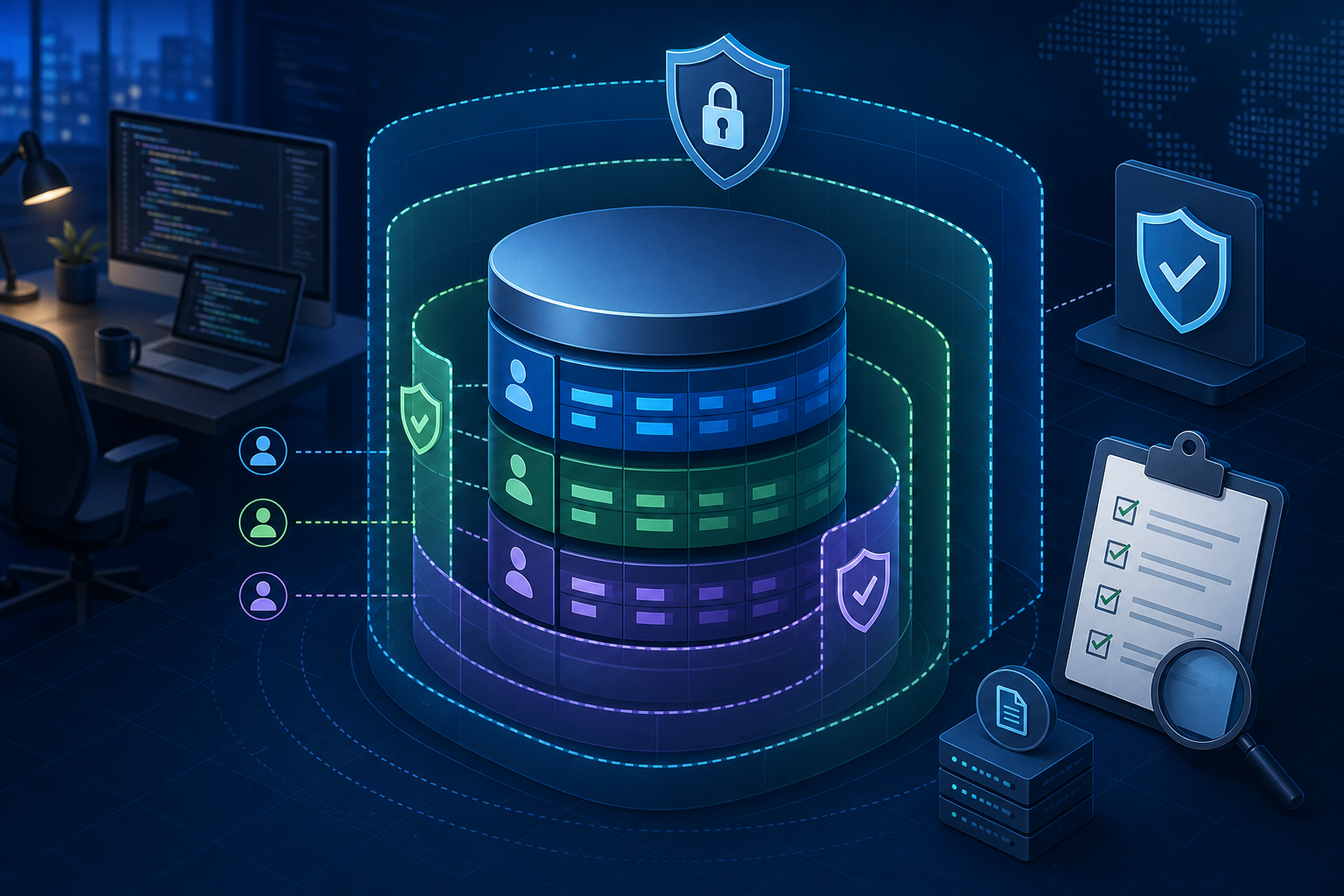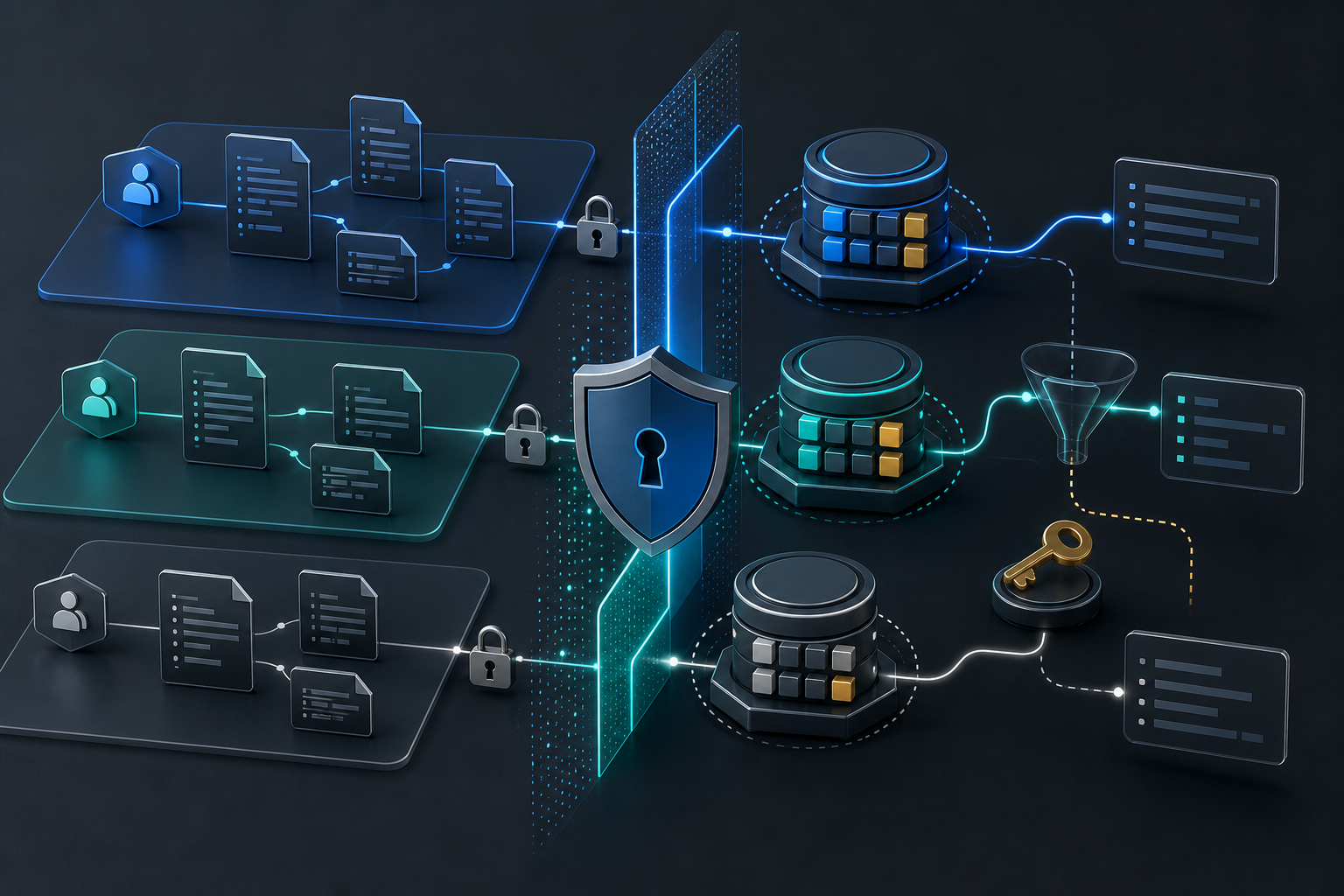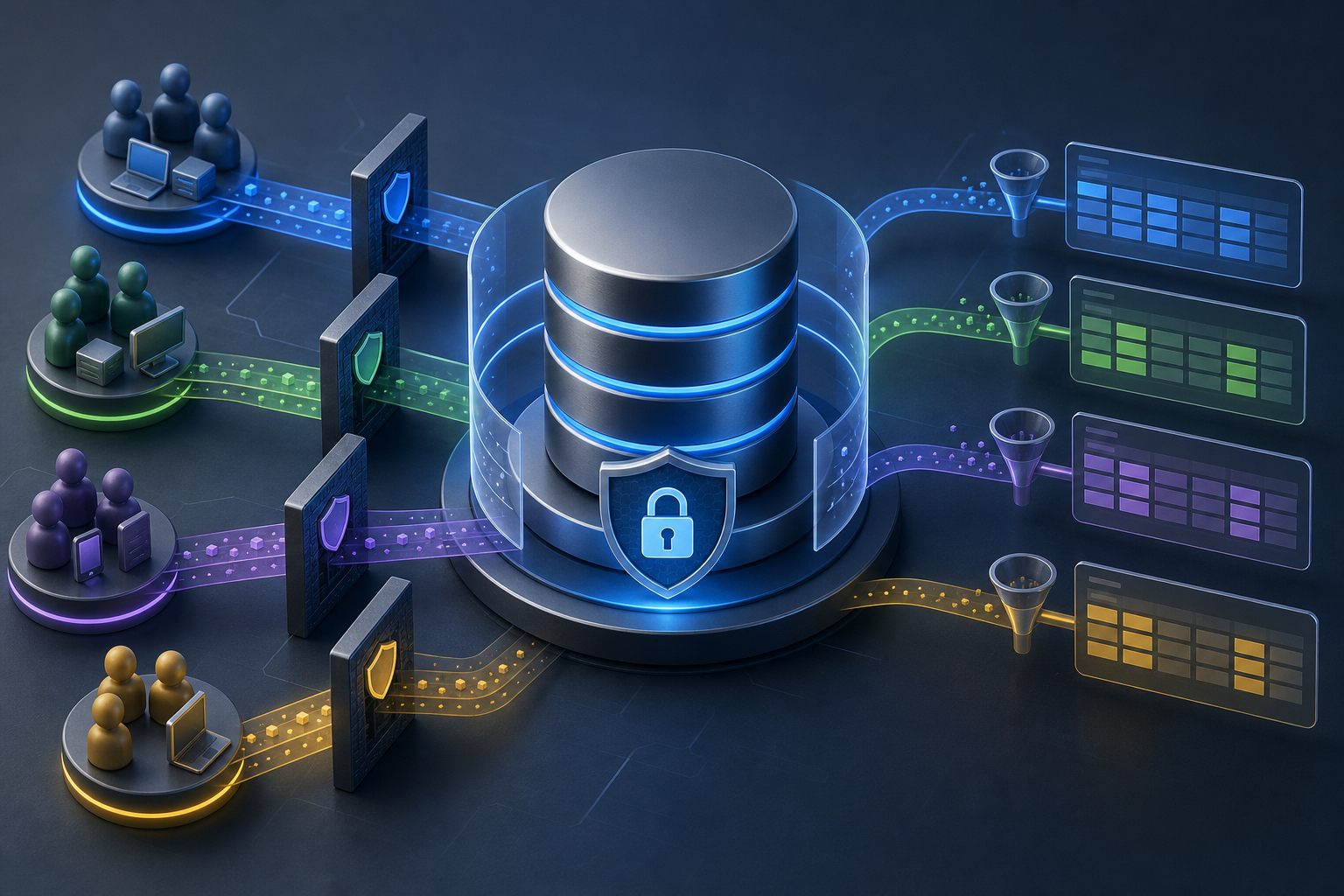
Why multi-tenant access becomes a database security problem
The practical problem behind PostgreSQL row-level security is simple: a multi-tenant application often needs every request to see only the rows that belong to its tenant, and application-layer checks alone are easy to miss, bypass, or implement inconsistently. Once tenant boundaries are enforced in the database, a bad query, a forgotten join filter, or a misrouted service call is much less likely to expose data across tenants.
That matters operationally because multi-tenant data leaks are usually silent until they are not. A single incorrect query path can expose customer records, billing data, support tickets, or audit information across tenants. Row-level security shifts the control point closer to the data and makes tenant filtering part of the access model rather than a reusable code convention.
After reading this article, you should be able to decide whether PostgreSQL row-level security fits your environment, understand how it enforces access, validate a basic design, and know what to check before production use.
Key takeaways
PostgreSQL row-level security is most useful when tenant isolation must be enforced consistently inside the database, not just in application code. It works by attaching policies to tables so that row visibility and row modifications are filtered according to the current database role and session context.
The strongest use cases are shared-schema multi-tenant applications, service-layer architectures with strict tenant context propagation, and systems where you need defense in depth against application bugs. It is less useful when the application already uses separate databases per tenant, or when the operational cost of policy management outweighs the isolation benefit.
The main discipline is not turning RLS on. The real work is designing policy logic, making tenant context trustworthy, testing for bypass paths, and confirming how privileged roles, migrations, and maintenance jobs behave. For a deeper discussion of policy structure and auditability, see PostgreSQL Row-Level Security Policy Design and Auditing.
How row-level security works in PostgreSQL
RLS policies are evaluated by PostgreSQL when a query reads or modifies rows in a protected table. The table owner, privileged roles, and session configuration can change the effective behavior, so you must understand the entire execution path rather than assuming a policy alone provides isolation.
A common design pattern uses a tenant identifier column such as tenant_id on every shared table. The application sets a trusted session value, often through a request-scoped database setting or role context, and policies compare that context to the row value. The database then filters rows before the result set is returned to the caller.
This means RLS is not a replacement for application authentication. It is the enforcement layer that consumes identity or tenant context and makes that context effective at the table boundary. If the context is wrong, missing, or user-controlled, the policy can be correct and still produce unsafe results.
A compact workflow for secure multi-tenant access looks like this:
Authenticate request
  -> establish tenant identity in trusted session context
  -> connect with least-privileged database role
  -> apply row-level policies on shared tables
  -> verify visible rows and denied mutations
  -> log policy-relevant access and anomalies
A practical tenant-isolation scenario
Consider a SaaS platform with one shared invoices table that holds all customers' billing records. The application has separate APIs for invoice lookup, export, and status updates. Under normal operation, each request carries a tenant identity from the authentication layer, and the database session is expected to inherit that identity.
This is exactly the kind of environment where RLS helps. A forgotten WHERE tenant_id = ... clause in one API path would be enough to expose another customer's invoice if the database is otherwise unrestricted. With RLS, the table itself becomes tenant-aware, so even an unsafe query still returns only rows allowed by policy.
This does not remove the need for application validation. If your service can act on behalf of multiple tenants, you still need trustworthy tenant propagation, proper role separation, and a way to ensure privileged jobs do not accidentally run under a tenant-scoped role. In practice, RLS reduces the blast radius of mistakes, but it does not remove the need to design for those mistakes.
What this means in practice
The operational value of RLS is strongest when you treat it as a boundary control, not as a convenience feature. The policy should express the business rule in database terms: which role may see which rows, under what session context, and for which operations. That makes the authorization decision deterministic and harder to bypass than code-level filtering.
In day-to-day operations, the main effect is that developers and engineers must think about tenant context as part of the database contract. Query shape, connection pooling, role assumption, and background processing all matter. A connection pool that reuses sessions without clearing tenant context can create cross-request contamination. A migration or reporting job that runs with elevated privileges can see more data than intended if its role is not explicitly controlled.
When you design the surrounding architecture, it is worth comparing RLS against other isolation strategies. The more shared your schema is, the more valuable a database-level boundary becomes. The more isolated your tenants already are, the less incremental gain RLS may provide. Related access-path design trade-offs are similar to index planning in other database systems; for a parallel on how access patterns and exposure interact, see Designing Secure MongoDB Indexes for High-Performance Queries.
Decision guidance: when RLS is a good fit
Use PostgreSQL row-level security when all of the following are true:
- Tenants share tables and you need strong logical isolation inside the database.
- The application can reliably set trusted tenant context on each session or transaction.
- You can keep privileged roles narrow and auditable.
- You are willing to test both read and write paths under realistic roles.
RLS may not be the best choice when:
- Each tenant already has a separate database or cluster and the isolation boundary is physical.
- Your workload depends heavily on broad administrative queries that would become awkward under policy enforcement.
- Your app cannot provide trustworthy tenant context without major redesign.
- You cannot operationalize policy reviews, regression tests, and role hygiene.
A good rule is that RLS should make a correct design safer, not rescue a weak identity model. If the application cannot reliably identify the tenant, policy enforcement will inherit that weakness.
Implementation trade-offs you need to account for
RLS improves security posture, but it introduces new operational responsibilities. The first trade-off is complexity. Every protected table needs a policy strategy, and every role that touches the table needs to be evaluated for intended access. That means more configuration, more testing, and more documentation.
The second trade-off is debugging overhead. When a query returns no rows, you must distinguish between "no data exists" and "the policy blocked access." Engineers need a consistent way to validate session context and inspect the effective role. Without that discipline, RLS can make troubleshooting slower.
The third trade-off is around privileged access. Database owners, superusers, maintenance jobs, and replication-related workflows may see different behavior than standard application roles. You must verify which roles bypass policies, which roles are exempt, and which operational tasks need an explicit exception path.
Performance overhead is usually not the first concern, but policy evaluation still adds work to every protected statement. In production, validate the impact on your most common read patterns and your most expensive write paths. The right question is not whether RLS is fast in theory; it is whether your policy shape is acceptable under your workload and connection model.
Common mistakes that undermine security
One common mistake is trusting application code to set tenant context without verifying that the database session actually received it. If the context is missing or inherited from a reused connection, the policy may behave unexpectedly.
Another mistake is mixing tenant-scoped and privileged activity in the same role. That makes it hard to reason about what the role can access, and it increases the risk that an administrative task runs with broader visibility than intended.
A third mistake is assuming read policies are enough. Multi-tenant systems need to evaluate inserts, updates, deletes, and bulk operations as well. If a role can write rows that it cannot later read, or read rows it should not write, the policy model may be inconsistent.
A fourth mistake is failing to test direct SQL paths. Background workers, ad hoc scripts, data repair tools, and reporting tasks often bypass the application layer. If they connect with the wrong role or rely on inherited session state, they can expose or corrupt data.
Finally, teams often forget to verify the behavior of table ownership and privileged roles. Those cases are not edge conditions in production; they are part of the normal operating model and should be explicitly documented.
Validation checks before production
A production-ready RLS rollout should include checks that prove the policy works under the exact access model you plan to use. Focus on evidence, not assumptions.
Verify these conditions
- The application sets tenant context in a trusted way for every request or transaction.
- The database role used by application traffic is least-privileged and cannot bypass policy unintentionally.
- Protected tables have policies for all required operations, not only
SELECT. - Privileged roles, maintenance jobs, and migrations are reviewed separately.
- Connection pooling does not leak tenant context between requests.
- Test queries confirm that a tenant can only read and mutate its own rows.
- Failure cases are visible in logs or monitoring so that policy denials can be distinguished from empty results.
If you need a more detailed audit-oriented control set, the policy-design article linked above is the better companion piece, especially for reviewing bypass conditions and operational ownership.
Compact production readiness checklist
Use this as a final gate before enabling RLS on customer-facing data:
- Tenant identity source is trusted and not user-controlled.
- Every shared table has a documented policy owner.
- Read and write policies are both defined and reviewed.
- Application, job, and admin roles are separated.
- Privileged bypass behavior is understood and approved.
- Connection reuse is tested under concurrent tenant traffic.
- Negative tests prove cross-tenant access is denied.
- Monitoring can distinguish policy denial from missing data.
- Backup, restore, and migration processes have been checked for policy impact.
Final operational guidance
PostgreSQL row-level security is a strong fit when your security goal is to enforce tenant boundaries inside the database and reduce reliance on every caller behaving correctly. It is most effective when backed by least-privilege roles, trustworthy session context, and explicit validation of both read and write paths.
If you can state exactly where tenant identity comes from, how the database receives it, which roles are allowed to bypass policy, and how you will test denial behavior before launch, RLS is likely a good operational control for secure multi-tenant access. If you cannot answer those questions cleanly, the risk is not that RLS fails loudly; it is that it appears to work while leaving a gap in the access model.
Use this guidance together with JavaScript input validation and A* pathfinding optimization to connect the workflow with related operational context already available on the site.