Why secure ETL optimization matters
The practical problem in big data environments is not whether an ETL pipeline can move data, but whether it can move sensitive data safely at production scale without creating unnecessary exposure. A pipeline that is fast but leaks access through broad permissions, writes intermediate plaintext to shared storage, or transforms records without validation is operationally risky even if the job succeeds every night.
Optimizing big data ETL pipelines for secure data processing means balancing throughput, latency, and blast-radius control. The goal is to reduce the time data spends in exposed states, limit who and what can touch it, and preserve traceability from ingestion to output. After reading this article, you should be able to decide whether your current pipeline design is secure enough, identify where optimization reduces exposure rather than increasing it, and verify the controls that matter before production use.
Key takeaways
Secure ETL optimization is not a separate discipline from performance tuning; the two are linked. The safest design is usually the one that minimizes unnecessary data movement, avoids broad intermediate exposure, and enforces controls as close to the source as possible.
A secure pipeline typically needs four things working together: restricted access, protected transport and storage, controlled transformation boundaries, and validation that detects anomalies or schema drift before bad data propagates. If you already monitor data freshness and runtime behavior, techniques such as detecting anomalies in big data pipelines with Apache Spark can help you spot security-relevant failures as operational signals rather than waiting for downstream incidents.
The most useful production question is not “Is the pipeline encrypted?” but “Where can sensitive data be observed, copied, delayed, or transformed without authorization?” That question leads directly to the design choices that matter.
What secure ETL optimization actually means
In practice, secure ETL optimization is about reducing the number of trust boundaries the data crosses while keeping the job efficient enough to run reliably. Each additional hop, staging location, or ad hoc service account expands the attack surface. Every wide read permission, shared bucket, or unprotected temporary table is a point where sensitive data can be exposed.
This is why secure optimization often starts with data flow simplification. If a transformation can happen in memory, inside a controlled compute cluster, or using partition-aware reads instead of full scans, you reduce both cost and exposure. If a pipeline must materialize intermediate data, it should do so in a tightly governed location with short retention, strict encryption, and access scoped to the job identity.
Security controls also affect throughput. Excessive token fetching, repeated decrypt/re-encrypt cycles, and uncontrolled schema retries can add latency and increase operational noise. A well-designed pipeline avoids those penalties by using predictable identities, stable schemas, and well-defined retry behavior.
How security controls affect performance
A common misconception is that security always adds overhead in ways that make pipelines slower. Some overhead is unavoidable, but much of the cost comes from poor implementation rather than security itself.
For example, broad row-level masking applied too late can force a job to process far more sensitive fields than necessary. Likewise, coarse partitioning can cause a pipeline to read irrelevant data, which increases scan costs and broadens exposure. In contrast, applying filtering early, aligning storage layout with access patterns, and pruning partitions can lower both risk and compute cost. If your data layout is already partitioned, optimizing Apache Spark query performance with partition pruning is often one of the most practical ways to reduce unnecessary reads.
The same principle applies to joins and shuffles. Unnecessary shuffles increase the number of places where data is written to temporary storage and the amount of time it remains in transit. Lowering shuffle volume is both a performance improvement and a security improvement when the data is sensitive.
Compact secure ETL workflow
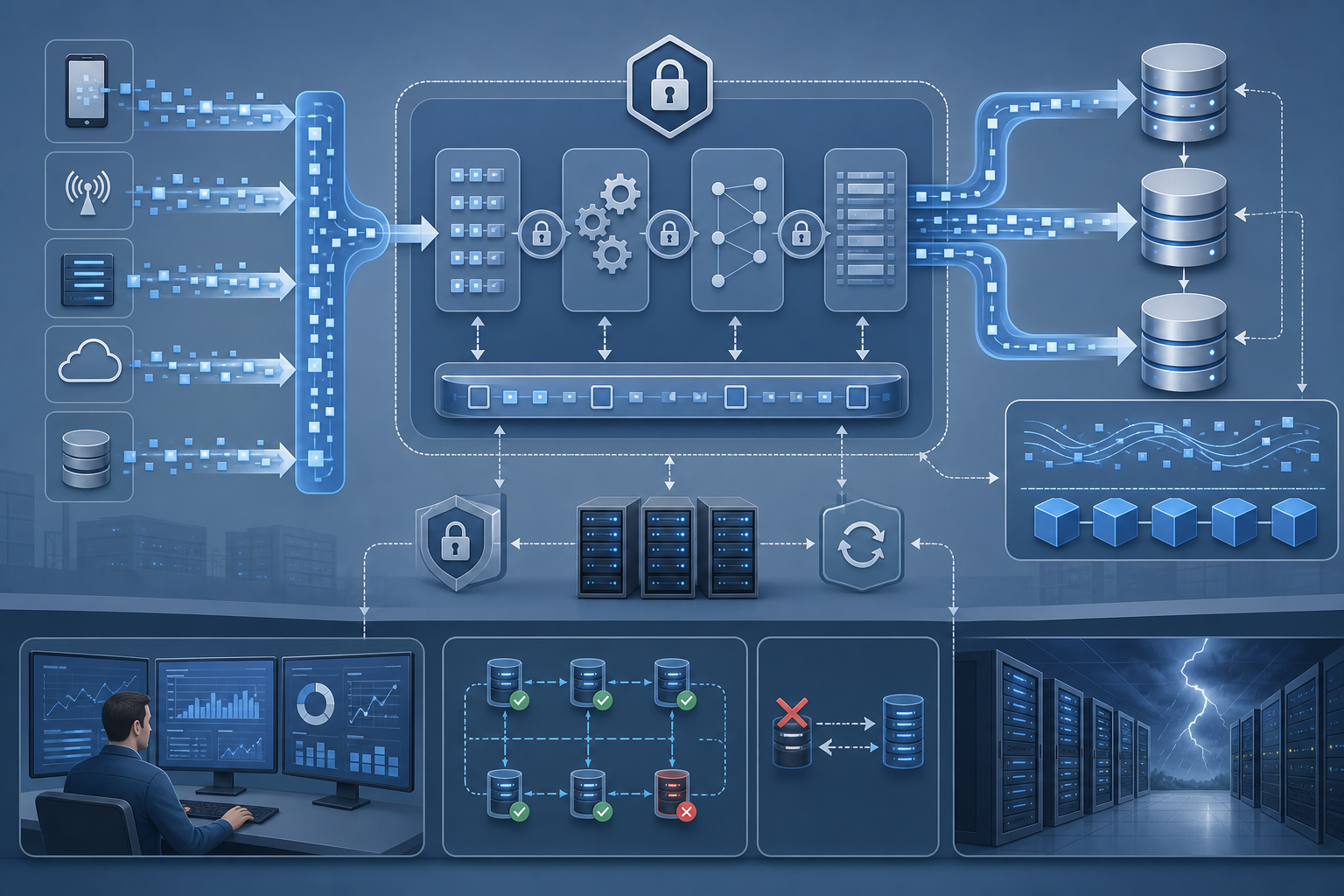
A secure ETL pipeline usually follows a compact flow like this:
Source system
  -> authenticated extraction with least-privilege identity
  -> encrypted transport
  -> controlled landing zone or in-memory transform
  -> early filtering, masking, or tokenization
  -> validation for schema, volume, freshness, and anomaly signals
  -> restricted publish path to curated storage
  -> audit logging and retention enforcement
This workflow is intentionally simple. The security value comes from limiting where raw sensitive data exists, ensuring every transformation is attributable, and validating the output before downstream systems consume it. It is not necessary for every ETL job to follow the exact same mechanics, but the control points should remain recognizable.
A realistic scenario
Consider a team that ingests customer support events, payment status updates, and operational logs into a lakehouse or distributed warehouse. The pipeline runs every 15 minutes, joins multiple sources, enriches records with account metadata, and publishes a curated dataset used by analytics and fraud detection.
The pipeline is already “working,” but the team notices three issues. First, the same service account can read raw source files, intermediate staging objects, and final output tables. Second, temporary files remain available longer than expected after retries. Third, schema changes in one source occasionally cause partial loads, which downstream jobs interpret as valid data.
This is exactly the kind of environment where secure ETL optimization matters. A more secure design would reduce the scope of the service identity, avoid writing raw data to shared staging unless required, mask or tokenize sensitive fields before broad fan-out, and validate row counts and schema compatibility before publishing. If runtime instability is also a concern, pairing these controls with optimizing Spark job performance with query tuning techniques helps ensure the pipeline remains both efficient and predictable.
The operational win is not just better security posture. It is fewer failed loads, less reprocessing, less exposure in temporary storage, and faster detection of upstream problems before they become data quality incidents.
Implementation choices and trade-offs
There is no single secure pattern that fits every big data ETL system. The right design depends on the sensitivity of the data, the architecture of the compute environment, and the cost of transforming records in place versus staging them.
Minimize raw data exposure
The strongest pattern is to limit raw data exposure to the smallest possible trust boundary. That may mean decrypting data only inside a hardened job container, using short-lived credentials, and transforming sensitive fields immediately after ingest.
The trade-off is operational complexity. Short-lived credentials, identity federation, and strict network controls are usually more difficult to operate than shared static credentials. But they reduce the risk that one compromised job or operator path exposes all source systems.
Mask, tokenize, or redact early
If downstream consumers do not need raw personal or payment data, transform those fields as early as possible. Early masking reduces the scope of downstream access reviews and lowers the chance that sensitive values appear in logs, retries, or cached outputs.
The trade-off is analytical flexibility. Early redaction can make debugging harder and can reduce the usefulness of some aggregates if the transformation is too aggressive. The rule of thumb is to preserve raw values only where there is a clearly justified operational need and a controlled path for access.
Use partitioning and selective reads to shrink blast radius
Data layout choices directly affect both performance and security. Partition-aligned queries reduce how much data a job touches, which is useful when only a subset of time windows, tenants, or regions need processing. Less data read means fewer records exposed during each run.
This is also where schema discipline matters. A partitioned dataset with unstable column definitions or inconsistent file naming can negate the benefit by forcing fallback scans or brittle exception handling. Security and performance both improve when data layout is predictable.
Control retries and intermediate storage
Retries are essential in distributed systems, but they can multiply exposure if they leave behind partial outputs or duplicate sensitive records. A secure pipeline should define what is safe to retry, what must be cleaned up on failure, and which intermediate objects are automatically expired.
The trade-off is stricter failure handling. Some pipelines will fail faster instead of recovering silently. That is usually desirable in security-sensitive processing because a visible failure is easier to contain than a partially correct load.
What this means in practice
In practical terms, secure ETL optimization is about choosing pipeline behaviors that are explicit, bounded, and measurable.
If a job can read only the partitions it needs, then verify that the query planner actually prunes the rest. If a job masks sensitive fields, verify that the masked fields do not appear in logs, debug outputs, cache layers, or error payloads. If a job uses a landing zone, verify retention, encryption, and access scope rather than assuming the bucket policy is enough.
It also means treating validation as part of security, not only data quality. Volume checks, freshness checks, and schema checks can reveal suspicious changes such as unexpected record drops, duplicate spikes, or unplanned field additions. These are often the first signs that an upstream source changed, an identity was misconfigured, or a malicious feed was introduced.
A useful operational standard is this: if a pipeline processes sensitive data, every place the data exists should have an owner, an access rule, and a retention rule. If you cannot name those three things for an intermediate artifact, the design is probably too loose.
Decision guidance: when to optimize and when to redesign
Not every pipeline needs the same level of hardening. Use the sensitivity of the data and the exposure pattern to decide how far to go.
Choose incremental optimization if the pipeline already has constrained access, encrypted transport, defined retention, and acceptable validation, but it is inefficient because it scans too much data, retries excessively, or writes unnecessary intermediates. In that case, the main opportunity is to reduce work without changing the trust model.
Choose a redesign if raw data is broadly accessible, temporary files persist without control, transformations happen in unsecured shared environments, or validation occurs only after downstream systems have already consumed the output. Those are structural problems. Tuning alone will not fix them.
A good rule is that performance tuning should never expand access. If an optimization requires wider permissions, longer-lived credentials, or more exposed staging, it needs strong justification and compensating controls.
Common mistakes that weaken secure ETL
One frequent mistake is assuming encryption alone solves the problem. Encryption in transit and at rest is necessary, but it does not protect against overprivileged identities, overly verbose logging, or intermediate plaintext in the wrong place.
Another mistake is using one broad service identity for multiple data domains. This makes auditing difficult and enlarges the blast radius of a compromise. Separate job identities by function or sensitivity tier where possible.
A third mistake is validating only after publish. If the pipeline writes malformed or incomplete data to curated storage first, downstream consumers may treat it as truth. Validation should happen before the final publish gate whenever possible.
A fourth mistake is ignoring operational artifacts. Temporary tables, spill files, debug logs, dead-letter queues, and error traces often contain more sensitive information than the final dataset. These locations need the same governance as the primary data path.
Production readiness checklist
Before you treat a secure ETL pipeline as production-ready, verify the following:
- Source access is limited to the minimum identity required for extraction.
- Transport and storage encryption are enabled and the required keys or secrets are managed under approved controls.
- Raw sensitive data is exposed only in the smallest practical trust boundary.
- Intermediate files, tables, and logs have explicit retention and access rules.
- Sensitive fields are masked, tokenized, or redacted before broad fan-out where appropriate.
- Partitioning, filtering, and join strategy reduce unnecessary reads and shuffles.
- Validation checks cover schema drift, record volume, freshness, and anomaly signals.
- Retries are bounded, observable, and safe with cleanup behavior defined.
- Audit logs show who accessed the data path, when, and for what purpose.
- Failure modes are documented, and rollback or replay behavior is known.
If any of these are unknown, the pipeline is not fully ready, even if it is currently passing jobs.
Final takeaway
Optimizing big data ETL pipelines for secure data processing is less about adding security features after the fact and more about designing the data path so sensitive information is exposed as little as possible. The best pipelines are not only fast and reliable; they are deliberately constrained, easy to validate, and difficult to misuse. If your current design makes data easier to move but harder to govern, it is worth rethinking before production scale turns small gaps into persistent risk.
Use this guidance together with model drift detection and ASP.NET Core Identity hardening to connect the workflow with related operational context already available on the site.