
Why this matters
A Node.js API can look healthy right up until a burst of traffic, a buggy client, or a scripted abuse pattern pushes it past safe limits. At that point the problem is no longer just latency; it becomes resource contention, noisy-neighbor behavior, and in some cases a denial of service against your own application tier or downstream dependencies. Node.js rate limiting with Redis addresses that operational gap by enforcing request budgets consistently across multiple processes and servers instead of only within a single runtime.
After reading this article, you should be able to decide when Redis-backed rate limiting is the right control, understand how it works in a distributed Node.js deployment, validate the behavior before production use, and spot the trade-offs that matter when protecting APIs from abuse.
Key takeaways
- Redis is useful for rate limiting when you need shared counters or tokens across multiple Node.js instances.
- The key design choice is not only the algorithm, but also the identity used for the limit: user, token, IP, tenant, or route combination.
- The limiter should fail in a deliberate way. You need a policy for Redis outages, key expiration, and what happens under partial failure.
- Rate limiting protects capacity, but it does not replace authentication, authorization, bot detection, or application-level input validation.
- Production readiness depends on observability: you should be able to confirm hit rate, rejection rate, and which keys are being throttled.
How Redis-backed rate limiting works in Node.js
The simplest local limiter keeps counters in memory. That approach is easy to implement, but it breaks down as soon as you run more than one Node.js process, add a load balancer, or autoscale pods. Each instance then sees only a slice of traffic, which means one client can exceed the intended limit by spreading requests across instances.
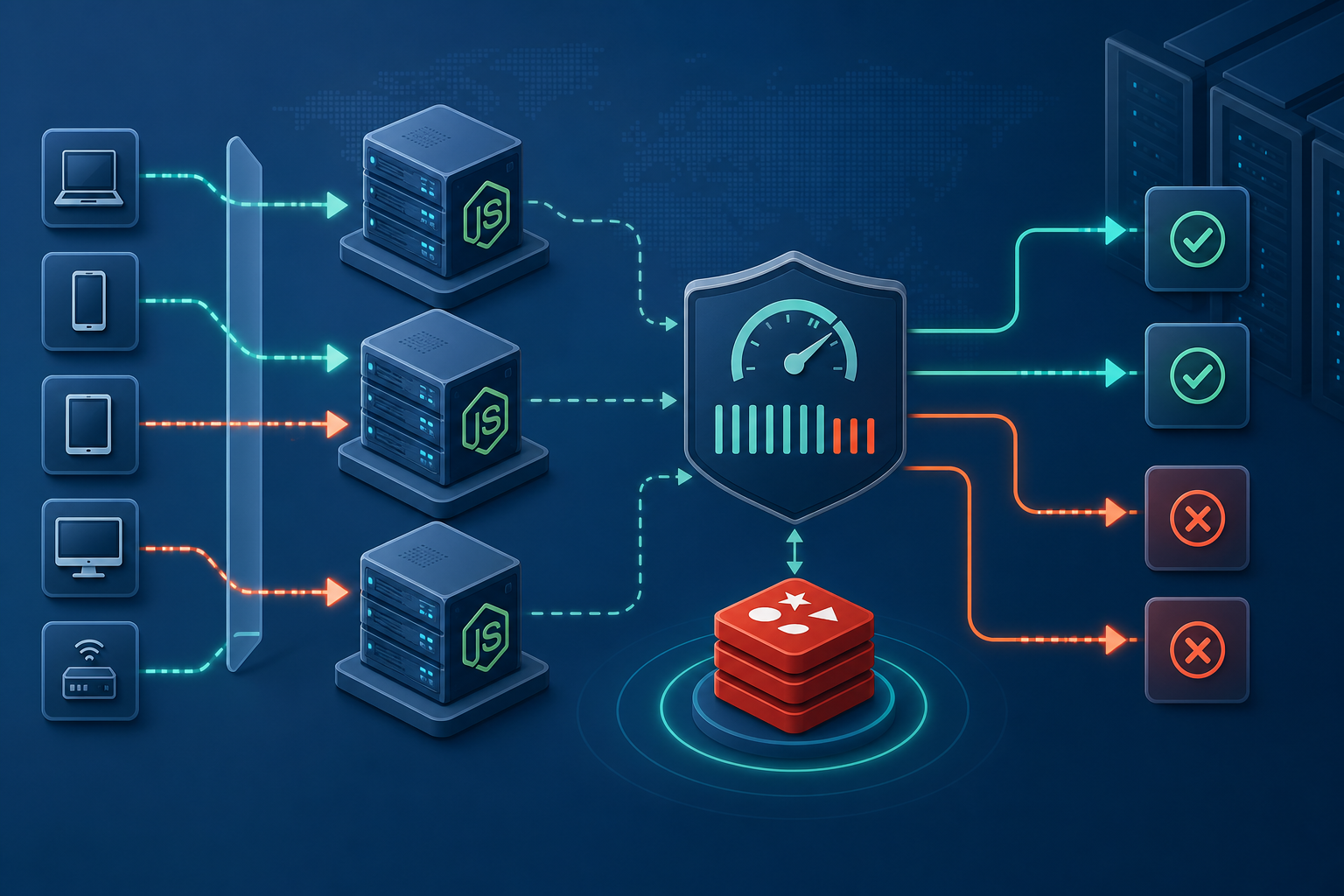
Redis solves that by acting as a shared state store. Each request maps to a key, such as rate:user:123 or rate:ip:203.0.113.10, and the application updates that key on every request. Depending on the algorithm, the application may use one of these common patterns:
- Fixed window: count requests within a time window such as one minute.
- Sliding window: approximate or exact counts across a moving time range.
- Token bucket: refill a token pool over time and allow bursts up to the bucket size.
- Leaky bucket: smooth requests into a steady processing rate.
For API protection, token bucket and sliding window patterns are often better operational fits than a naïve fixed window because they reduce burst edge cases. That said, the right choice depends on how strict the API is, whether short bursts are acceptable, and how much state and computation you want to maintain in Redis.
The important point is that the limiter must make its decision atomically. If two requests race to update the same counter independently, the limit can be exceeded. In practice, that usually means using Redis primitives carefully or encapsulating the logic in a Lua script so the increment, expiration, and decision happen as a single operation.
If you are setting up a new Node.js runtime alongside this control, make sure the basic environment is verified first; How to Get Started with Node.js is a useful baseline for runtime checks before you add production controls.
Compact workflow block
Request arrives
  -> identify the client scope (IP, token, user, tenant, or route)
  -> look up the Redis key for that scope
  -> update counter or token state atomically
  -> decide allow or deny
  -> attach rate-limit headers if your API contract supports them
  -> log the decision for monitoring and incident response
This workflow is compact, but it captures the operational sequence that matters. The identity scope must be stable enough to prevent easy evasion, the Redis update must be atomic, and the decision must be visible to operators through logs or metrics.
A practical scenario you may recognize
Consider a SaaS API deployed on three Node.js containers behind a load balancer. Each container handles the same login and data-export endpoints. One customer has a misconfigured integration that retries failed requests in a tight loop. Without shared rate limiting, each container enforces its own local threshold, so the customer can effectively triple the allowed request volume and cause pressure on the database.
With Redis-backed rate limiting, all three containers consult the same request state. The repeated requests are counted against the same identity, so the system starts rejecting traffic before the database is overwhelmed. In that situation, the limiter is not just a security control; it is a resilience control that protects the rest of the platform from one broken client.
This scenario is also where identity choice matters. If you rate limit only by IP, a NAT gateway or corporate proxy may penalize multiple legitimate users together. If you rate limit only by user ID, unauthenticated abuse may still be expensive. A common production pattern is to combine dimensions, such as IP before authentication and user or token after authentication, while keeping route-specific limits for expensive endpoints like exports or search.
What this means in practice
In practice, Node.js rate limiting with Redis is less about “blocking too much traffic” and more about defining a request budget that matches how your service fails. For a read-heavy API, you may want to allow short bursts but cap sustained volume. For a write path or expensive export endpoint, you may want a stricter limit because each request consumes more downstream capacity.
A practical implementation usually has three layers of policy:
- Global guardrails to stop obvious abuse across the application.
- Route-level controls for expensive or sensitive endpoints.
- Identity-aware controls that apply stricter limits after authentication and looser limits for anonymous traffic if needed.
The headers and response body you return on a rejection should also be intentional. Many teams send a 429 Too Many Requests response with a retry hint. If you expose rate-limit headers, keep them consistent and documented so clients can react programmatically. This matters in operational environments because client behavior often determines whether throttling reduces load or merely shifts the problem into retry storms.
If your organization already uses a different stack for API protection, such as middleware in another runtime, compare the policy model rather than the syntax. For example, the design considerations in ASP.NET Core Rate Limiting Middleware for API Protection can help teams align on identity, fairness, and rejection behavior even when the implementation language differs.
Implementation trade-offs to evaluate
Redis-backed rate limiting is effective, but it is not free.
The first trade-off is state dependency. A distributed limiter gives you consistency across instances, but Redis becomes part of the request path. That means latency, availability, and data durability of Redis now influence your API’s control plane. You need to decide whether a Redis failure should allow requests through, deny them, or switch to a fallback mode. The safest choice depends on the endpoint. For highly sensitive actions, fail-closed may be appropriate; for public read traffic, fail-open may preserve availability.
The second trade-off is algorithm complexity versus fairness. A fixed window is simple and inexpensive, but it can allow boundary bursts. A sliding window or token bucket is fairer, but it usually costs more in data structure complexity and implementation care. If your abuse pattern is mostly sustained hammering, a simple limiter may be enough. If you need to prevent burst exploitation, choose a more precise algorithm.
The third trade-off is key design. Broad keys, such as IP-only, reduce Redis cardinality and are easier to operate. Narrow keys, such as user plus route plus token, produce better fairness but can increase memory use and operational complexity. The best choice is often endpoint-specific rather than global.
The fourth trade-off is user experience. Aggressive limits can protect infrastructure but frustrate legitimate automation and power users. If you expect API consumers to batch requests or run parallel jobs, define the contract clearly and tune the thresholds to your service level objective rather than an arbitrary number.
Decision guidance
Use Redis-backed rate limiting when any of the following are true:
- your Node.js API runs on multiple instances and must enforce a shared budget;
- you need limits that survive process restarts and are visible across the fleet;
- you want to protect expensive endpoints from retries, scraping, or accidental loops;
- you need operational observability into who is being throttled and why.
It may not be the best fit if your deployment is a single Node.js process with simple traffic, if the API is low value and low risk, or if you cannot afford Redis in the request path and do not have a safe fallback policy. In those cases, simpler controls may be enough until the service scales or the abuse pattern changes.
A good rule is to select the narrowest control that still works across your deployment model. If local memory counters are accurate enough for your topology, keep them simple. If they are not, Redis is the right step up.
Common mistakes
One common mistake is rate limiting only by IP in environments where many clients share a proxy, gateway, or mobile carrier address. That can throttle legitimate traffic at scale and hide the real source of abuse.
Another mistake is relying on Redis without setting a clear expiration policy. Stale keys can accumulate, and counters that do not expire correctly can lock out clients longer than intended.
A third mistake is treating 429 as the whole solution. If clients retry immediately without jitter, a throttled endpoint can still stay hot. The server, client library, and API contract should all support reasonable backoff behavior.
A fourth mistake is failing open or closed by accident. You should decide the failure mode explicitly and document it, especially for security-sensitive endpoints. Many incidents come from an assumption that the limiter is protecting something when in reality a Redis outage has quietly disabled it.
A fifth mistake is omitting metrics. Without a way to measure allowed versus rejected requests, key cardinality, and top throttled identities, you cannot tell whether the limiter is helping or simply creating a new operational bottleneck.
Production readiness checklist
Before putting a Redis-backed limiter into production, verify the following:
- The limiting identity is defined for each protected route.
- The algorithm matches the required fairness and burst behavior.
- Redis operations used by the limiter are atomic.
- Key expiration is correct and tested.
- The failure mode for Redis outages is documented and intentional.
429behavior and retry guidance are clear to API consumers.- Metrics and logs expose allowed, rejected, and error outcomes.
- Limits are reviewed per route, not copied blindly across the API.
- The limiter is tested under concurrent load across multiple Node.js instances.
- The policy is aligned with authentication, authorization, and downstream capacity limits.
Validation before production use
Validation should focus on observable behavior, not just code paths. Start by confirming that a single client can hit the limit when traffic is routed across multiple Node.js instances. Then test boundary conditions: what happens exactly at the threshold, how long until the budget resets or refills, and whether concurrent requests can slip through during a race.
You should also simulate Redis latency and temporary unavailability. The goal is to confirm that the limiter behaves according to the chosen failure policy and that the rest of the API remains stable. If the service is security-sensitive, validate that the limiter is not bypassed by changes in request path, hostname, proxy headers, or authentication state.
For teams that also maintain reporting or audit-style operational output, the discipline is similar to structured validation in Node Reporting Template FAQ: How to Structure Reliable Operational Reports; the exact artifact differs, but the operational question is the same: can you trust the result under real conditions?
Final takeaway
Node.js rate limiting with Redis is a practical control when you need one consistent policy across multiple application instances and want to protect APIs from abuse, bursts, and accidental overload. The implementation details matter, but the real production question is simpler: does the limiter enforce the right identity, fail the right way, and provide enough evidence for you to trust it during an incident? If the answer is yes, Redis-backed rate limiting is a strong fit for API protection.
Use this guidance together with Apache Spark memory tuning and parse JSON logs with Pandas and regex to connect the workflow with related operational context already available on the site.