Purpose
Unsafe branching decisions usually fail at merge time, release time, or during incident recovery. The operational risk is not just a messy history; it is shipping unreviewed changes, losing traceability, blocking hotfixes, or creating release branches that cannot be reproduced. This checklist helps you verify a Git branching workflow before production use so you can decide whether the approach fits your team, apply it consistently, and validate the controls that make merges and releases safer.
How to use this checklist
Run the checklist in order, from branch policy to release verification. For each phase, capture evidence, assign an owner, and mark items as pass only when the output is observable in the repository, CI system, or release record. If an item fails, treat it as a workflow gap, not a tooling annoyance.
Use this checklist during branch policy reviews, release readiness reviews, or after an incident caused by merge ambiguity. If your team is still deciding between rebasing and merging, review Git Rebase vs Merge: Choosing the Right Workflow before standardising your branch rules.
Phase 1: Define the branching model
Purpose
Confirm that the branching model matches your change rate, deployment cadence, and traceability requirements. A workflow that works for a small repository may fail under multiple release trains, parallel hotfixes, or regulated audit needs.
Checklist items
- Confirm the primary branch names and allowed purposes, including
main,release/*, andhotfix/*if used. - Review whether short-lived feature branches are required for every change or whether direct commits are permitted under controlled conditions.
- Validate that the repository has a documented rule for when to merge, rebase, or fast-forward.
- Document which branch types are protected and which roles can bypass protection.
- Assign ownership for branch policy decisions, approval rules, and emergency overrides.
- Test that the chosen model supports a clean rollback path for production releases.
Evidence to capture
Branch policy document, repository settings export, access control summary, and an example branch topology from a recent release.
Acceptance criteria
The repository has one clearly defined integration path for normal work, one documented release path, and a written exception process for emergencies.
Owner
Engineering lead or repository maintainer.
Review cadence
Review quarterly and after any failed release, hotfix, or major change to the delivery model.
Common mistakes
Teams often allow multiple branching patterns in the same repository, which makes merge history hard to interpret. Another common failure is leaving the emergency override process undocumented, so a one-off fix becomes an unrepeatable precedent.
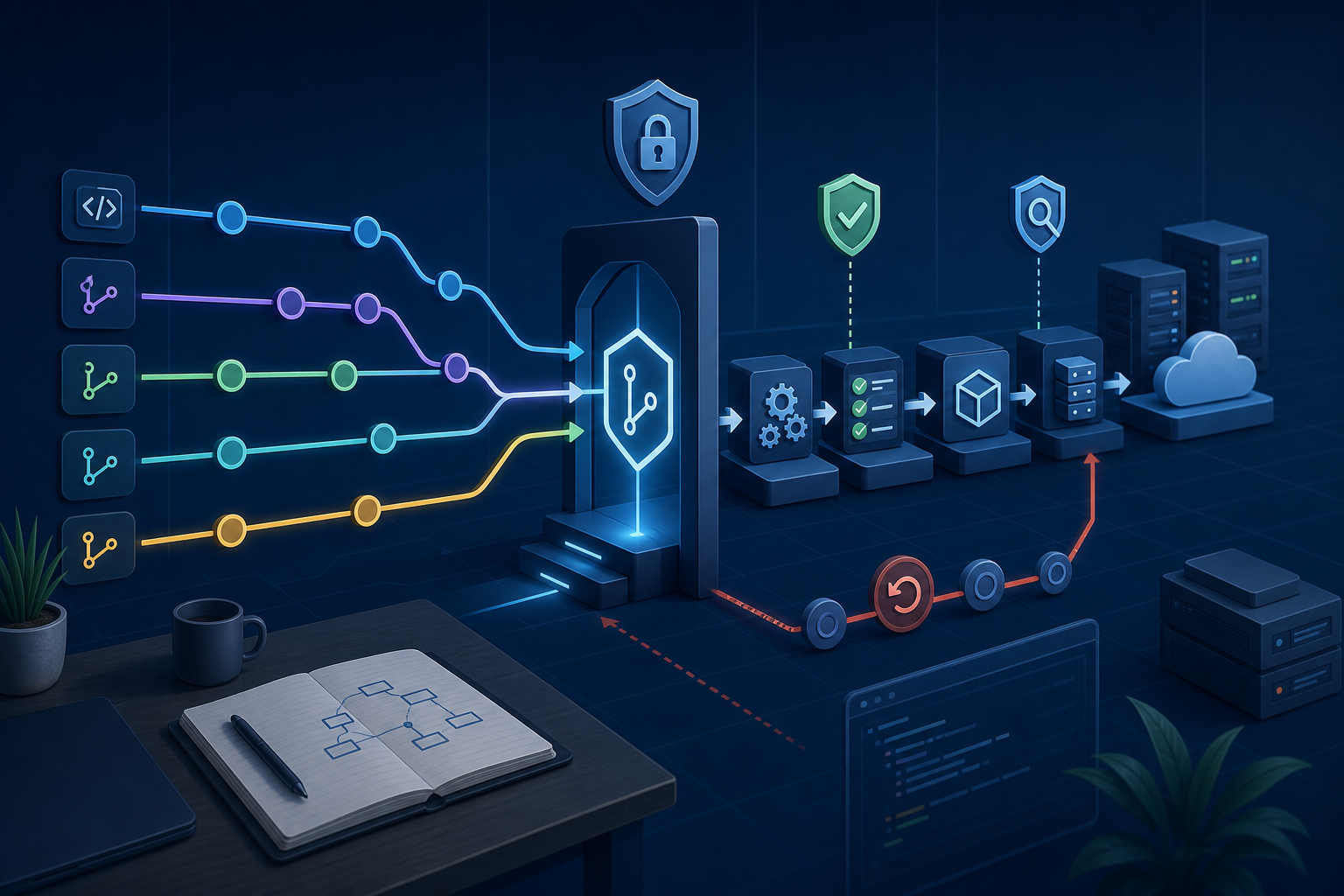
Phase 2: Verify branch protection and access control
Purpose
Confirm that repository controls prevent accidental direct changes to critical branches and require the review evidence you expect before merge.
Checklist items
- Validate that protected branches reject direct pushes from non-authorised users.
- Confirm that pull request or merge request approvals are required before protected branch updates.
- Review whether status checks must pass before merge is allowed.
- Document whether force-push is disabled on shared branches or limited to a narrow admin group.
- Assign a reviewer quorum for high-risk changes, including security-sensitive and infrastructure changes.
- Test that branch protection fails closed when required checks are unavailable.
Evidence to capture
Branch protection settings, access review results, approval rule configuration, and a failed test merge that demonstrates protection is active.
Acceptance criteria
Protected branches cannot be updated outside the approved path, and required checks stop merges when validation is missing or broken.
Owner
Repository admin, platform engineer, or DevOps lead.
Review cadence
Review monthly for high-change repositories and after any permission change.
Pass/fail rule
Pass only if an unauthorised user cannot push or merge into a protected branch and the repository records the blocked action. Fail if a privileged bypass exists without an explicit exception record.
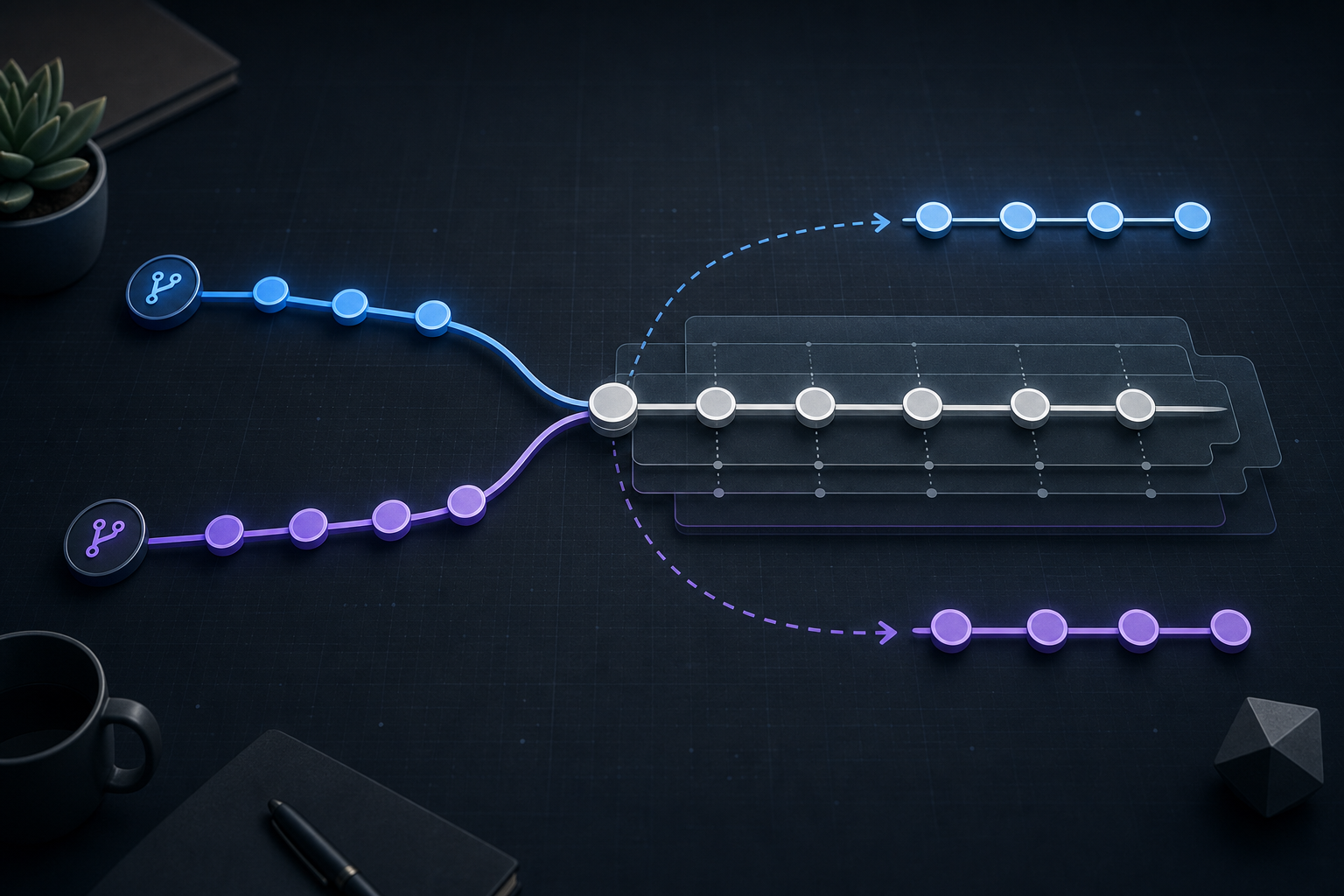
Phase 3: Standardise merge and rebase rules
Purpose
Confirm that the team uses one predictable integration pattern so history remains readable and conflict handling is deliberate. If you choose rebase for local cleanup, make sure the team understands when to avoid rebasing shared history and how to recover from interrupted operations. For conflict handling specifics, see Git Rebase Conflicts: Resolve and Continue Safely.
Checklist items
- Confirm whether merge commits are preserved for feature integration or flattened for linear history.
- Review whether rebase is allowed only on private branches before sharing.
- Validate that contributors know when to use
git merge,git rebase, orgit pull --rebase. - Document the conflict-resolution rule for shared branches, including who may resolve conflicts in release branches.
- Assign one workflow for normal integration and one exception path for emergency fixes.
- Test that the repository history remains understandable after a typical feature merge and after a release merge.
Evidence to capture
Workflow guide, example commit history, and a sample merge review showing the chosen pattern in use.
Acceptance criteria
The team can explain and reproduce the chosen integration method without improvising during a release.
Owner
Team lead or senior engineer responsible for Git standards.
Review cadence
Review after workflow changes, onboarding cycles, and conflict-heavy releases.
Common mistakes
A frequent mistake is allowing developers to rebase branches that others already pulled. Another is using merge commits inconsistently, which makes audit trails difficult to follow and complicates release archaeology.
Phase 4: Validate feature branch hygiene
Purpose
Confirm that work branches are small, traceable, and easy to review. Branches that live too long or mix unrelated changes increase merge risk and make release forecasting unreliable.
Checklist items
- Confirm that each feature branch maps to a single change request, ticket, or incident item.
- Review whether branch names encode enough context to identify the change quickly.
- Validate that long-lived branches are refreshed from the integration branch on a defined schedule.
- Document the maximum expected branch lifetime for normal work.
- Assign an owner to close stale branches and remove abandoned work.
- Test that a branch can be reviewed without unrelated commits or debug-only changes.
Evidence to capture
Branch naming convention, stale-branch report, and a sample pull request showing scope discipline.
Acceptance criteria
Branches are short-lived, reviewable, and tied to a clear business or operational change.
Owner
Feature owner or implementing engineer.
Review cadence
Review weekly for active teams and after each release cycle.
Pass/fail rule
Pass if the branch can be traced to one work item and the review diff is focused. Fail if unrelated refactors, temporary fixes, or unrelated dependency updates are bundled together.
Phase 5: Verify CI, test, and policy gates
Purpose
Confirm that merge eligibility depends on objective validation, not manual memory. Branching is safer only when automated checks catch regressions before integration.
Checklist items
- Validate that the required test suite runs on the branch type that will be merged.
- Confirm that unit, integration, lint, and security checks are required where they are relevant.
- Review whether CI results are immutable enough to prevent stale or reused green states.
- Document what happens when a required check is skipped, cancelled, or times out.
- Assign ownership for flaky checks and release-blocking pipeline failures.
- Test that a deliberately broken change cannot be merged while required checks are failing.
Evidence to capture
CI pipeline logs, required-check configuration, a failed test merge, and the remediation record for any flaky job.
Acceptance criteria
A change cannot reach the protected branch without passing the required checks that your policy defines.
Owner
Build engineer, DevOps engineer, or CI maintainer.
Review cadence
Review every release train and after any failed gate or recurring flaky test.
Common mistakes
Teams sometimes treat CI as advisory rather than mandatory. Another mistake is requiring too many unstable checks, which encourages bypasses; if this happens, reduce the required set to controls that are reliable and meaningful.
Phase 6: Check release branch and tagging discipline
Purpose
Confirm that release branches, tags, and version markers provide a reproducible record of what was shipped. This phase matters when you need to reproduce a build, triage a production issue, or branch a hotfix from a known-good state.
Checklist items
- Confirm that release branches are created from a known integration point and not from an unreviewed working branch.
- Validate that release tags are unique, immutable, and created from the exact commit that was deployed.
- Review whether version numbers or release identifiers are assigned before deployment approval.
- Document who can create release tags and who can move them, if movement is allowed at all.
- Assign a release manager for naming, tagging, and branch cut decisions.
- Test that you can reproduce the release artifact from the tagged commit and pipeline definition.
Evidence to capture
Release branch log, tag list, deployment record, and artifact traceability evidence.
Acceptance criteria
Every production release can be traced back to one immutable commit and one approved pipeline execution.
Owner
Release manager or delivery lead.
Review cadence
Review every release and after any incident requiring build reproduction.
Pass/fail rule
Pass only if the deployed version maps to a stable branch or tag and the same source state can be rebuilt. Fail if tags are mutable, ambiguous, or created after deployment without traceability.
Phase 7: Validate hotfix and rollback readiness
Purpose
Confirm that emergency changes can be isolated, reviewed, and merged back without losing provenance. Hotfix branches are useful only if they are controlled and reintegrated correctly.
Checklist items
- Confirm that hotfix branches are cut from the deployed release or production baseline.
- Review whether hotfix approvals are stricter than normal feature merges.
- Validate that the hotfix path includes a back-merge or forward-merge into the main integration branch.
- Document the rollback procedure for a bad release, including the branch or tag used for reversal.
- Assign an incident owner for emergency merge decisions and post-fix reconciliation.
- Test that a hotfix can be applied and traced without bypassing audit requirements.
Evidence to capture
Hotfix branch history, emergency approval record, rollback script or procedure, and post-merge reconciliation log.
Acceptance criteria
You can ship a critical fix quickly and still preserve the history needed to prevent the same fix from being lost in future merges.
Owner
Incident commander, release manager, or senior on-call engineer.
Review cadence
Review after every hotfix exercise, production incident, and major release.
Common mistakes
A typical mistake is merging the hotfix into production but forgetting to bring it back into the main line. Another is using the hotfix path as a shortcut for normal work, which weakens controls exactly when they matter most.
Phase 8: Confirm collaboration, review, and audit evidence
Purpose
Confirm that the workflow leaves enough evidence for peer review, operational debugging, and audit without exposing unnecessary risk.
Checklist items
- Validate that merge requests record reviewers, approvals, and linked work items.
- Review whether commit messages are specific enough to explain why the change exists.
- Document whether signed commits, protected tags, or equivalent integrity controls are required.
- Assign responsibility for retaining merge records and release approvals.
- Test that you can reconstruct who approved, who merged, and what checks passed for a shipped change.
- Confirm that audit evidence is retained for the required retention period.
Evidence to capture
Merge request history, approval records, commit log samples, and retention policy reference.
Acceptance criteria
A production change has a complete lineage from work item to reviewed merge to deployed version.
Owner
Security, compliance, or engineering operations.
Review cadence
Review semi-annually or according to audit and retention requirements.
Pass/fail rule
Pass if the repository and delivery records can answer who changed what, who approved it, and what was deployed. Fail if the trail depends on informal chat history or local developer memory.
Readiness scoring
Use this simple score to judge whether your branching workflow is ready for safer merge and release operations.
- 0 points: not defined or not enforced
- 1 point: defined in documentation only
- 2 points: enforced in tooling or process, with evidence
- 3 points: enforced and regularly reviewed with measurable exceptions
Score each phase from 0 to 3, then total the result.
Interpreting the score
- 18 to 24: Ready for controlled production use
- 12 to 17: Partially ready; fix weak phases before broad rollout
- 0 to 11: Not ready; the workflow is too dependent on informal discipline
If your score is low in branch protection, CI gating, or rollback readiness, treat that as a production risk even if the branching model looks simple on paper.
Practical follow-up actions based on review results
If one or more phases fail, make the smallest change that closes the risk:
- Tighten branch protection when unreviewed commits can reach critical branches.
- Reduce allowed branch patterns when the history is confusing or inconsistent.
- Simplify required checks when flakiness is encouraging bypasses.
- Shorten branch lifetime when merges are becoming unpredictable.
- Add immutable tags and release records when you cannot reproduce shipped artifacts.
- Rehearse hotfix and rollback procedures when emergency changes are the main source of uncertainty.
Final takeaway
A safer Git branching workflow is not defined by branch names alone; it is proven by protected merges, reproducible releases, clear rollback paths, and evidence that the team can repeat the process under pressure. If each phase in this checklist passes, you have enough control to trust the workflow in production and enough documentation to keep it stable as the repository grows.
Use this guidance together with SQL Server vulnerability assessment and branch and bound algorithm to connect the workflow with related operational context already available on the site.
Part of the Programming: Git Insights content cluster.