Purpose
The practical problem is not whether your team can build a model; it is whether the learning process is producing evidence you can trust before anything reaches production. AI and machine learning work often fails operationally when data quality is unclear, evaluation is inconsistent, ownership is vague, or deployment assumptions are never verified. If you are running experiments, reviews, or pre-production gates, this checklist helps you decide whether the work is ready, what evidence to collect, and what still needs to be fixed.
Use this checklist to confirm whether the approach applies, validate the learning workflow, and verify production-readiness signals before release. It is written for technical teams that need a repeatable review method, not just a training plan. For a broader operational view of how code, data, and models fit together, see What Is Programming in AI and Machine Learning? Operational Insights for Technical Teams.
How to use this checklist
Work through the phases in order. For each item, capture objective evidence, assign an owner, and record the acceptance decision. If a check fails, do not “average out” the result with stronger areas; fix the failing item or explicitly document the risk and decision rationale.
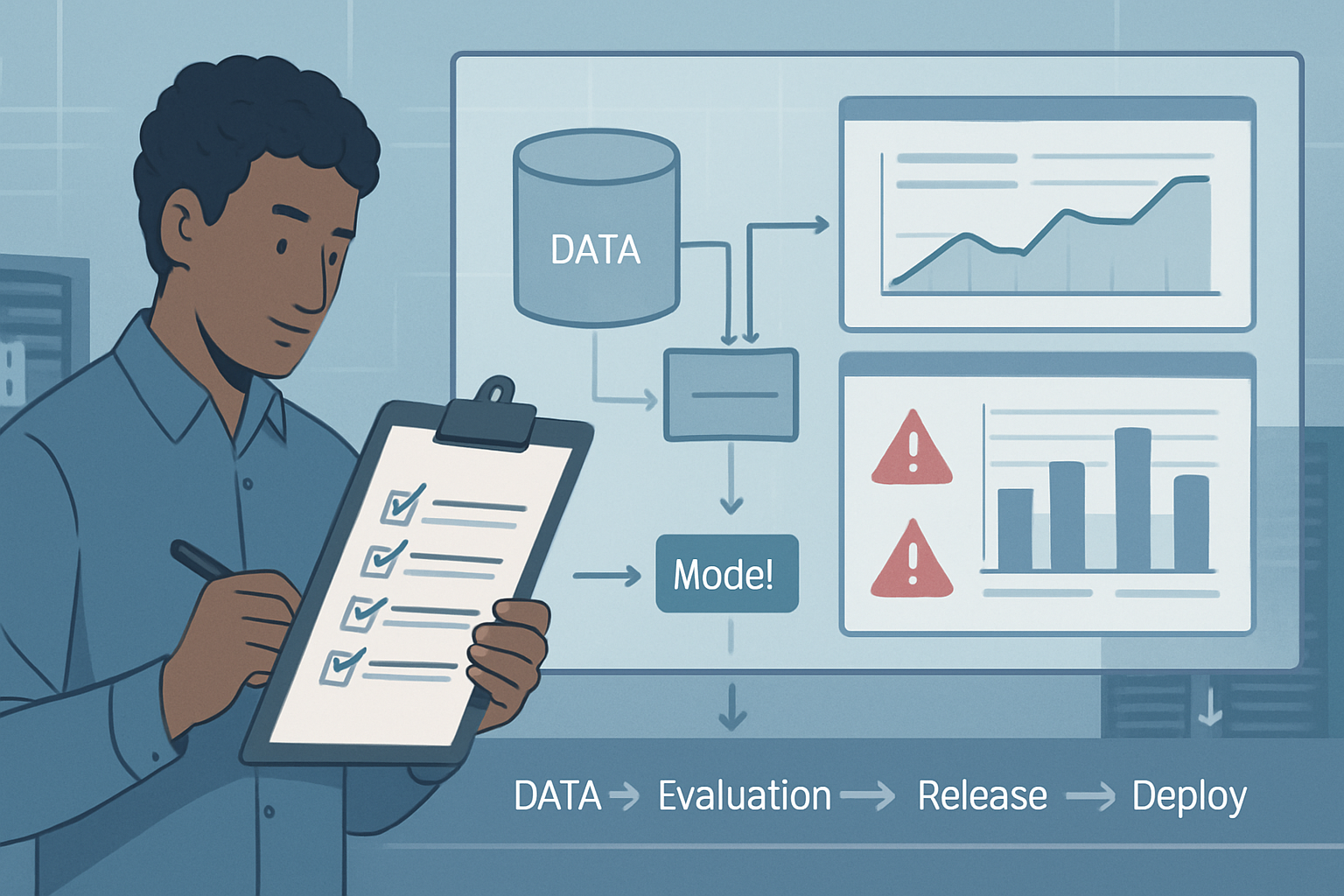
A practical review should produce three things: a documented readiness score, a list of verified gaps, and a go/no-go decision with named owners. If your organization uses formal operational gates, you can adapt this checklist into a review board packet or pre-merge validation checklist.
1. Scope and learning objective
Purpose
Confirm that the learning problem is well defined, operationally relevant, and narrow enough to validate without hidden assumptions. If the objective is vague, later evaluation will be meaningless even if the model looks accurate.
Checklist items
- Confirm the target outcome is stated in measurable terms, such as classification, ranking, forecasting, or anomaly detection.
- Review the business or operational decision the model will influence and document what action changes when the prediction changes.
- Validate that the target label, ground truth source, or proxy metric is available and stable enough for review.
- Document the assumed environment, including data sources, latency constraints, and any known edge cases.
- Assign a single accountable owner for the learning objective and acceptance decision.
Evidence to capture
Record the problem statement, success metric, data source list, and decision owner in a review note or ticket. Include examples of positive and negative cases if they help clarify the boundary.
Acceptance criteria
The objective is specific, measurable, and bounded. The owner can explain the expected production decision in one sentence, and there is a clear way to tell whether the learning outcome is usable.
Owner
Product owner, ML lead, or system engineer responsible for the use case.
Review cadence
At project start and whenever scope changes.
Common mistakes
Teams often start with a dataset instead of a problem, which leads to a model that is technically valid but operationally irrelevant. Another common failure is using a metric that does not map to the real decision.
2. Data readiness and representativeness
Purpose
Verify that the data used for learning reflects the conditions the model will face in production. Many AI and machine learning projects fail because the training set is clean but unrealistic, or because the label distribution does not match the deployment population.
Checklist items
- Confirm the training, validation, and test splits are defined and protected from leakage.
- Review whether the dataset is representative of the intended production population, time window, and usage patterns.
- Validate that missing values, duplicates, outliers, and schema drift are measured, not assumed.
- Document all feature sources, transformation steps, and any manual filtering applied before training.
- Test whether the same input record could appear in more than one split, especially for time series, user-level, or asset-level data.
- Assign data ownership for each source, including update frequency and quality expectations.
Evidence to capture
Keep a data profile summary with counts, distributions, null rates, duplicate rates, and split methodology. Capture lineage for transformations and any exclusions.
Acceptance criteria
There is no confirmed leakage, the split strategy matches the problem type, and the dataset is sufficiently representative for the intended decision domain. Data quality issues are either within agreed tolerance or explicitly accepted.
Owner
Data engineer, ML engineer, or analytics owner.
Review cadence
Per dataset version, and again before retraining or major feature changes.
Common mistakes
A common mistake is random splitting when the problem requires time-based separation. Another is ignoring class imbalance until evaluation, when it is too late to know whether the model is learning the right signal.
3. Baseline and benchmark definition
Purpose
Establish a meaningful comparison so you can tell whether the learning work is improving on a simple alternative. Without a baseline, a complex model may look impressive while adding no operational value.
Checklist items
- Confirm a simple baseline exists, such as a rule-based method, historical average, majority class, or prior model.
- Review the baseline against the same data split and evaluation criteria used for the candidate model.
- Validate that the chosen benchmark reflects business cost, not just statistical convenience.
- Document the threshold for “good enough” performance, including minimum improvement or acceptable error bands.
- Assign a reviewer to sign off on whether the benchmark is fair and reproducible.
Evidence to capture
Store baseline results, evaluation scripts, and metric definitions in the same review package as the candidate model.
Acceptance criteria
The candidate model is compared against a reproducible baseline using the same test conditions. The improvement is large enough to justify operational complexity, monitoring, and maintenance.
Owner
ML lead or technical reviewer.
Review cadence
At each major experiment cycle and before model selection.
Common mistakes
Teams sometimes compare a tuned model against a weak or poorly documented baseline. That creates false confidence and makes later production failure more likely.
4. Evaluation design and validation integrity
Purpose
Verify that evaluation results are trustworthy and not the product of leakage, overfitting, or metric selection bias. This phase answers whether the learning results would survive an independent review.
Checklist items
- Confirm the evaluation metric matches the intended operational tradeoff, such as precision, recall, calibration, latency, or cost-weighted error.
- Review whether cross-validation, temporal validation, or holdout testing is appropriate for the problem structure.
- Validate that hyperparameter tuning did not use the final test set.
- Test that results are stable across multiple runs, folds, or time windows where randomness is expected.
- Document confidence intervals, error slices, or subgroup results where they materially affect the decision.
- Assign a reviewer to verify that no evaluation shortcuts were used.
Evidence to capture
Save evaluation code, random seeds or run identifiers, metric tables, and subgroup breakdowns. Include notes on any failed experiments if they influenced the final choice.
Acceptance criteria
The evaluation method matches the problem type, the final test remains untouched until the end, and the result is stable enough to support a production decision.
Owner
ML engineer or validation reviewer.
Review cadence
Per experiment cycle and before release approval.
Common mistakes
A frequent error is optimizing for a single headline metric while ignoring false positives, false negatives, or calibration. Another is reporting only the best run without showing variance.
5. Operational constraints and integration fit
Purpose
Confirm that the model can function within real system constraints and will not create hidden operational debt. This includes latency, throughput, deployment shape, dependency management, and failure behavior.
Checklist items
- Confirm the intended serving mode is defined, such as batch, online, near-real-time, or embedded in a workflow.
- Review latency, throughput, memory, and compute assumptions against the target environment.
- Validate that all runtime dependencies, feature generation steps, and model artifacts are versioned.
- Document how inputs, outputs, and fallback behavior integrate with upstream and downstream systems.
- Test the inference path with representative payloads, including malformed or missing fields.
- Assign an operations owner for runtime support and incident escalation.
Evidence to capture
Capture architecture notes, interface contracts, dependency versions, and inference test results. Include expected resource usage and rollback assumptions.
Acceptance criteria
The model can run in the intended environment without unresolved dependency or performance gaps, and failure behavior is defined before release.
Owner
Platform engineer, ML engineer, or application owner.
Review cadence
At design review, before deployment, and after significant runtime changes.
Common mistakes
A model can pass offline tests and still fail operationally because feature generation is too slow, payload formats drift, or fallback behavior was never designed.
6. Security, privacy, and governance checks
Purpose
Ensure the learning workflow does not expose sensitive data, violate policy, or create unmanaged risk. For technical teams, this is not a paperwork exercise; it is part of making the system safe to operate.
Checklist items
- Confirm data handling rules cover access control, retention, masking, and permissible use.
- Review whether any training data includes sensitive, regulated, or restricted fields.
- Validate that secrets, credentials, and private endpoints are excluded from datasets, logs, and model artifacts.
- Document approval requirements for data use, third-party components, and export or residency constraints.
- Test that audit logging records the minimum required operational events without exposing unnecessary payload content.
- Assign a security or privacy reviewer for sign-off where required.
Evidence to capture
Retain access reviews, policy references, masking rules, and approval records. Record any data exclusions or mitigation steps.
Acceptance criteria
There is a documented policy basis for the data and model workflow, restricted information is handled correctly, and required approvals are complete.
Owner
Security, privacy, or governance lead.
Review cadence
Per dataset, per model release, and after policy changes.
Common mistakes
Teams often assume that because data is “internal,” it is automatically safe to use. They also forget that logs, artifacts, and troubleshooting outputs can leak sensitive content even when the training set was sanitized.
7. Deployment readiness and rollback safety
Purpose
Verify that the model can be released safely and reversed quickly if it behaves unexpectedly. If you cannot explain how to stop it, isolate it, or revert it, the release is not ready.
Checklist items
- Confirm the deployment method is defined, including canary, shadow, blue/green, or direct cutover.
- Review rollback steps and verify that the previous version, ruleset, or feature flag path is still available.
- Validate health checks, monitoring signals, and alert thresholds before production use.
- Document the approval gate, release window, and rollback owner.
- Test the deployment pipeline in a non-production environment using the same artifact format and configuration shape.
- Assign an on-call owner for the launch window and first observation period.
Evidence to capture
Store deployment manifests, rollback instructions, health check definitions, and sign-off records.
Acceptance criteria
Deployment is repeatable, rollback is proven, and monitoring can detect material failure conditions within the agreed response window.
Owner
DevOps engineer, platform engineer, or release manager.
Review cadence
Before each release and after infrastructure or pipeline changes.
Common mistakes
A common mistake is treating a successful training run as deployment readiness. Training success does not prove safe rollout, observability, or rollback reliability.
8. Readiness scoring and decision rule
Purpose
Convert the checklist into a simple operational decision so reviewers can act consistently.
Scoring method
Score each phase as follows:
- 2 points = all checks passed with evidence
- 1 point = partially complete or minor documented gap with compensating control
- 0 points = failed or unverified
Maximum score: 16 points across the eight phases.
Decision rule
- 14–16 points: Ready for production review, assuming no critical security or compliance exceptions.
- 10–13 points: Conditionally ready; proceed only with documented mitigations and named owners.
- 0–9 points: Not ready; fix the failed phases before any release decision.
Pass/fail override
A single failure in security, privacy, rollback safety, or evaluation integrity should normally block release, even if the total score is high. Use the score to support the decision, not replace it.
9. Review packet and evidence checklist
Purpose
Keep the review auditable and reproducible so another engineer can verify the decision later.
Checklist items
- Document the problem statement, data split logic, evaluation method, and baseline comparison in one packet.
- Capture the current model version, feature set version, and dependency versions.
- Record owner names, approval timestamps, and exception decisions.
- Validate that run artifacts, metrics, and logs are stored in an approved location with access control.
- Confirm that the packet includes both the evidence for approval and the open items that remain unresolved.
Acceptance criteria
A reviewer can reconstruct what was tested, how it was tested, and who approved the result without relying on tribal knowledge.
Owner
Review coordinator or technical lead.
Review cadence
Every release candidate and after material retraining.
Final verification
Before production use, confirm that the model’s objective, data, evaluation, operational fit, security posture, and rollback plan all hold together as one controlled system. If any phase is weak, the safest action is to document the gap, assign an owner, and keep the model out of production until the evidence is complete. That discipline is what makes AI and machine learning work operationally useful rather than merely experimental.
Use this guidance together with .NET checklist to connect the workflow with related operational context already available on the site.