Why thread-safe logging matters in Python
When multiple worker threads write to the same log destination, the operational problem is usually not just interleaved text. The real issue is that logging can become a shared resource that slows request handling, amplifies latency under bursts, and makes error reporting less predictable. In a service that depends on concurrent work, the logging path itself should stay lightweight and resilient.
QueueHandler and QueueListener solve this by separating log production from log emission. Application threads place log records onto a queue quickly, and a dedicated listener thread performs the slower work of formatting and writing those records to files, streams, sockets, or other handlers. After reading this article, you will be able to decide whether that model fits your workload, understand how it works, apply a compact implementation pattern, and verify what matters before production use.
Key takeaways
Python logging is thread-safe at the library level, but that does not mean every logging design is efficient under concurrency. A queue-based design is useful when the cost of formatting and I/O should be removed from worker threads.
The core operational value is decoupling. QueueHandler minimizes blocking in application code, while QueueListener centralizes output handling in one place. That approach helps when many threads generate logs at once, when handlers are expensive, or when you want to isolate application threads from slow or unreliable log targets.
This pattern is not automatically better for every program. It introduces a queue, one more thread, and a different shutdown lifecycle. It is most valuable when logging volume, thread count, or output latency makes synchronous handlers a measurable concern.
How QueueHandler and QueueListener work
The standard logging flow in many Python programs is direct: a thread emits a log record, the logger passes it to one or more handlers, and those handlers format and write the message immediately. In a single-threaded utility, that is usually fine. In a thread-heavy service, the same flow can force application threads to wait on file locks, network calls, or slow disk flushes.
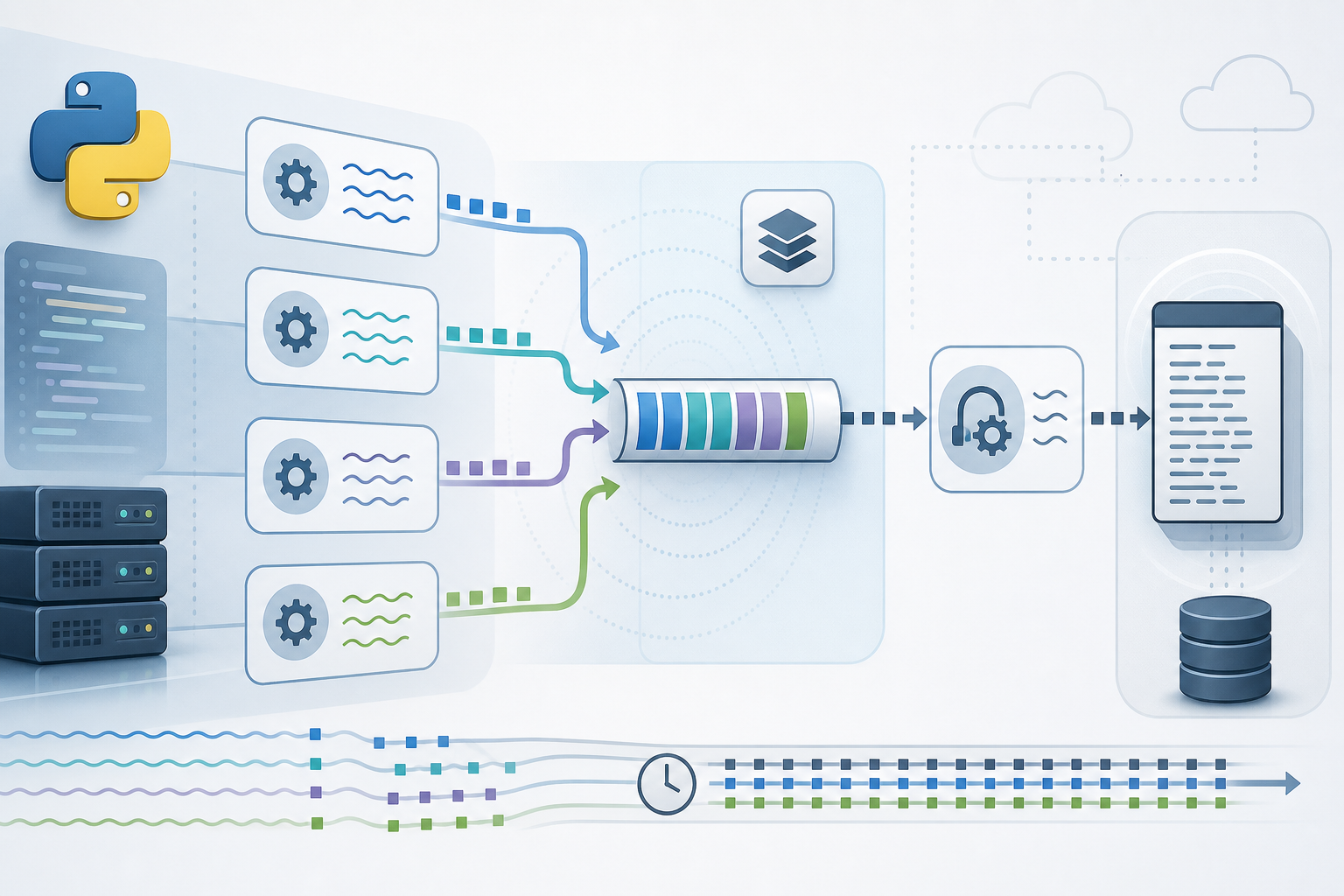
With QueueHandler, the emitting thread converts the log event into a record and enqueues it. The enqueue operation is typically much cheaper than formatting and writing. QueueListener runs separately, pulls records from the queue, and dispatches them to the real handlers. Those handlers can still write to files, syslog, stderr, or other sinks, but the work no longer happens on the hot path of every worker thread.
A useful way to think about it is that QueueHandler is the fast intake point and QueueListener is the serialized output worker. This is also a clean fit when you want to combine thread-safe logging with structured parsing or downstream log processing, especially if later automation depends on validating patterns as described in Python Regex Validation for Secure Log Parsing and Data Extraction.
Compact workflow
Application thread logs event
        ↓
QueueHandler enqueues LogRecord
        ↓
QueueListener dequeues records
        ↓
Real handlers format and write output
        ↓
Shutdown flushes queue and stops listener
That workflow is deliberately simple, but the operational consequences are important. Worker threads stay focused on business logic, the queue absorbs short bursts, and output handling is centralized where you can control formatting, fan-out, and final delivery.
A practical implementation pattern
A common production pattern is to configure one queue, one listener, and a small set of downstream handlers. The listener owns the file or console handler; the worker threads only see the queue-based handler.
import logging
import queue
from logging.handlers import QueueHandler, QueueListener

log_queue = queue.Queue(-1)

stream_handler = logging.StreamHandler()
stream_handler.setFormatter(
    logging.Formatter("%(asctime)s %(levelname)s %(threadName)s %(name)s: %(message)s")
)

queue_handler = QueueHandler(log_queue)
listener = QueueListener(log_queue, stream_handler, respect_handler_level=True)

root_logger = logging.getLogger()
root_logger.setLevel(logging.INFO)
root_logger.handlers.clear()
root_logger.addHandler(queue_handler)

listener.start()

logger = logging.getLogger(__name__)
logger.info("Logging is routed through the queue")

# Later during shutdown
listener.stop()
This configuration keeps the application-facing side narrow. The queue handler is attached to the logger hierarchy, while the listener manages the real output handler. If your logs are forwarded into external automation or subprocess-driven workflows, keep the output format stable and the final sink well controlled; if you also orchestrate commands, the same careful input and timeout discipline used in Python Asyncio Subprocess Management for Secure Automation is a useful operational mindset.
A few practical notes matter here. queue.Queue(-1) creates an unbounded queue, which avoids immediate backpressure but can grow if log output is slower than log production. A bounded queue can protect memory but may require a policy for what happens when it fills. Also, listener.stop() matters: it ensures the queue is drained and the listener thread exits cleanly.
What this means in practice
In a real service, the benefit is often less about prettier logs and more about protecting request threads from unpredictable I/O. Imagine a Python API server with dozens of worker threads, each emitting audit events, validation warnings, and error traces. If those threads all write directly to the same destination, a slow filesystem or busy collector can create contention right where you least want it.
With the queue-based pattern, each worker only pays the cost of creating a record and enqueueing it. The listener thread absorbs the I/O cost and formats output once in a consistent place. That makes logging behavior easier to reason about during load spikes, and it simplifies the question of where to enforce output rules such as level filtering or final formatting.
This also helps when logs are part of a security workflow. Security teams often need reliable, ordered records for investigations, anomaly detection, or evidence review. Thread-safe queue-based logging does not solve retention or integrity on its own, but it can reduce the chance that log emission becomes the hidden bottleneck that drops visibility at the moment you need it most.
When this approach is the right choice
Use QueueHandler and QueueListener when one or more of these are true:
- You have multiple active threads generating logs concurrently.
- Logging calls are on a performance-sensitive path.
- Handlers perform relatively expensive work, such as frequent file writes or formatting-heavy output.
- You want a single point of control for multiple downstream handlers.
- You need the application threads to remain as free as possible from I/O concerns.
It is less compelling when the application is small, log volume is low, or all logging is already directed to a very cheap and local sink. In those cases, the queue adds moving parts without enough operational payoff.
The main decision rule is simple: if the cost of logging is visible in latency, CPU contention, or shutdown complexity, a queue-backed model is worth considering. If not, the direct handler model may be simpler and entirely adequate.
Trade-offs and limitations
The queue pattern improves decoupling, but it does not eliminate complexity. You are exchanging direct handler contention for queue management and listener lifecycle management.
One trade-off is buffering. A queue introduces a delay between log creation and log emission. For most operational logs, this is acceptable. For some highly time-sensitive workflows, that small delay may matter. Another trade-off is memory pressure if the queue grows faster than the listener can drain it. A bounded queue helps cap memory use, but then you need to decide whether to block, drop, or otherwise handle overflow.
There is also shutdown behavior to think about. If the process exits before the listener drains the queue, recent logs can be lost. That is why controlled startup and shutdown matter as much as the logging setup itself.
Finally, queue-based logging does not automatically make downstream log targets reliable. If the handler writes to a flaky file system or a remote collector, the listener still depends on that target being healthy. The pattern improves thread safety and isolation, not the fundamental reliability of the destination.
Common mistakes to avoid
A frequent mistake is attaching both the queue handler and the real output handler to the same logger tree. That can create duplicate records or reintroduce the same blocking behavior you were trying to avoid. The worker side should generally see only the queue handler.
Another mistake is forgetting to stop the listener during shutdown. That can leave records in the queue and produce partial logs at exactly the moment you need final diagnostics.
A third issue is assuming an unbounded queue is always safe. If log production outpaces consumption for long periods, memory usage can climb. The right queue size depends on expected burstiness, sink speed, and acceptable loss or delay.
It is also easy to overlook handler levels and formatting. If the listener owns the downstream handlers, confirm that their levels and formatters are intentional, because that is where final filtering and output shape are applied.
Production readiness checklist
Before using this pattern in production, verify the following:
- The application logger hierarchy sends records to the queue handler only.
- The listener owns the actual output handlers.
- Queue size is intentional, with a known choice between bounded and unbounded behavior.
- Shutdown calls stop the listener after critical work completes.
- Log formatting is consistent and suitable for your collection pipeline.
- Handler levels are tested to ensure the desired records appear.
- Burst logging does not cause memory growth or unacceptable delay.
- Error paths still emit enough context if the queue or sink becomes stressed.
A simple decision guide
If you are running a multi-threaded Python service and logging is either slowing work or making output behavior hard to control, the queue-based model is usually the right design to evaluate first. If you only need a small application script with occasional logs, the extra listener thread may be unnecessary.
The practical decision is not whether Python logging is thread-safe in the abstract. It is whether the logging path is part of your workload’s critical path. When it is, QueueHandler and QueueListener give you a cleaner separation between generating events and writing them out.
For teams that care about operational clarity, this pattern is often a worthwhile default for concurrent services: worker threads stay fast, logging becomes easier to centralize, and the final output path is easier to reason about before deployment. The key is to validate the queue behavior, listener shutdown, and handler configuration in the same environment where the application will run.
Use this guidance together with secure ML model monitoring pipeline to connect the workflow with related operational context already available on the site.
Part of the Programming: Python Insights content cluster.