Why secure subprocess handling matters
Automating shell commands is common in build pipelines, incident response tooling, backup jobs, and host health checks. The practical problem is that a command launched from Python can inherit the same security and reliability risks as any other operational control point: shell injection, hung processes, unbounded output, ambiguous exit handling, and leaked secrets in logs. When that command is launched from an asynchronous application, the risk increases if the event loop is allowed to wait indefinitely or if process output is consumed too late.
Python asyncio subprocess management gives you a non-blocking way to launch and supervise external commands, which is useful when your automation must continue handling network traffic, task queues, or concurrent jobs. After reading this article, you should be able to decide whether asyncio subprocesses are appropriate for your workflow, apply a safe execution pattern, validate command success or failure, and verify the controls you need before production use.
Key takeaways
- Prefer argument lists over shell invocation whenever possible.
- Treat subprocess input, output, and exit codes as security-sensitive data.
- Always enforce timeouts, handle cancellation, and clean up child processes.
- Capture only the output you need, and redact or suppress secrets.
- Verify platform-specific behavior before relying on signals, process groups, or encoding defaults.
What asyncio changes compared with synchronous subprocess calls
Traditional subprocess calls block the current thread until the command finishes or the timeout expires. In an asynchronous program, that behavior can stall unrelated work such as API handlers, message consumers, or scheduler loops. asyncio.create_subprocess_exec() and asyncio.create_subprocess_shell() allow the event loop to keep running while the child process executes.
That does not make the command safer by itself. The security model still depends on how you construct the command, where its arguments come from, and how you treat its output. If user-controlled data enters the command line, the safest default is to avoid the shell entirely and pass an argument vector. This is the same general validation mindset that applies to other inputs, such as Python Regex Validation for Secure Log Parsing and Data Extraction, where controlled patterns and strict checks help prevent false assumptions from becoming operational mistakes.
The main difference with asyncio is supervision. You gain non-blocking concurrency, but you also need to manage coroutine cancellation, backpressure from stdout or stderr, and cleanup if the parent task fails. In other words, the process lifecycle becomes part of your automation design, not just a utility call.
How the pattern works
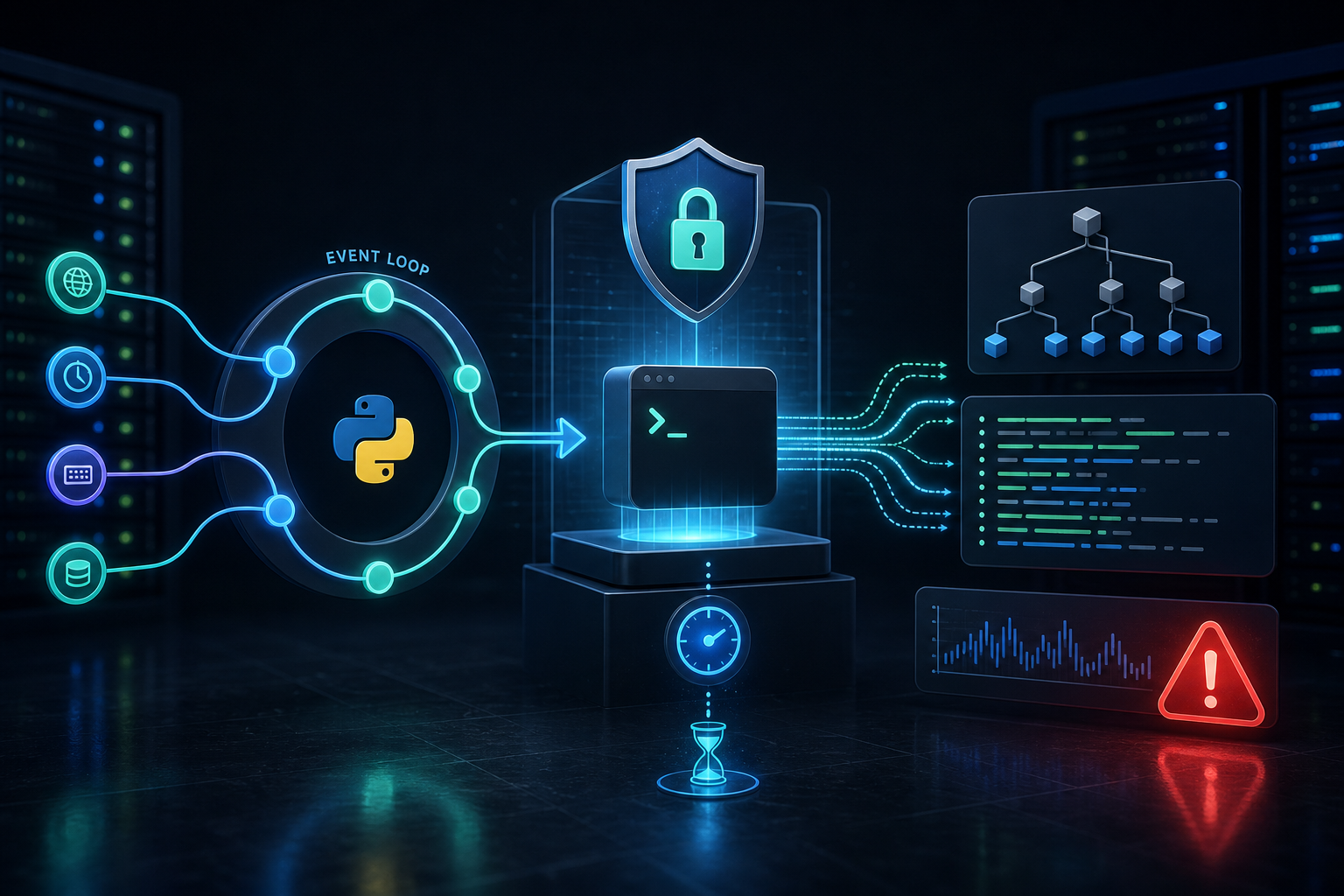
A secure asyncio subprocess workflow is usually built around four controls:
- Build the command from fixed executable names and validated arguments.
- Launch the process without invoking a shell unless shell syntax is unavoidable.
- Read stdout and stderr deliberately, with size and timeout limits.
- Confirm the exit code and decide whether to retry, alert, or fail closed.
A compact workflow for production-minded automation looks like this:
validate inputs -> build argv -> launch subprocess -> enforce timeout
-> capture/limit output -> inspect exit code -> cleanup on failure/cancel
A minimal non-shell example illustrates the core pattern:
import asyncio

async def run_command(path: str) -> tuple[int, str, str]:
    proc = await asyncio.create_subprocess_exec(
        "/usr/bin/rsync",
        "-a",
        "--delete",
        path,
        "/backup/target/",
        stdout=asyncio.subprocess.PIPE,
        stderr=asyncio.subprocess.PIPE,
    )

    try:
        stdout, stderr = await asyncio.wait_for(proc.communicate(), timeout=60)
    except asyncio.TimeoutError:
        proc.kill()
        await proc.wait()
        raise

    return proc.returncode, stdout.decode(errors="replace"), stderr.decode(errors="replace")
This pattern is intentionally conservative. It uses a fixed executable path, avoids shell interpolation, and sets a timeout. In production, you would also validate path before the process starts, decide whether stdout must be stored at all, and define how much stderr is acceptable before flagging the run.
When asyncio subprocesses are a good fit
This approach is most useful when your Python service must orchestrate external tools while staying responsive. Common cases include scheduled backups, certificate renewal hooks, compliance scans, network utility wrappers, and asynchronous job runners that need to supervise command-line tools alongside other coroutines.
It is a strong fit when all of the following are true:
- You need concurrency without dedicating a thread to every job.
- The command is trusted or tightly constrained.
- You can define clear timeout and exit-code expectations.
- Output volume is bounded or can be streamed safely.
It is less suitable when the command is highly variable, the input is user-generated and difficult to validate, or the tool must run interactively. For example, if a subprocess is mainly being used to call an external HTTP client, a native library or direct request implementation may be easier to secure and observe. In those situations, a pattern such as Python Requests Tutorial: Secure API Calls with TLS Verification may be a better operational choice than shelling out to a separate binary.
Practical scenario: an internal maintenance daemon
Consider a maintenance daemon that runs on Linux hosts, watches a queue, and executes approved maintenance jobs such as log rotation, disk checks, or archive verification. The daemon must keep processing events even if one command hangs or returns a large error message. It also runs under a restricted service account, so a failed command should not leave behind zombie processes or hold open file descriptors.
This is a realistic fit for asyncio subprocess management because the service already has an event loop and must supervise multiple tasks. A secure implementation would likely use fixed binaries, a small approved command set, and an allowlist for arguments such as directories or retention windows. If the daemon accepts patterns for parsing job output, those patterns should be validated carefully before use, just as you would validate other operational inputs.
The operational question is not whether asyncio can start the command. It can. The question is whether the parent coroutine can prove the command completed correctly, within policy, and without exposing sensitive output to logs or metrics.
What to verify in the command interface
The command boundary is where most mistakes happen. If you allow arbitrary strings into create_subprocess_shell(), you have effectively delegated parsing to the shell, which is rarely acceptable in secure automation. Use the shell only when you need shell features such as pipelines, redirection, or glob expansion, and treat that path as higher risk.
For safer command handling, verify the following before launch:
- The executable path is fixed or resolved from a trusted location.
- Each argument is validated for type, length, range, and allowed character set where appropriate.
- Paths are canonicalized if they must stay under a permitted directory.
- Secrets are not embedded directly in command-line arguments unless there is no safer alternative.
- The command does not depend on environment variables you have not explicitly set.
A useful rule is to treat every field that crosses into the subprocess boundary as a policy decision, not just a string concatenation problem. That matters especially in automation built on top of parsed logs, file names, or job metadata.
Output handling, timeouts, and cancellation
The most common operational failure is a subprocess that never exits. In asyncio, a hanging process can block your task indefinitely unless you enforce a timeout and know how to terminate the child. wait_for() around communicate() is a practical default because it allows you to read both pipes and detect slow or stuck commands.
Output handling also deserves caution. If a command can produce large stdout or stderr streams, buffering everything in memory can create instability. In that case, you may need to stream and cap output, write to a file, or consume output incrementally. Avoid logging raw command output by default if it can contain tokens, hostnames, file paths, or customer data.
Cancellation is another edge case. If the parent coroutine is cancelled, the subprocess may keep running unless you explicitly kill it and wait for reaping. In production, the cleanup path should be as deliberate as the success path.
Implementation trade-offs
Asyncio subprocesses reduce blocking, but they do not remove complexity. The main trade-off is control versus convenience. You get a structured way to supervise external tools, but you also take on process lifecycle management, buffering decisions, and platform differences.
A few trade-offs are worth weighing carefully:
create_subprocess_exec()vscreate_subprocess_shell(): exec is safer for fixed arguments; shell is more flexible but expands the attack surface.communicate()vs streaming reads: communicate is simpler; streaming can reduce memory pressure but needs more careful concurrency control.- Strict timeouts vs forgiving retries: short timeouts contain failures quickly; retries can hide persistent faults if they are not bounded and observable.
- Direct subprocess calls vs native APIs: native APIs are often easier to validate and instrument, but subprocesses may be the only practical integration with existing tooling.
Version and platform behavior should be verified rather than assumed. Process-group handling, signal delivery, encoding defaults, and child cleanup semantics can differ across operating systems and Python versions. If your automation depends on these details, confirm them in the exact runtime you plan to deploy.
What this means in practice
In practice, secure asyncio subprocess management means drawing a clear line between orchestration and execution. Python should decide which approved tool to run, how long it may run, what evidence to collect, and what to do on failure. The subprocess should not be given unnecessary freedom to interpret input, discover dependencies, or continue after the parent has moved on.
That has three operational consequences. First, the command contract should be narrow and documented: expected arguments, exit codes, stdout behavior, and stderr thresholds. Second, observability should focus on outcome, duration, and failure class rather than raw text dumps. Third, recovery should be explicit. If a command times out, the parent must know whether to retry, alert, or stop the workflow.
This is also where output validation matters. If your subprocess emits structured data such as JSON or delimited fields, validate that data before acting on it. The same discipline used in secure request handling applies here: do not assume output is trustworthy simply because the process exited successfully.
Decision guidance
Use asyncio subprocesses when the external tool is already part of your operating model and the parent process must remain responsive. That includes services that coordinate maintenance jobs, run audit tools, or supervise long-running utilities in parallel.
Prefer another approach when any of the following is true:
- The command needs interactive prompts or TTY behavior.
- The input cannot be constrained tightly enough to avoid shell risks.
- The task can be handled more safely through a library API instead of a separate process.
- You cannot define acceptable exit codes, timeout limits, or output size limits.
A practical decision rule is simple: if you cannot describe the subprocess contract in one short paragraph, the integration is probably too loose for secure automation.
Common mistakes to avoid
The most frequent mistakes are usually subtle, not dramatic. They show up as rare failures, brittle behavior, or logs that accidentally expose sensitive data.
- Using the shell by default when argument lists would work.
- Assuming
returncode == 0is enough without checking stderr or expected output shape. - Forgetting to kill and reap a process after timeout or cancellation.
- Capturing unlimited stdout from a command that can grow without bound.
- Passing secrets on the command line where process listings or logs may expose them.
- Relying on environment inheritance without setting the variables explicitly.
- Ignoring platform differences in signal behavior and child-process cleanup.
These are avoidable if the subprocess is treated as an externally controlled boundary rather than an internal function call.
Production readiness checklist
Before enabling a Python asyncio subprocess workflow in production, confirm the following:
- The command uses
create_subprocess_exec()unless shell features are truly required. - All untrusted inputs are validated and normalized before launch.
- Timeout behavior is defined and tested.
- Cancellation triggers process cleanup and child reaping.
- stdout and stderr handling is bounded, intentional, and redacted where needed.
- Exit codes are mapped to clear operational outcomes.
- Environment variables, working directory, and executable path are explicitly set.
- Any platform-specific assumptions have been verified in the target runtime.
- Retry behavior is limited and observable.
- Logs and metrics do not leak secrets or oversized payloads.
Final takeaway
Python asyncio subprocess management is a practical way to supervise external commands without blocking an event loop, but secure automation depends on disciplined boundaries. Use fixed executables, validated arguments, timeouts, explicit cleanup, and bounded output handling. If the subprocess contract is clear and the runtime behavior is verified, asyncio can be a reliable orchestration layer; if not, the safer answer is usually to simplify the integration before production.
Use this guidance together with secure ML model monitoring pipeline and interactive rebase merge conflicts to connect the workflow with related operational context already available on the site.