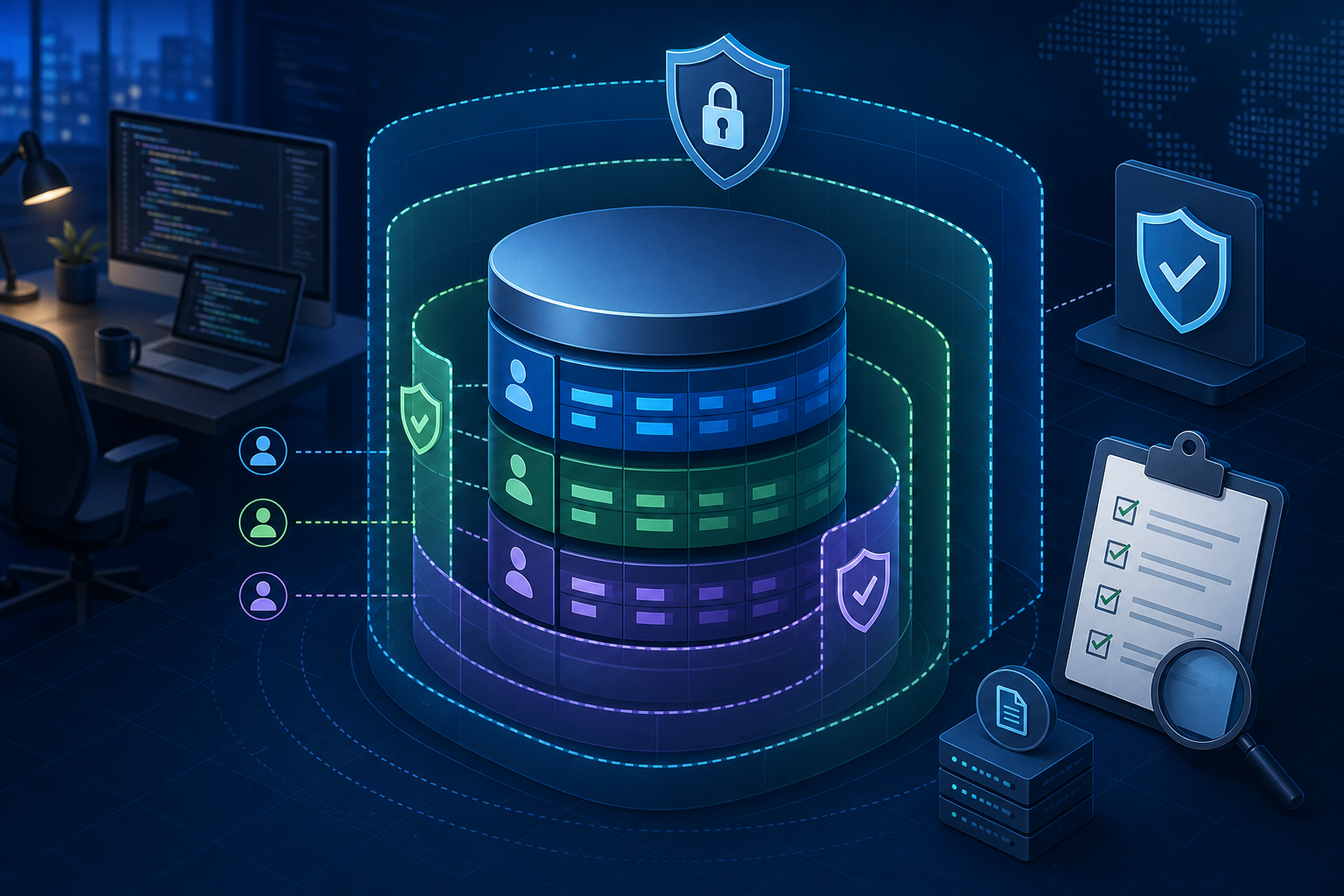

Why row-level security matters
The practical problem with multi-tenant and shared-database applications is simple: application code is rarely the only place where access control can fail. A missing WHERE tenant_id = ... clause, an admin query run from the wrong session, or a compromised service account can expose rows that should never be visible. PostgreSQL row-level security (RLS) helps reduce that risk by moving the row filter into the database engine itself.
That matters operationally because it gives you a centralized access boundary that applies consistently across applications, ad hoc queries, and many SQL paths. After reading this article, you should be able to decide whether RLS fits your environment, understand how it behaves, apply a practical validation workflow, and verify the controls you need before production use.
Key takeaways
PostgreSQL row-level security is most useful when data visibility must differ by tenant, team, owner, or request context. It is not a replacement for application logic, but it is a strong backstop when you need enforcement close to the data.
A few points matter most:
- RLS is enforced by policies attached to tables.
- Policies are evaluated alongside the invoking role and the row content.
- Privileged roles, table owners, and functions with elevated privileges can bypass or alter expected behavior if you do not design carefully.
- Secure deployment depends on role design, policy testing, and clear assumptions about who can read, insert, update, or delete each row.
For broader PostgreSQL authorization design, it helps to pair RLS with PostgreSQL Role-Based Access Control for Database Security, because roles define the permission boundary that RLS then refines at the row level.
How PostgreSQL RLS works
RLS adds a policy layer to tables. When a query accesses a protected table, PostgreSQL checks whether the current session role is allowed to see or change each row based on the defined policy. In practice, this means a query can succeed syntactically but still return zero rows because the policy filters the result set.
Conceptually, you usually work with three parts:
- The table, which contains the data.
- The policy, which defines which rows are visible or writable.
- The role, which determines whether the session is subject to the policy and what context it carries.
A policy can be permissive or restrictive depending on how you combine conditions, but the operational point is the same: the database evaluates row-level access at execution time. That is why a query that looks valid in development can behave very differently in production if the active role, session settings, or ownership model changes.
RLS is most effective when policies are based on stable attributes such as tenant_id, org_id, owner_id, or a trusted session context set by the application at connection time. It is less effective when policy logic depends on brittle application assumptions, untrusted client input, or complex cross-table lookups that are difficult to reason about under load.
A compact workflow for designing and validating RLS
The safest way to approach RLS is to treat it as a control that must be modeled, not just enabled. A compact operational workflow looks like this:
Identify data boundary -> map roles and session context -> define minimal policy -> test with restricted role -> verify bypass paths -> monitor and review
This workflow is intentionally short because most failures are design failures, not syntax failures. If the data boundary is wrong, the policy will faithfully enforce the wrong rule. If the role model is too broad, the database may grant more than the policy intended. If testing only happens as a superuser, you will miss the real user experience entirely.
When RLS fits, and when it does not
RLS is a strong fit for tenant isolation, per-customer data segregation, delegated administration, and ownership-based access where the database should enforce a consistent row filter regardless of the calling application. It is especially valuable when multiple services, jobs, or APIs touch the same tables and you want one source of truth for visibility rules.
It is a weaker fit when your authorization logic is highly dynamic, heavily dependent on external policy engines, or needs broad contextual decisions that are not easily represented in the database. In those cases, RLS can still be part of the control plane, but it should not be the only control. You may end up with duplicated logic if the application also evaluates access, but that duplication can be acceptable when the database must remain the final enforcement point.
A useful decision rule is this: if a row should never be visible outside a clearly defined boundary, and that boundary can be expressed from stable row attributes plus trusted session context, RLS is usually a good candidate. If access depends on many external signals that change frequently or are hard to model safely, consider whether the policy belongs partly or primarily in the application or an external authorization layer.
Practical scenario: shared tenant database
Imagine a SaaS platform where each customer has its own tenant_id but shares the same PostgreSQL cluster and schema. The application sets the tenant context after authentication, and every API request is expected to operate only on rows for that tenant. Most of the time this works, until a reporting job, a migration script, or a new endpoint forgets to apply the tenant filter.
This is the kind of environment where RLS adds real value. A policy that ties visibility to the current tenant context prevents accidental cross-tenant reads even when a query is written incorrectly. It also reduces the blast radius of a compromised application token because the token can only access the rows the policy allows.
The trade-off is that the application must be designed to supply trusted context reliably, and your team must know which roles can bypass the policy. If you do not distinguish between human admins, application roles, maintenance roles, and ownership roles, you may create a false sense of protection.
What this means in practice
In real operations, RLS changes how you think about access testing. Instead of asking only, “Does this query work?”, you also need to ask, “Which rows should this role see, and why?” That means validating behavior from the perspective of each role, not just from a privileged shell.
It also means planning for the query paths that do not resemble the application. Backups restored into a lab, BI tools, migration utilities, and troubleshooting sessions can all reveal whether your security model is actually enforced or merely assumed. If a service account is meant to be tenant-scoped, verify that its connection path cannot accidentally inherit a broader role or a privileged session state.
A practical control pattern is to pair RLS with minimal table privileges, clear role separation, and explicit session context. RLS should narrow access, not compensate for broadly granted SELECT, UPDATE, or DELETE rights.
Implementation trade-offs to weigh
RLS improves control, but it is not free. Every policy adds cognitive load for schema owners, application developers, and responders. Queries can also become harder to reason about because the visible result set depends on invisible policy logic. That is usually acceptable in exchange for stronger boundary enforcement, but it should be a deliberate choice.
Performance is another consideration. Well-designed policies on indexed columns are typically manageable, but poorly chosen policy predicates can make access checks more expensive or less predictable. For example, a policy that depends on non-indexed expressions or complex joins can be harder to scale and harder to explain during incident review.
There is also an operational trade-off between convenience and safety. If you allow many roles to bypass RLS for ease of administration, you weaken the control. If you apply RLS too aggressively without clear break-glass procedures, you can make maintenance and incident response unnecessarily difficult. The goal is not maximum restriction; it is predictable, auditable restriction.
Common mistakes that weaken RLS
The most common failure is assuming that enabling RLS automatically protects every access path. That is not true if the table owner, a superuser-like role, or a privileged function can bypass policy evaluation. Another frequent mistake is testing only with the application’s primary account instead of the least-privileged runtime role.
Other mistakes include:
- Using policy predicates that are too broad, such as relying on weak session variables without a trusted set-and-check pattern.
- Forgetting that write policies and read policies may need different logic.
- Granting direct table access to roles that should have gone through a narrower interface role.
- Not verifying behavior after schema changes, role changes, or connection-pool changes.
- Treating policy definitions as static when the application’s tenant model has evolved.
These issues often appear only after deployment because local tests are usually run with elevated privileges. The fix is not more faith in the policy; it is better validation against the actual production roles.
Decision guidance for production use
Use RLS when the database must enforce row visibility for more than one trust boundary and when those boundaries are stable enough to encode in policy logic. Prefer it for shared schemas, tenant data, owner-scoped records, and administrative separation where an accidental query mistake would be high impact.
Do not rely on RLS alone when you need application-level workflow approval, complex external authorization decisions, or broad cross-tenant operational access for many user classes. In those cases, RLS should still protect the data boundary, but the overall authorization design needs additional layers and explicit exception handling.
A useful rule is to ask two questions:
- Can I express the access rule in terms of row attributes and trusted session context?
- Can I test the policy from the perspective of every role that will touch the table?
If the answer to either is no, you need to redesign the policy model before production.
Validation checks before production
Before you enable RLS on sensitive tables, verify the following:
- The intended table roles are separated into read, write, and administrative paths.
- Policies are attached to every table that contains tenant- or owner-scoped data.
- The application uses a trusted method to set session context, and that context is not user-controlled.
- Testing covers the actual runtime role, not just a privileged account.
- Bypass behavior is explicitly understood for owners and elevated roles.
- Read, insert, update, and delete paths are all tested independently.
- Indexes support the policy columns used most often in predicates.
- Restore, migration, reporting, and support workflows are checked for unintended broad access.
- Rollback or emergency access procedures are documented for incident response.
If you want a parallel control model for the broader permission structure around those tables, align it with PostgreSQL Role-Based Access Control for Database Security so role grants and row policies do not work against each other.
Compact production readiness checklist
Use this checklist as a final sanity check before turning on RLS for a production table:
- The data boundary is clearly defined in terms of tenant, owner, or team.
- The policy logic is simple enough to review and explain.
- The application role is least privilege.
- The session context is trusted and not derived directly from the client.
- Read and write behavior has been tested with the real runtime role.
- Privileged bypass paths are documented and approved.
- Query patterns and indexes have been reviewed for performance impact.
- Operational scripts, BI tools, and maintenance tasks were validated.
- An emergency access path exists and is controlled.
- The team knows how to detect policy regressions after schema changes.
Final takeaway
PostgreSQL row-level security is best viewed as a database-enforced safety boundary, not a shortcut for weak application authorization. It works well when you can define a stable row ownership model, pair it with disciplined role design, and validate it from the perspective of the real runtime account. If you can do those things, RLS can materially reduce accidental exposure and limit the blast radius of a compromised or misconfigured service path.
Use this guidance together with SQL Server transaction log backup to connect the workflow with related operational context already available on the site.
Use this guidance together with Transparent Data Encryption and Oracle RMAN incremental backup to connect the workflow with related operational context already available on the site.