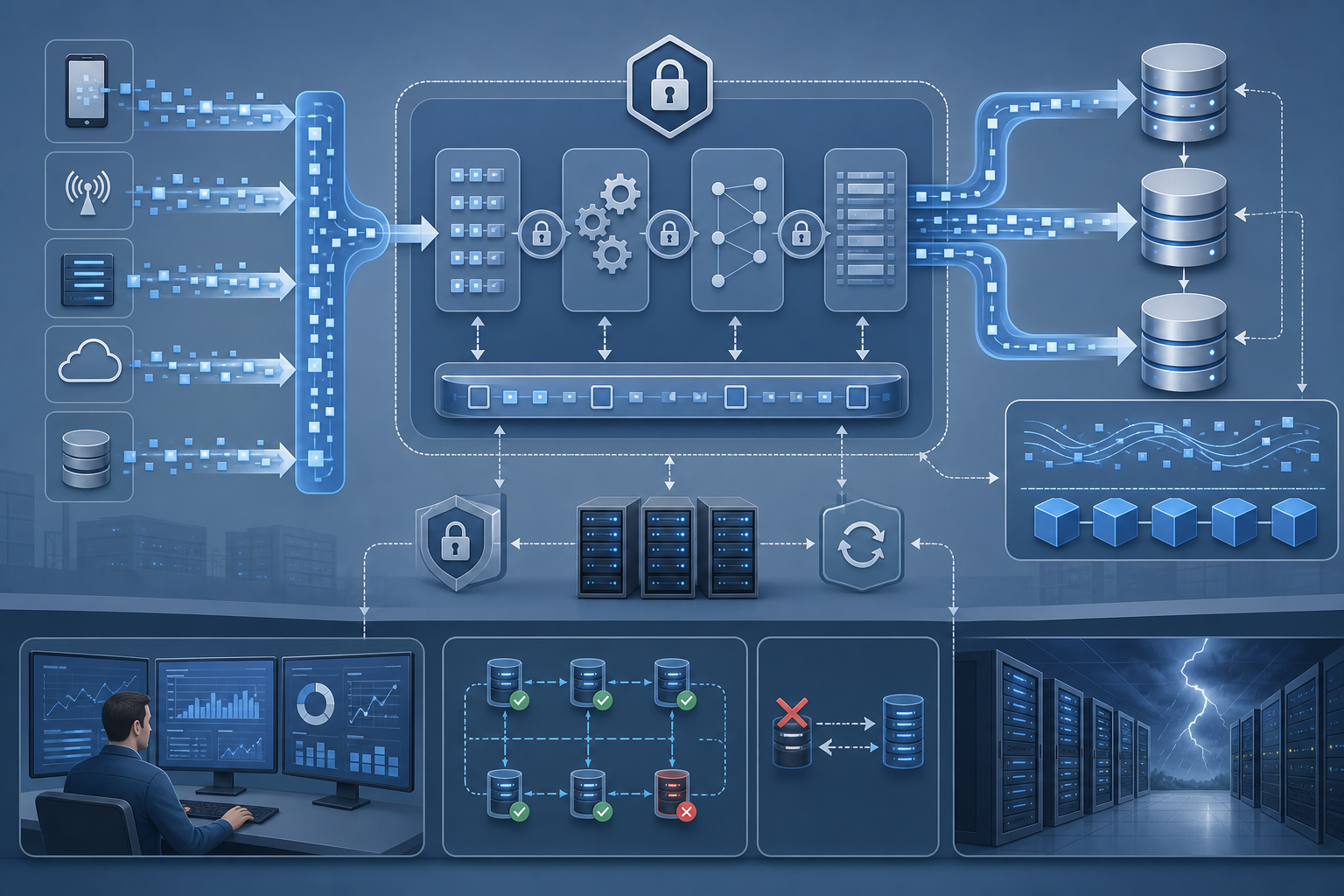

Why secure data pipelines matter
The practical problem behind secure data pipelines is not simply preventing unauthorized access to a cluster. In a big data system, sensitive records often move through multiple hops: source systems, ingestion endpoints, message brokers, object storage, processing engines, temporary shuffle space, analytical stores, and downstream consumers. Every hop can expose data through weak authentication, permissive service accounts, unencrypted transport, overbroad query access, or insecure logging.
That matters operationally because pipeline failures are not always visible as outages. A pipeline can continue to run while quietly leaking data, storing temporary files with sensitive payloads, or giving more access than intended to service identities used by jobs and automation. If you understand how secure data pipelines are built, you can decide where controls belong, validate whether your current design is acceptable, and check the right evidence before production.
Key takeaways
A secure pipeline is built around three questions: who can move data, where can data be observed, and how do you prove each transfer was authorized and intact. The strongest designs combine identity-aware access control, encryption in transit and at rest, data minimization, and auditable validation at every boundary.
Security also has to fit the processing model. Batch ETL, streaming ingestion, and ad hoc analytics do not fail in the same way, so the controls should not be identical. For example, streaming systems usually need tighter broker authentication and consumer authorization, while batch pipelines need stronger protection around intermediate files, object storage permissions, and job credentials. If your environment includes Spark-based processing, it is often worth aligning security design with performance tuning concerns as well; large shuffles, spill files, and partitioning behavior can create unexpected data exposure points, so operational articles such as Optimizing Apache Spark Jobs for Large-Scale Data Processing and How to Optimize Spark Streaming Performance for Large Data Pipelines become relevant when you assess how data moves through compute stages.
What a secure big data pipeline actually protects
A secure pipeline protects more than the final dataset. It protects the full path from ingestion to consumption.
The main exposure points are usually predictable:
- Source authentication and API credentials used by ingestion jobs
- Transport between producers, brokers, processors, and storage layers
- Temporary staging areas, spill files, and local scratch disks on workers
- Central storage buckets, tables, and metadata catalogs
- Service accounts and roles used by schedulers, notebooks, and jobs
- Logs, traces, and error payloads that may include sensitive values
- Exports, extracts, and downstream analytics endpoints
A good design treats each of these as a control point rather than assuming the cluster boundary is enough. That is especially important in multi-tenant environments, shared Kubernetes clusters, or cloud deployments where storage, compute, and identity are managed separately.
How secure data pipelines work
At a technical level, secure pipelines rely on layered controls rather than a single security feature. The layers usually map to four phases: ingest, process, store, and serve.
During ingest, the system should authenticate the producer or connector and validate that the payload is expected. Mutual TLS, signed tokens, service-to-service authentication, and broker ACLs are common mechanisms, but the important point is that ingestion should not rely on network location alone.
During processing, the job identity should be narrowly scoped. A pipeline that reads raw events, enriches them, and writes refined records should not use a broad cluster-admin style credential. Temporary credentials, role assumption, and per-job service accounts reduce blast radius if one job or worker is compromised.
During storage, data should be encrypted at rest, but encryption alone is not enough. The storage policy must also restrict who can read, list, or export the data. In many incidents, the problem is not that encryption was absent; it is that too many principals could still access decrypted data through the application layer.
During serving, the pipeline should expose only what the consumer needs. This may mean masking fields, filtering rows, applying column-level controls, or publishing separate views for different audiences. The most secure pipeline is often the one that prevents sensitive data from entering low-trust zones in the first place.
A compact workflow for secure pipeline design
1. Classify the data and define the minimum required audience.
2. Map every pipeline hop from source to consumer.
3. Assign a unique identity to each job, broker, and service.
4. Enforce transport encryption and verify certificate or token policy.
5. Restrict storage, catalog, and export permissions to least privilege.
6. Prevent sensitive data from entering logs, temp files, and debug output.
7. Add validation checks for schema, payload integrity, and access behavior.
8. Review audit logs, then confirm the pipeline still meets operational needs.
This workflow is intentionally compact. Its value is not in the number of steps but in forcing you to validate the boundaries where leaks usually happen.
Practical scenario: a daily customer event pipeline
Consider a common environment: a security-conscious organization ingests application events from multiple regions, enriches them with account metadata, and stores both raw and curated datasets for analytics and fraud detection. Different teams need different access. Fraud analysts need near-real-time access to selected fields. Data scientists need larger historical extracts. Support engineers should only see masked records. The pipeline runs in batch at night and in streaming mode during business hours.
This is the type of environment where security gaps often appear in the seams. The ingestion endpoint may be properly authenticated, but the enrichment job might write intermediate files to a shared bucket with permissive access. The analyst view may be restricted, but the raw table could still be queryable by a generic service account. A failed enrichment record may be dumped into logs with a full customer payload. None of these are unusual on their own, and none require a major outage to matter.
In a setup like this, the secure design decision is not just “enable encryption.” It is deciding which identity is allowed to read raw events, where enrichment happens, what gets masked before storage, and whether temp artifacts are automatically deleted. For this kind of mixed workload, processing performance and security can interact directly: poorly partitioned Spark jobs may create larger spill surfaces or longer-lived intermediates, while streaming backpressure can encourage operators to temporarily widen access just to keep data flowing. Security should therefore be checked alongside job behavior, not after it.
Controls that usually matter most
The following controls deliver the most practical protection in most big data systems:
- Identity and access control: each pipeline component should use a dedicated identity with narrowly scoped permissions.
- Encryption in transit: all traffic between producers, brokers, processors, and storage should use authenticated encryption.
- Encryption at rest: object storage, disks, and tables should be encrypted, with key management reviewed separately from storage access.
- Schema and payload validation: malformed, oversized, or unexpected records should be rejected or isolated before they reach critical stages.
- Data minimization: pass only the fields needed for the next processing step.
- Sensitive data handling: mask, tokenize, or redact where possible before writing logs or secondary stores.
- Auditing and monitoring: record access, job identity, data movement, and unusual export behavior.
The strongest programs usually focus first on identity, storage permissions, and logging hygiene. Those are the places where security teams can reduce the largest risk with the least operational friction.
Implementation trade-offs
Secure pipelines impose trade-offs, and ignoring them usually leads to bypasses.
The first trade-off is between strict isolation and operational simplicity. Per-job identities, separate storage paths, and fine-grained permissions increase security but also add configuration overhead. If the environment is small or highly standardized, that overhead is manageable. In large heterogeneous systems, you need templates and policy-as-code or the design becomes fragile.
The second trade-off is between inspection and privacy. Deep validation, content scanning, and detailed logging improve detection but can themselves become a liability if they capture sensitive values. For high-risk fields, metadata-only logging or redaction is often better than verbose payload logging.
The third trade-off is between performance and control enforcement. Encryption, row filters, token checks, and additional audit logging add latency. In batch systems the cost is often acceptable; in streaming systems you may need to place controls carefully so they do not create avoidable backpressure or excessive retries.
The fourth trade-off is between centralized governance and local autonomy. Central policy makes compliance easier, but pipeline owners still need enough flexibility to handle schema drift, backfills, and emergency operations. Too much central restriction can push teams toward shadow pipelines and manual exports, which are usually less secure.
What this means in practice
In practice, secure data pipelines are less about adding a long list of tools and more about proving that each pipeline stage has a justified trust model.
If a job reads sensitive data, you should be able to answer three questions immediately: which identity is used, what it can access, and where the data can go next. If you cannot answer those questions, the design is not yet production-ready.
A practical validation pattern is to test the pipeline from both the expected path and the failure path. Confirm that authorized jobs can process data with the intended latency. Then try the most likely misuse cases: an unauthorized account reading the same storage path, a malformed message entering the broker, a job writing to an unexpected bucket, or a debug log exposing a field that should be masked. If the design only works on the happy path, it is not secure enough.
This is also where operational discipline matters. For example, if a Spark transformation relies on broad storage access because a later stage needs the data, that is a sign to revisit the data flow rather than just widen the permissions. Similarly, if streaming consumers need to read from a topic that contains both sensitive and non-sensitive records, separation by topic or schema is usually safer than relying on consumers to ignore the extra fields.
Decision guidance: when the approach applies
Use a secure pipeline design whenever the data has any of the following characteristics:
- It contains regulated, confidential, or customer-identifying information.
- It crosses team or tenant boundaries.
- It is processed by multiple systems with different trust levels.
- It is written to shared storage, notebooks, or interactive analytics tools.
- It is exported to external partners or lower-trust downstream systems.
If the data is low sensitivity, static, and confined to a single fully trusted environment, you may not need the same level of segmentation. Even then, you should still enforce transport encryption, service identities, and logging controls because those are low-cost safeguards with high value.
A useful decision rule is this: if a pipeline can be read, transformed, or exported by a principal that does not need the whole dataset, then you need stronger segmentation or masking before production.
Common mistakes
The most common mistake is assuming encryption equals security. Encrypted storage is important, but permissive roles, broad table access, and verbose logs can still expose data after decryption.
Another common mistake is using shared credentials across jobs. Shared service accounts make incident response harder because you lose attribution and cannot easily revoke only one workload.
Teams also frequently forget temporary data. Intermediate files, local executor spill, checkpoints, dead-letter queues, and debug dumps often outlive the main record path and may be less protected than the final tables.
A fourth mistake is validating only production paths. If backfills, retries, and schema evolution are not tested, the system often reverts to unsafe defaults during the exact events where operators are under pressure.
Finally, organizations sometimes over-log sensitive payloads because they want better observability. In practice, logging should prefer IDs, hashes, counts, and status codes over raw content whenever possible.
Production readiness checklist
Before a secure data pipeline goes live, verify the following evidence exists:
- Each source, job, broker, and sink has a unique identity.
- Transport encryption is enforced on every network hop.
- Storage encryption and key access policy are documented and reviewed.
- Raw, intermediate, and curated data paths are separately controlled.
- Sensitive fields are masked, minimized, or excluded from logs.
- Failed records have a controlled quarantine path.
- Audit logs capture reads, writes, exports, and privilege changes.
- Access reviews confirm the job can only reach the intended datasets.
- Recovery, backfill, and retry behavior do not bypass controls.
- Operators know how to revoke access or rotate credentials without breaking the whole pipeline.
If any of these items is missing, the pipeline may still function, but it is not yet well defended.
Final takeaway
Implementing secure data pipelines in big data systems means securing the entire data path, not just the destination. The right design limits who can move data, constrains where it can be observed, validates what is accepted, and leaves an audit trail that proves those controls are working. If you can map identities, control points, and temporary exposure surfaces for each hop, you can make an informed production decision and reduce the chance that a working pipeline is also an unsafe one.
Use this guidance together with C# file upload validation to connect the workflow with related operational context already available on the site.
Part of the Programming: Big Data Insights content cluster.