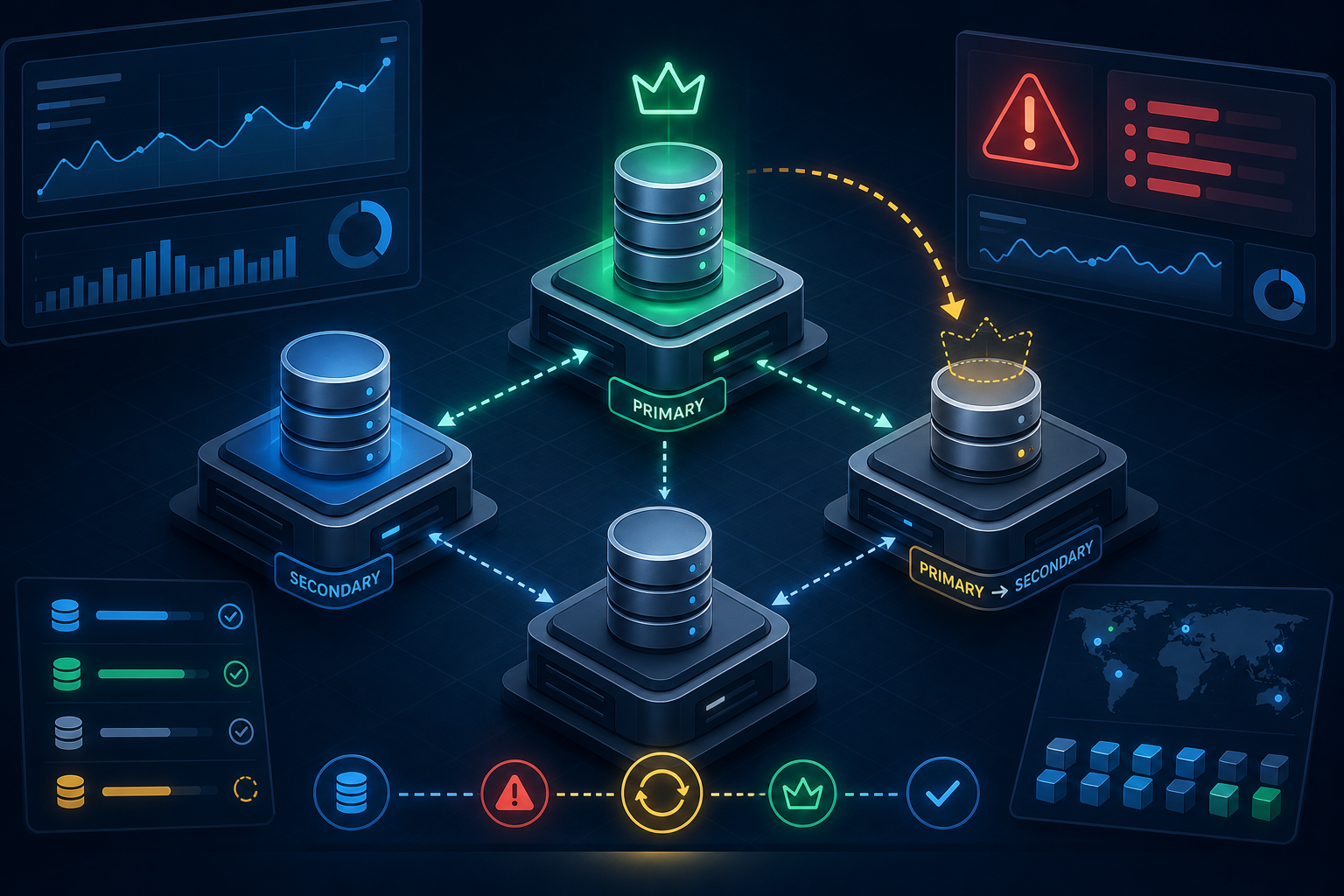

Key takeaways
MongoDB replica set failover is the mechanism that keeps writes available when a primary becomes unreachable, but it is not a substitute for operational readiness. Automatic recovery depends on quorum, election stability, member health, and application retry behavior. If any of those pieces are weak, failover can still create avoidable downtime, write errors, or split-brain risk.
You can use this article to determine whether automatic failover is appropriate for your environment, understand what MongoDB does during an election, and validate the recovery path before you depend on it in production. It also gives you a compact verification workflow, practical decision rules, and the checks that matter most when you are deciding whether failover is truly ready.
Why automatic failover matters operationally
The practical problem is simple: the primary is the only replica set member that accepts writes, so when it fails, your application experiences an availability event even if the data is still present on secondaries. Automatic recovery exists to reduce the time between primary loss and a new primary becoming writable again. In the best case, the outage is brief and contained. In the worst case, failover stalls because the set lacks quorum, elections thrash, or clients keep sending traffic to a dead node.
That is why failover is more than a database feature. It is a coordination problem across the replica set, the network, the driver, and the application retry logic. If any of those layers behave poorly, the database may recover correctly while the service still appears down.
If you are already troubleshooting election behavior or write interruption symptoms, this topic pairs naturally with MongoDB Replica Set Failover: Detect and Recover Fast, because detection and recovery validation are two sides of the same operational problem.
How replica set automatic recovery works
MongoDB replica sets use elections to choose a new primary when the current primary is unavailable or steps down. Secondaries monitor the set, and eligible members participate in the election process. A new primary can only emerge if enough voting members are available to reach a majority. That majority requirement is what prevents conflicting primaries from being elected during partial outages.
Automatic recovery is therefore not a single setting you turn on. It is the result of a healthy replica set design:
- A majority of voting members must be reachable.
- At least one secondary must be eligible to become primary.
- The election should complete within the normal detection window for your environment.
- Clients must discover the new primary and reconnect without manual intervention.
In practice, the database can only recover automatically if the topology allows it. A two-node set with no arbiter, a WAN-separated layout with unstable links, or a heavily delayed secondary can all undermine failover even when the cluster is technically running.
Compact workflow for validating automatic recovery
1. Confirm replica set majority is available and stable
2. Verify at least one secondary is eligible to become primary
3. Check driver retry and server selection behavior
4. Simulate a primary loss in a non-production window
5. Observe election time, client reconnect time, and write recovery
6. Review logs for repeated elections, rollbacks, or stale routing
7. Record whether the recovery meets your operational tolerance
This workflow is intentionally compact because the goal is not to perform a deep forensic analysis every time. It is to establish whether failover works predictably enough for production use.
What you need in place for automatic recovery to succeed
The most important prerequisite is quorum. A replica set can tolerate failures only as long as a majority of voting members remain available. That means member count, voting configuration, and placement all affect whether recovery can proceed. If a loss leaves the set without majority, failover stops being automatic and becomes a manual recovery event.
The second prerequisite is eligibility. Not every member should be allowed to become primary in every design. Hidden, delayed, or intentionally unelectable members can help with analytics, backups, or recovery strategies, but they do not improve primary availability if they cannot participate in elections.
The third prerequisite is client behavior. Even when a new primary is elected correctly, applications still need a clean way to discover it. Drivers should be configured to use the replica set topology, handle transient selection errors, and retry safely where your write semantics allow it. If client code is hard-wired to a single host, automatic failover is reduced to a partial database feature.
Finally, recovery depends on the quality of the surrounding infrastructure. Low-latency, stable networks make elections less noisy. Reliable time sync reduces operational confusion during incident review. Adequate resource headroom helps avoid unnecessary stepdowns caused by overloaded members.
A practical environment you may recognize
Consider a typical internal service running on three database nodes across two availability zones. The team expects a failed primary to be replaced automatically so API writes only pause briefly. On paper, the topology looks resilient. In practice, one node has intermittent network latency, the application still caches a single seed host, and the deployment pipeline occasionally restarts a secondary during maintenance.
That environment often behaves well during routine testing and poorly during real failure. The first outage triggers an election, but the application continues talking to the old node or waits longer than expected to discover the new primary. Another maintenance window removes quorum unexpectedly, and automatic recovery no longer applies at all.
This is the kind of environment where failover seems like a solved problem until the first meaningful incident. The right question is not whether elections exist. It is whether the full recovery path is stable under the exact conditions you run in production.
Implementation trade-offs that affect failover behavior
Automatic recovery is a trade-off between availability, consistency, and operational simplicity. A tightly configured replica set with enough voting members and stable connectivity usually recovers faster, but it also requires more careful placement and monitoring. A looser topology may be cheaper to run but less predictable under failure.
There are several decisions that influence the trade-off:
- More voting members can improve fault tolerance, but only if they are placed so a majority survives likely failures.
- Geographically distributed members can protect against site loss, but they can also increase election latency and make quorum harder to preserve.
- Read scaling through secondaries can be useful, but it does not improve write availability unless the set can still elect a primary.
- Aggressive maintenance practices can keep infrastructure fresh, but frequent member restarts can create unnecessary failover events if sequencing is poor.
If your main concern is query performance during steady state, that belongs to a separate tuning problem. In many deployments, query latency is driven more by indexing strategy than by election behavior. For that reason, it is worth distinguishing failover design from read performance work such as MongoDB Indexing Best Practices for Faster Query Performance. They interact operationally, but they solve different problems.
What this means in practice
In production terms, automatic recovery means you should expect a short write interruption after primary loss, not zero impact. The practical goal is to keep the interruption bounded, observable, and recoverable without manual node surgery.
That leads to a few useful rules of thumb:
- If your set cannot keep majority during a single expected failure domain loss, do not assume automatic recovery will protect you.
- If client drivers are not configured for replica set discovery, a healthy election may still look like an outage.
- If your members are stable but elections are slow, look at network delay, resource saturation, and member eligibility before changing application code.
- If the set recovers but your app writes still fail for an extended period, the problem is often in retry policy or topology discovery, not in the election itself.
The most reliable production posture is one where failover is boring: a primary disappears, a new one appears, clients reconnect, and the service resumes with minimal operator intervention. If failover feels exciting during testing, it is usually because the recovery path has not been exercised enough.
Decision guidance: when automatic recovery is a good fit
Automatic recovery is a good fit when your replica set has clear majority survivability, predictable member placement, and application clients that can reselect a new primary without manual overrides. It is especially appropriate for services where short write interruption is acceptable but prolonged downtime is not.
It is a weaker fit when your topology regularly loses majority during planned maintenance, when nodes are spread across unstable links, or when your client library cannot reliably handle topology changes. In those cases, the issue is not that failover is unavailable. It is that the operating model does not support it well enough to trust.
A practical decision rule is this: if you cannot explain which failure domains can disappear without losing majority, you are not ready to rely on automatic recovery. If you can explain that, and you can prove client reconnection behavior under test, you are much closer to production confidence.
Common mistakes that break automatic recovery
One common mistake is assuming that three nodes automatically means resilience. It only means resilience if a majority can survive the failure you expect. A poor placement strategy can turn a three-node set into a fragile design.
Another mistake is allowing maintenance actions to remove quorum. Rolling restarts, host patching, and storage work can all trigger an avoidable election or prevent one from completing. Maintenance should preserve majority or be coordinated with explicit recovery expectations.
A third mistake is treating the database as the only recovery layer. If the application does not discover new primaries quickly, failover time becomes much longer from the user’s perspective than from the database’s perspective.
Other frequent errors include:
- Leaving an ineligible or heavily delayed member in a role that operators expect to help with recovery.
- Ignoring election noise caused by network instability or overloaded hosts.
- Failing to distinguish a recovered primary from a fully recovered application path.
- Testing failover only in calm conditions and never during real maintenance-like activity.
Evidence to verify before production use
Before you trust automatic recovery, verify the actual outcome rather than the intended design. You want evidence that the set can elect a new primary, that clients can find it, and that writes resume in line with your service objectives.
A solid verification pass usually includes these checks:
- Majority remains available after the expected single-node failure.
- A secondary is eligible and can be elected without manual intervention.
- The application driver detects the new topology promptly.
- Writes resume without permanent connection pinning to the failed node.
- Logs show a single, understandable election event rather than repeated thrashing.
- No unexpected rollbacks, inconsistent routing, or prolonged selection errors occur.
If those checks do not pass, fix the design before production rollout. If they do pass, document the expected recovery behavior so operators know what normal looks like during an incident.
Production readiness checklist
Use this compact checklist to decide whether automatic recovery is ready for real traffic:
- Majority survives the most likely single failure domain loss.
- At least one secondary is eligible to become primary.
- Planned maintenance will not routinely remove quorum.
- Application drivers use replica set discovery and safe retry behavior.
- Failover has been tested under conditions close to production.
- Recovery time is acceptable for the service objective.
- Operators know which symptoms indicate election delay versus client reconnection delay.
- Logs and monitoring make it easy to confirm the elected primary.
If one of these items is missing, the failure is usually not in MongoDB itself. It is in the way the replica set, the clients, or the operational process were assembled.
Final takeaway
Automatic failover in a replica set is only dependable when quorum, member eligibility, network stability, and client reconnection all line up. The right way to configure automatic recovery is not to chase a single setting, but to prove that the full path from primary loss to resumed writes works the way your production service needs it to. If you can verify majority, validate elections, and confirm client recovery, you have a failover design worth trusting.
Use this guidance together with MySQL query optimization to connect the workflow with related operational context already available on the site.