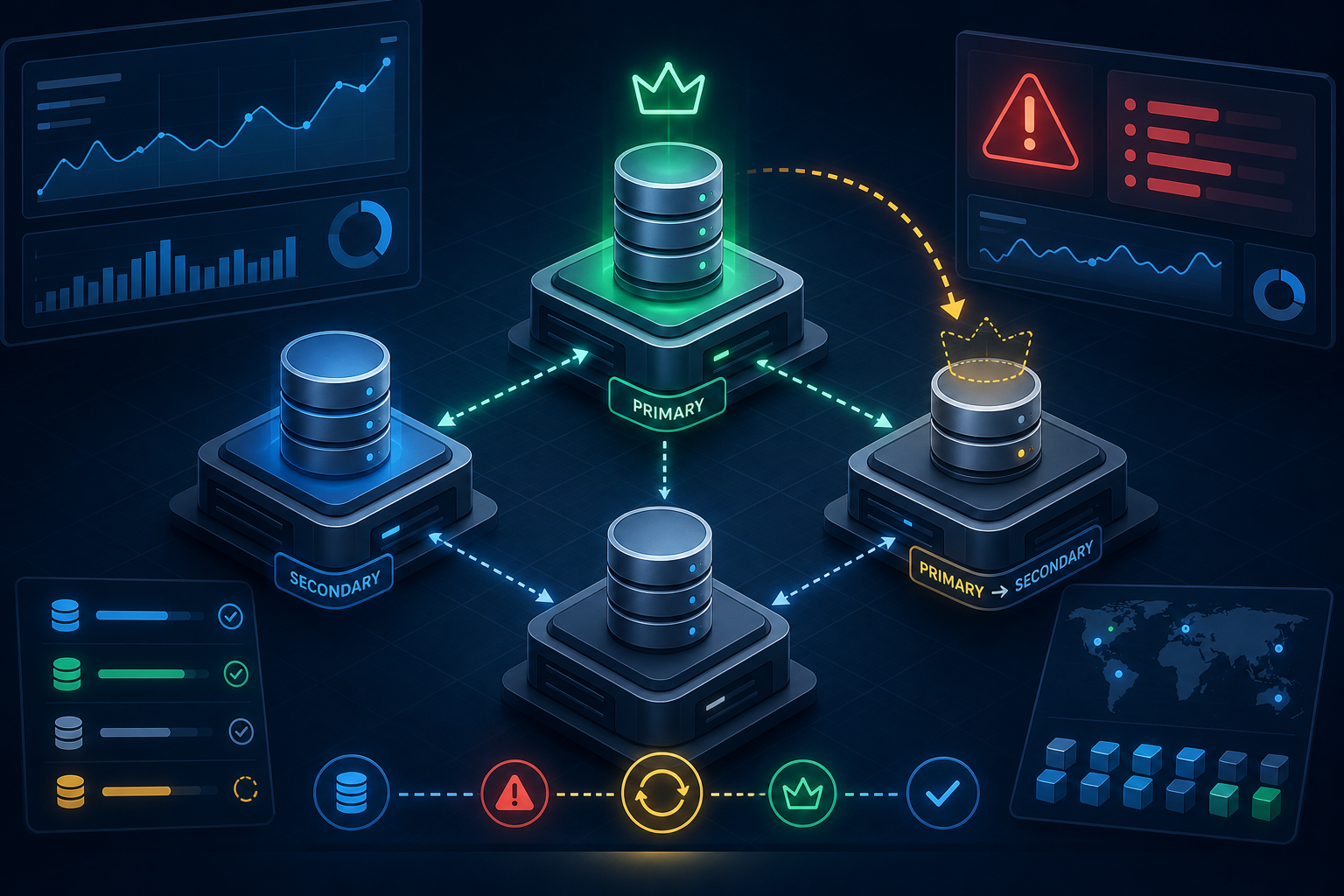
Key takeaways
MongoDB replica set failover is not just a database event; it is an application availability event. When the primary changes, writes may pause, client sessions can see transient errors, and monitoring must distinguish between a healthy election and a genuine outage.
The practical goal is simple: detect the failover quickly, confirm which node became primary, decide whether the change was expected, and validate that clients have reconnected cleanly. In environments with strict uptime or security controls, the most important work is often not forcing a failover but proving that recovery is safe and complete.
A good failover response relies on three things: timely signals from the replica set, correct interpretation of the election outcome, and a short validation workflow that checks the database and application layers together. If your operational runbooks already focus on data layout or query efficiency, MongoDB Indexing Best Practices for Faster Query Performance can help ensure that recovery checks do not hide a separate performance problem.
Why replica set failover matters operationally
A replica set exists to preserve availability when one node becomes unavailable, but failover is not invisible. The moment the primary steps down or becomes unreachable, the cluster begins an election. During that interval, writes are typically unavailable and some clients may see retryable errors, timeouts, or topology refresh delays. The operational question is therefore not whether failover happens, but whether your systems detect it fast enough to avoid extended impact.
This matters most in three situations. First, planned maintenance, where a controlled switchover should preserve service continuity and leave a clear audit trail. Second, unplanned node loss, where you need to know whether the remaining members can elect a healthy primary. Third, partial network failures, where a node may still be running but isolated from the majority, causing election behavior that looks like a database problem when the real issue is connectivity or quorum.
Failover response also intersects with security and access controls. If clients are pinned to a single address, if TLS trust is misconfigured, or if authentication metadata is stale, the database may elect a new primary correctly while applications still fail. That is why recovery should include both topology checks and connection-path checks, not just a node health check.
How failover works in practice
A replica set uses election rules to choose a primary from the available voting members. When the current primary becomes unavailable, steps down, or is no longer reachable by a majority, the remaining members assess state, priority, and freshness before electing a new primary. Clients that understand replica set topology will usually rediscover the new primary automatically, but they still need time to update their view.
In practice, failover may be triggered by maintenance, process crash, host failure, storage issues, network partitions, or an intentional stepdown. The external symptom is often the same: writes fail temporarily, the old primary no longer accepts write traffic, and the cluster transitions through an election period. The difference is in what you should do next.
If the event is expected, the objective is to verify that the elected primary is the correct node and that clients recover without manual intervention. If the event is unexpected, the objective is to determine whether there is a single-node failure, a quorum issue, or a broader infrastructure problem. For teams who also maintain query reliability under failover, Designing Secure MongoDB Indexes for High-Performance Queries is relevant because poor index design can magnify the apparent impact of a failover during read-heavy fallback behavior.
Compact workflow
Detect election event
  -> confirm current primary
  -> check replica set health and majority
  -> identify cause: expected maintenance or unexpected loss
  -> validate client reconnection and write success
  -> watch for rollback, lag, or repeated elections
  -> return to normal operations only after all checks pass
Detecting failover quickly
The fastest reliable detection comes from combining database signals with infrastructure signals. A single error counter rarely tells the full story. Instead, look for a pattern: one member loses primary status, election messages appear in logs, write errors spike briefly, and client connection pools refresh their view of the topology.
At the database layer, confirm which node is primary and whether the set still has a majority. Useful checks are the current member state, election metadata, replication lag, and whether a node is in a recovering or unreachable state. At the infrastructure layer, check process health, host reachability, storage latency, and any recent change in networking or firewall policy.
A practical detection rule is this: if clients report write failures but the database shows a healthy primary and majority, suspect connection path or application-side topology handling. If the database cannot maintain majority or repeatedly re-elects a primary, treat it as an infrastructure or quorum issue first.
What to look for first
- A change in primary role or election messages in the database logs
- Temporary write failures or retryable errors in the application tier
- Replica members with lag, unreachable state, or inconsistent connectivity
- Cluster health indicators showing no writable primary or no majority
- Recent maintenance, host reboot, network reconfiguration, or certificate changes
The key point is speed with precision. Fast detection is useful only if it points you toward the right class of problem. Otherwise, teams waste time restarting healthy services while the real issue persists.
Confirming the elected primary and the health of the set
Once failover is detected, the first recovery question is whether the new primary is legitimate. Do not assume that the node with the most recent heartbeat is the right one. Confirm that it is writable, that it has majority support, and that the old primary is either demoted or safely isolated.
From an operational standpoint, you want three confirmations. The elected primary should be in a writable state. The rest of the replica set should agree on the topology. And the application should be able to discover the new primary through its normal connection path.
This is also where many teams uncover hidden problems. A node may be technically primary but still unsuitable for production because of high replication lag, disk pressure, clock drift, or low resource headroom. In security-sensitive environments, you should also verify that authentication and TLS checks remain consistent after the election, especially if clients terminate through a load balancer or service mesh.
A reliable validation pattern is to check the database view first, then a client write, then a read from the expected path. If those three pass, you have much stronger evidence that failover completed successfully than any single dashboard metric can provide.
Recovering safely after failover
Safe recovery is mostly about restraint. The worst reaction to a brief election is to restart multiple nodes, change topology settings on the fly, or manually force another election without understanding why the first one occurred. The safer pattern is to stabilize the environment, verify the new primary, and only then decide whether to intervene.
If the event was expected, recovery usually means confirming that the planned stepdown or host maintenance completed cleanly and that replication caught up. If the event was unexpected, recovery means identifying the root cause before returning the system to normal operational confidence. In particular, repeated elections, uneven lag, or asymmetric connectivity indicate that the underlying issue is still active even if the cluster appears writable again.
The practical objective is to avoid a false recovery. A replica set can look healthy while one member is unstable, a network path is degraded, or clients still target stale endpoints. That is why post-failover validation should include both the cluster and the application path.
Practical scenario: a primary host is rebooted during maintenance
Consider a production replica set where the primary host is taken down for patching. The operator expects a failover, but the application begins logging intermittent write errors and a small subset of API requests time out longer than usual. The replica set itself elects a new primary within an acceptable window, yet client behavior remains uneven.
This is a common pattern in environments with mixed client libraries or stale connection pools. The database election may be successful, but some app instances still hold connections that need to refresh. In other cases, DNS, firewall rules, or load balancer targets cause traffic to hit a node that no longer matches the expected topology. If the application also performs expensive queries during failover, the symptoms can resemble a database outage even though the real issue is elevated latency and retry behavior.
What this means in practice is that recovery should not stop when the new primary appears. You still need to verify that all application tiers are rediscovering the topology, that retry logic is functioning, and that the cluster is not entering a second election because the maintenance activity affected more than one voting member.
Decision guidance: when to observe, when to intervene, when to escalate
Not every failover needs manual action. The right response depends on whether the cluster has majority, whether the election completed, and whether the application recovered within your tolerance window.
Observe only when the election is clearly progressing, majority remains available, and client errors are brief and diminishing. Intervene when the new primary is unhealthy, the election is stuck, or clients continue failing after the cluster has stabilized. Escalate immediately when multiple members are down, the set cannot form a majority, or connectivity changes suggest a broader infrastructure or security event.
A useful decision rule is to separate symptoms into three buckets:
- Healthy failover: one primary changed, election completed, clients recovered, lag remains acceptable.
- Degraded recovery: failover completed but client errors, lag, or retries persist.
- Broken failover: no stable primary, repeated elections, or majority loss.
Only the first case should move quickly back to normal operations. The second requires focused investigation. The third is an availability incident until proven otherwise.
Implementation trade-offs
Replica set failover is a resilience feature, but its behavior depends on topology and client design. More voting members improve election safety, but they also add operational overhead. Higher availability settings can reduce the chance of split-brain-like symptoms, but only if the network is stable and the quorum design is correct.
There is also a trade-off between failover speed and client stability. Aggressive retry behavior can mask short outages, but it can also amplify load during an election if many clients retry at once. Conservative retry settings reduce pressure on the cluster, but they can make a brief election look like an application outage. The right balance depends on workload criticality and the connection pattern used by your services.
Monitoring depth is another trade-off. Heavy telemetry gives you faster diagnosis, but too much alerting can produce noise during legitimate elections. The most useful signals are usually the simplest: role change, majority status, replication lag, client write success, and evidence of repeated elections.
Common mistakes during failover recovery
One common mistake is assuming the first node that reports healthy is the correct primary. Another is restarting application services before verifying the database election outcome, which can turn a short failover into a longer outage if the app reconnects too early or to the wrong endpoint.
Teams also often miss the distinction between a primary loss and a majority loss. If a replica set cannot maintain quorum, recovery may require infrastructure repair rather than database tuning. Similarly, ignoring replication lag can create a situation where the set is writable but not yet safe to trust for time-sensitive work.
A final mistake is declaring success too early. If clients still experience retries, if logs show topology churn, or if a secondary is far behind, the system is still in a fragile state even if basic reads and writes appear to work.
What this means in practice
For day-to-day operations, the best failover response is a short, evidence-based validation sequence. You are not trying to prove every component is perfect. You are trying to prove that the elected primary is correct, the replica set still has quorum, the application can reconnect, and no hidden instability remains.
That means your runbook should answer four questions quickly: Did the primary change? Is the new primary writable? Do the remaining members agree on the topology? Are client writes succeeding again? If you can answer those with evidence, you can usually make a sound decision about whether to continue monitoring or escalate.
It also means that failover should be measured as a full-stack event. Database metrics alone are not enough, and application errors alone are not enough. The useful picture comes from both.
Production readiness checklist
Use this checklist to confirm your environment can handle failover without guesswork:
- The replica set has a clearly defined voting and priority design.
- Monitoring alerts on primary changes, election events, and majority loss.
- Client applications use replica set-aware connections and retry behavior appropriate to the workload.
- Operational runbooks distinguish planned stepdown from unplanned loss.
- Logs and metrics are retained long enough to reconstruct election timing.
- Connectivity, DNS, TLS, and firewall paths are verified for all replica set members.
- Post-failover checks include a real write test, not just a status query.
- The team knows the criteria for stable recovery versus escalation.
- Any maintenance plan includes a rollback path if the expected primary does not return cleanly.
- Security controls are validated after role changes, not only during normal operation.
Failover is successful when the system elects a valid primary, clients recover with minimal disruption, and the cluster remains stable after the event. If you can prove those three outcomes quickly, you have a practical recovery process rather than just a theoretical replica set design.