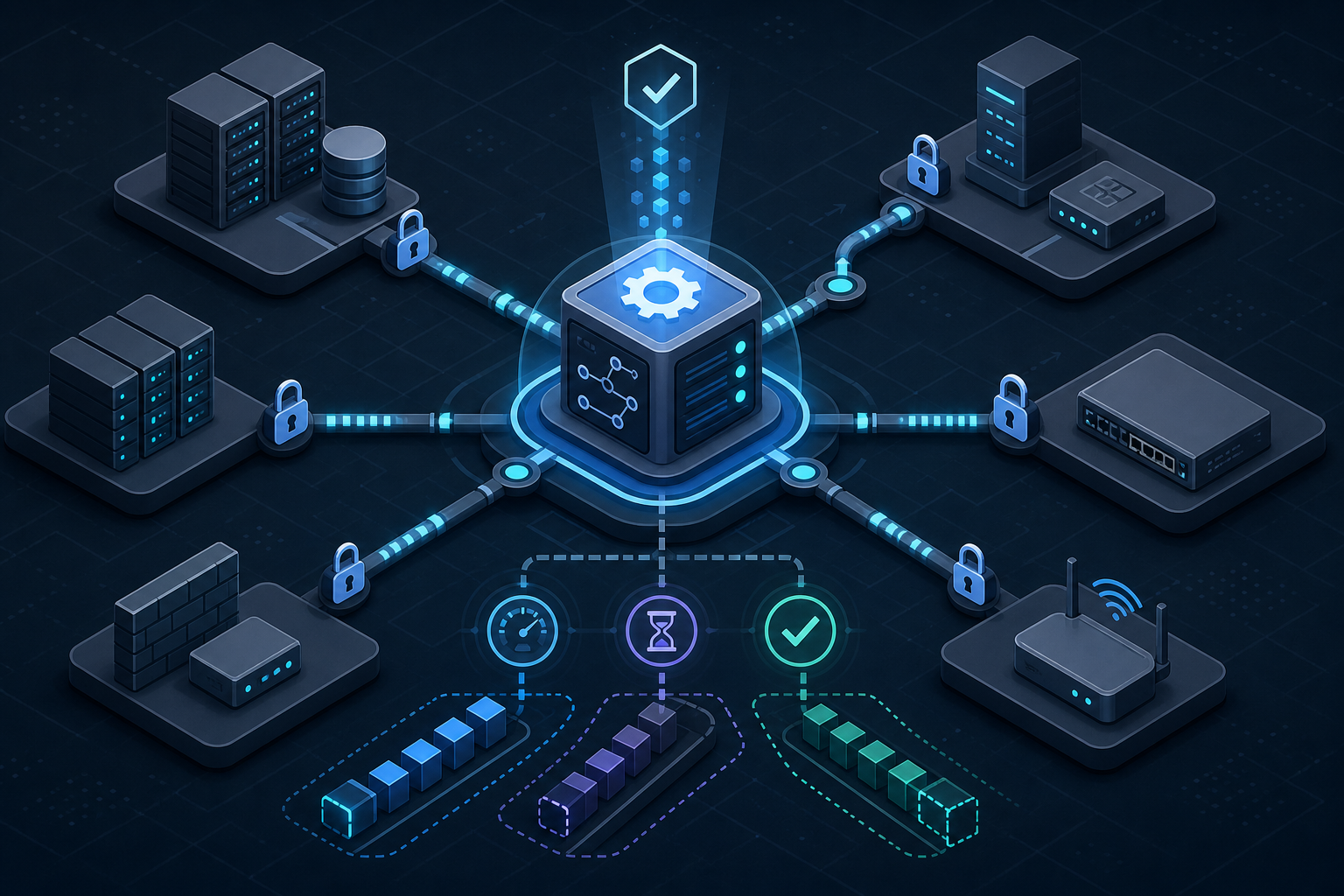
The operational problem
Network automation breaks down quickly when scripts block, hang, or accept unsafe input from upstream systems. In practice, that means a maintenance job can stall on a single slow device, credentials can be exposed through careless process handling, or a burst of concurrent tasks can turn into an uncontrolled failure cascade. Python asyncio helps solve the concurrency side of that problem, but secure automation depends on more than non-blocking I/O.
This article explains how to use Python asyncio patterns for secure network automation so you can run many remote operations concurrently, keep failure boundaries tight, and validate behavior before production use. After reading it, you should be able to decide when asyncio is a fit, apply a practical workflow for safe task execution, and verify the checks that matter before you let the code touch production devices or security-sensitive endpoints.
Key takeaways
asyncioimproves network automation most when the bottleneck is remote latency, not CPU work.- Security and reliability depend on bounded concurrency, explicit timeouts, cancellation handling, and strict output validation.
- Unsafe subprocess calls, untrusted command arguments, and unbounded task fan-out are common failure points.
- A secure design treats every remote call as partial and fallible, not as a guaranteed success path.
- Production readiness requires validation of timeout behavior, exception handling, logging, and input constraints under realistic failure conditions.
Why this matters in operational environments
Network automation tends to fail in ways that are expensive to debug. A job may appear healthy while it is actually waiting on one device that never returns. Another task may finish successfully, but its output may be malformed, truncated, or polluted by shell interpolation. In a security-sensitive environment, those failure modes are not just reliability problems; they can become control-plane risks if automation assumes success without verification.
asyncio is useful because it lets one Python process manage many socket-driven operations efficiently. That makes it a strong fit for tasks such as configuration drift checks, inventory collection, API polling, or orchestrating remote commands across multiple endpoints. But concurrency alone does not make the workflow safe. You still need to decide how many tasks may run at once, what happens when one task fails, how long you wait, and how to validate the results before using them downstream.
A practical rule is simple: use asyncio when the work is mostly waiting on network responses or external processes, and use defensive control flow when the outputs may influence privileged changes. If the code launches subprocesses as part of the workflow, review command construction and exit-code handling carefully; the same applies when your automation relies on external helpers or parsers. For that part of the stack, Python Asyncio Subprocess Management for Secure Automation is a relevant companion because subprocess safety is often the place where otherwise good async code becomes fragile.
How secure asyncio network automation works
The core pattern is to separate concurrency from trust. asyncio manages scheduling, but your code defines the boundaries:
- Input boundary: validate hostnames, addresses, identifiers, and command parameters before they enter the async workflow.
- Execution boundary: apply timeouts, concurrency limits, and cancellation behavior per task.
- Result boundary: parse and verify output before the data can affect state, logs, or follow-on actions.
- Failure boundary: classify errors so one failure does not silently contaminate the whole batch.
This is especially important for network automation because each remote call may fail differently. A TCP connect timeout is not the same as an authentication error, and neither is equivalent to a malformed payload or an unexpected exit status. Secure patterns keep those cases distinct so that retries, alerts, and rollbacks can be handled intentionally.
A useful design choice is to make each unit of work small and observable. Rather than running one large opaque coroutine that connects, authenticates, fetches data, parses results, and writes them somewhere, split the operations into bounded stages. That makes timeout behavior more predictable and makes it easier to isolate unsafe output handling.
Compact workflow block
validate input -> bound concurrency -> start task group -> apply per-task timeout
-> collect result or error -> verify output schema -> log sanitized outcome
-> fail closed on ambiguity
This workflow is compact by design. It reflects a secure default: if a task returns something unexpected, treat it as a failure until a human or a separate validation rule confirms it is safe to use.
Practical scenario: polling a mixed fleet during a change window
Consider a change window where you need to verify interface status and version consistency across a mixed fleet of routers, firewalls, and load balancers. The environment is familiar to many engineers: some endpoints are fast and stable, some are intermittently slow, and a few occasionally return partial responses or vendor-specific quirks. The automation must finish within the window, but a single delayed host should not block the entire run.
In that environment, a secure asyncio design might fan out requests in controlled batches, assign a per-host timeout, and normalize outputs into a common schema. If a device returns an unexpected banner or malformed JSON, the code records the anomaly and marks that host as failed rather than attempting to infer meaning from incomplete data. If the inventory source contains malformed host identifiers, those values are rejected before any connection attempts begin.
That behavior is operationally useful because it gives you a clean pass/fail view without forcing the rest of the fleet to wait on a bad endpoint. It also reduces the temptation to over-trust the first successful response in a batch.
Pattern 1: bound concurrency instead of launching everything at once
One of the most common mistakes in async automation is assuming that more concurrency always improves throughput. In reality, remote systems have rate limits, session limits, authentication throttles, and control-plane resource constraints. Unbounded task creation can create self-inflicted outages or trigger defensive controls on the targets.
Use a semaphore or a worker pool to cap concurrency at a value your environment can absorb. The right limit depends on endpoint capacity, network latency, authentication method, and whether the task is read-only or state-changing. The safe answer is usually not “as high as possible”; it is “high enough to meet the window without overwhelming the weakest target.”
A decision rule helps here: if you cannot explain why a specific concurrency limit is safe for the target class, start low and measure. If the failure mode of saturation includes timeouts, dropped sessions, or lock contention, treat that as a security and reliability signal, not just a performance issue.
Pattern 2: treat timeouts as a required control, not a convenience
Timeouts are one of the most important security and reliability boundaries in network automation. Without them, a stalled socket or slow remote process can hold resources indefinitely and reduce the effectiveness of retry logic. With them, you can define what “slow enough to fail” means for each operation class.
For network tasks, use both an outer timeout for the overall job and a per-request timeout for each remote action. That prevents one bad endpoint from consuming the whole run and helps you separate a batch-level failure from a single-host failure. If the behavior of your chosen timeout strategy matters to the correctness of the job, validate it explicitly; Python Asyncio Timeout Handling for Reliable Network Tasks is useful context because timeout semantics often determine whether cancellation is clean or messy.
The practical point is that a timeout should lead to a known outcome. It should cancel work, release resources, and produce a structured error that can be logged and aggregated. It should not leave a coroutine half-finished while the caller assumes the operation succeeded.
Pattern 3: make cancellation explicit and predictable
Cancellation in asyncio is normal control flow, not an exceptional edge case to ignore. In a secure automation context, cancellation may happen because a timeout was exceeded, a batch exceeded its error threshold, or the operator stopped the run. The code should be able to shut down without leaking connections, writing partial state, or masking the real reason for termination.
The important behavior is not just whether a task can be canceled, but whether it cleans up correctly. If a task opens a connection, starts a remote operation, or acquires any temporary resource, it should release that resource in finally blocks or equivalent cleanup paths. If you suppress cancellation blindly, the event loop may continue carrying work that the caller believes has already stopped.
A secure approach is to propagate cancellation unless you have a specific reason to convert it into a task-level failure. When conversion is necessary, preserve the original cause in structured logs so operators can distinguish timeout-driven termination from application errors.
Pattern 4: validate every result before it becomes input to the next stage
Automation pipelines often fail when one stage trusts another stage too much. In async network workflows, that can happen when the code parses remote output and immediately feeds it into a device change, a remediation action, or a report that drives decisions.
Validation should include the structure and the content. For example, if a task is expected to return JSON, verify that the payload parses, that required keys exist, and that the values fit allowed ranges or patterns. If a command returns text, use strict parsing rules instead of ad hoc string matching whenever possible. If the result is used to identify hosts, interfaces, or policy objects, treat unexpected characters as data quality errors rather than normal variation.
This is where secure automation and reliable automation meet. A malformed response is not just a nuisance; it can be a sign that the system is talking to the wrong endpoint, that a proxy or middlebox altered traffic, or that a helper process returned contaminated data.
Pattern 5: keep subprocess use defensive and narrow
Many network automation workflows use external tools, parsers, or helper utilities. That can be appropriate, but the boundary between Python and the subprocess is sensitive. Pass arguments as lists, avoid shell interpolation, enforce timeouts, inspect exit codes, and normalize output before using it. If you accept user-supplied values that reach the command line, validate them as data, not as command fragments.
In async code, it is also easy to assume that wrapping a subprocess in a coroutine makes it safe by default. It does not. You still need to control what gets executed and what happens if the helper hangs or returns partial data. This is especially relevant when the subprocess output becomes the source of truth for inventory, compliance, or remediation decisions.
What this means in practice
A secure asyncio automation script should behave like a disciplined operator, not a hopeful executor. It should refuse suspicious input, limit the number of simultaneous operations, stop waiting when a task exceeds policy, and report failures in a way that supports triage.
In a real environment, that means your code should answer questions such as:
- Did the job stop because one host failed, or because the global timeout expired?
- Did the output parse cleanly, or was it only partially readable?
- Did the run respect the intended concurrency limit under load?
- Did cancellation free connections and child processes properly?
- Were any unexpected values dropped, flagged, or quarantined before they reached later stages?
If you cannot answer those questions from logs or structured results, the workflow is not production-ready yet.
Implementation trade-offs to consider
asyncio is not always the best answer, even for network automation. The main trade-off is operational complexity. You gain efficiency and responsiveness, but you also inherit event-loop semantics, coroutine lifecycle management, cancellation behavior, and more careful error handling.
A few practical trade-offs matter most:
- Speed versus control: higher concurrency improves throughput until target systems start throttling or failing.
- Simplicity versus observability: small coroutines are easier to reason about, but too many tiny tasks can make tracing harder without good logging.
- Readability versus abstraction: helper wrappers reduce repetition, but over-abstracted async code can hide timeouts and exception paths.
- Native async versus subprocess-based helpers: native async is usually cleaner for network I/O, while subprocesses add safety and parsing concerns that must be handled explicitly.
A good default is to prefer native async libraries for network I/O where available, then add subprocesses only when a trusted external utility is genuinely the better tool. When subprocess orchestration becomes part of the design, review the command execution model carefully before production use.
Decision guidance: when this approach fits
Use Python asyncio for secure network automation when most of the runtime is spent waiting on remote responses, when you need to contact many endpoints in parallel, and when you can define clear limits for timeouts and concurrency. It is a strong fit for inventory collection, health checks, configuration verification, and API-driven orchestration.
Do not force asyncio into a workflow that is mostly CPU-bound, mostly local file processing, or dominated by complex sequential business logic. In those cases, the added lifecycle complexity may outweigh the concurrency benefit. Also be cautious if your organization cannot operationalize structured logging, timeout policy, or input validation, because async code without those controls can fail faster and more opaquely than a synchronous script.
If the workflow is security-sensitive, the decision should also consider blast radius. A design that makes it easy to fan out hundreds of calls should also make it easy to stop, audit, and contain failures. If it cannot, reduce the scope until it can.
Common mistakes that weaken secure async automation
The most common mistake is assuming that asynchronous execution is automatically safer because it is more modern or more efficient. It is not. It is only safer when the boundaries are designed explicitly.
Other frequent errors include:
- launching too many tasks and overwhelming a device or API;
- omitting per-task timeouts and waiting indefinitely on a hung endpoint;
- swallowing
CancelledErroror equivalent cancellation signals without cleanup; - trusting remote output before validating structure and content;
- passing unvalidated user input into subprocess commands;
- using logging that records sensitive material in raw form;
- treating partial success as full success in batch workflows.
If you recognize one of these patterns in existing automation, the fix is usually not a rewrite. It is often a combination of tighter limits, clearer error propagation, and stricter validation before results leave the task boundary.
Production readiness checklist
Before production use, confirm the following in a realistic test environment:
- Concurrency is intentionally capped and justified for the target systems.
- Every remote operation has a defined timeout.
- Cancellation releases network sessions, file handles, and subprocesses cleanly.
- Exceptions are classified into actionable categories, not flattened into generic failures.
- Output parsing rejects malformed or partial data.
- Sensitive data is not written to logs in raw form.
- Retry behavior is limited and does not amplify failure storms.
- Subprocess calls, if used, avoid shell interpolation and enforce exit-code checks.
- The workflow has been tested against slow targets, invalid inputs, and partial failures.
- Operators can tell from logs whether the run failed, timed out, or was canceled.
Final takeaway
Python asyncio is a strong foundation for secure network automation when you treat concurrency as only one part of the problem. The real value comes from pairing non-blocking I/O with strict timeouts, bounded fan-out, careful cancellation, and validation that refuses unsafe or ambiguous output. If you can explain those controls clearly, verify them under failure conditions, and keep the task boundaries narrow, the approach is ready for serious operational use.
Use this guidance together with git rebase and rebase git commits without losing local changes to connect the workflow with related operational context already available on the site.