Key takeaways
Production API resilience depends less on avoiding errors and more on handling them consistently. In Node.js, that means classifying failures early, normalizing asynchronous errors, returning safe HTTP responses, and deciding which errors should terminate the process rather than be hidden.
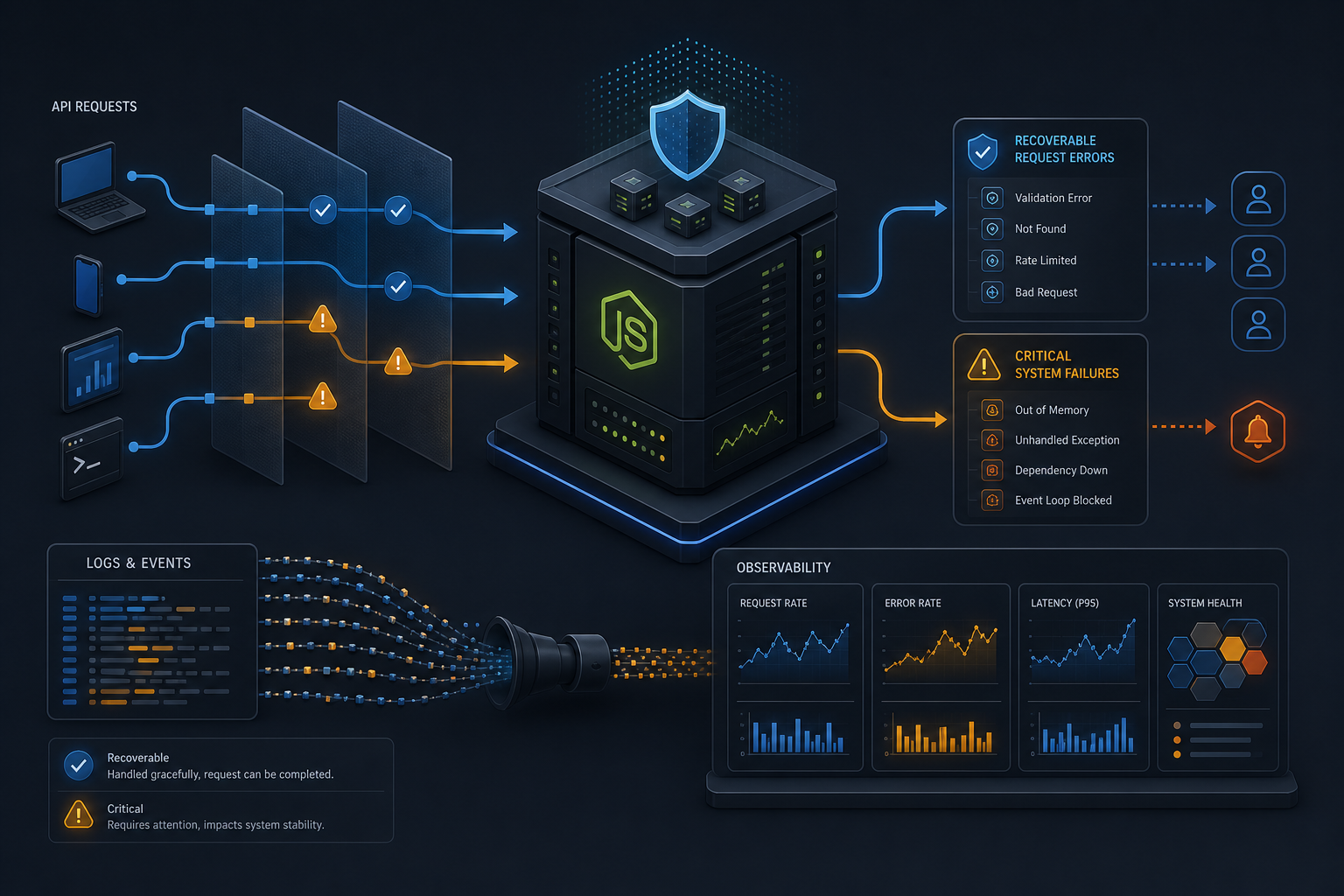
A strong error strategy gives you three things: predictable client behavior, useful operational signals, and a clear boundary between recoverable request failures and unrecoverable process failures. It also reduces the chance that one bad dependency, one malformed payload, or one unhandled rejection turns into a broader outage.
Why Node.js error handling matters in production APIs
The practical problem is simple: a production API rarely fails in one clean place. A request may begin with valid input, then hit a timeout in a downstream service, a validation issue in a payload mapper, and a database conflict during write. If those failures are handled inconsistently, clients receive random status codes, logs lose context, and the process can continue in an unsafe state.
Node.js adds one more concern: asynchronous execution makes it easy to separate the error from the code that caused it. That is useful for throughput, but it also means a missing await, a rejected promise, or an exception inside a callback can bypass your intended control flow if you do not standardize error handling.
This matters operationally because API resilience is not just about uptime. It is about preserving data integrity, returning actionable responses, and making sure one request failure does not become an incident. If your service handles CPU-heavy work or long-lived requests, it is also worth pairing error strategy with Node.js Event Loop Performance Tuning for High-Load Apps so timeouts and latency spikes are not mistaken for application bugs.
The core error model in Node.js APIs
A practical Node.js API usually needs to handle four broad categories of failure.
First are expected client errors: invalid JSON, missing fields, unsupported values, or authorization failures. These are not exceptions in an operational sense; they are part of normal request handling and should produce deterministic 4xx responses.
Second are transient system failures: database pool saturation, network timeouts, DNS failures, rate limits, and brief dependency outages. These often deserve retries, circuit breaking, or controlled degradation, but only when the operation is safe to repeat.
Third are application defects: null dereferences, incorrect assumptions, serialization bugs, and logic errors. These are usually 5xx responses and should be highly visible in logs and telemetry because they indicate code or design defects.
Fourth are unrecoverable process conditions: memory corruption in native extensions, invariant violations, or states where continuing may risk data integrity. These cases should not be hidden behind a generic error response. The process may need to terminate cleanly after logging and draining traffic.
The key design decision is to separate request-level failures from process-level failures. If every error is treated as a recoverable request error, the service may keep running in a compromised state. If every error is treated as fatal, the service becomes brittle and noisy.
How resilient error handling works in practice
Resilient APIs usually combine three layers: local error handling inside the request path, centralized translation into HTTP responses, and process-level safety nets for the failures that should not be swallowed.
At the request level, each boundary should validate assumptions early and convert unexpected exceptions into a typed error object or controlled failure. That usually means checking input before business logic runs, wrapping asynchronous operations that can fail independently, and preserving a causal chain so logs show where the failure started.
At the response level, one error normalization path should map internal failures to a consistent external shape. The exact response schema varies, but the same principle applies: clients should not see stack traces, arbitrary message text, or different formats depending on which controller or helper failed.
At the process level, unhandled exceptions and rejected promises should be treated as defects in your control flow, not as routine events. In Node.js, you should make a deliberate decision about how your runtime treats those conditions. If the process cannot guarantee correct state after the failure, terminate it cleanly and let the orchestrator replace it.
The architecture also benefits from observability hooks. Error logs should include a correlation identifier, request context, error type, and outcome. That context is what lets you distinguish a real defect from a downstream timeout or a bad client request. When those logs are paired with heap and latency diagnostics, you can tell whether an error spike is connected to resource pressure or simply a bad release; for memory-related symptoms, Node.js Memory Leak Debugging with Heap Snapshots is often the right complementary analysis.
A compact workflow for production error handling
Use this workflow as a decision path when you design or review an API endpoint:
Request enters
  -> validate input
  -> classify failure type
  -> execute business logic
  -> translate known errors to controlled response
  -> log unexpected errors with context
  -> decide retry / fallback / fail fast
  -> on unrecoverable failure, terminate cleanly
The value of this workflow is that it forces you to ask the right question at each boundary: is this a client issue, a transient dependency issue, an application defect, or a process integrity issue? That classification determines the response code, the retry policy, the log level, and whether the process should continue.
Practical pattern: a typed error boundary for routes
A common implementation pattern is to define a small set of error classes or error codes and handle them through one middleware layer. The point is not to create a large exception hierarchy. The point is to make request failures explicit enough that your API can respond consistently.
class AppError extends Error {
  constructor(message, statusCode, code, options = {}) {
    super(message, options);
    this.name = 'AppError';
    this.statusCode = statusCode;
    this.code = code;
    this.expose = options.expose ?? false;
  }
}

function errorHandler(err, req, res, next) {
  const statusCode = err.statusCode || 500;
  const code = err.code || 'INTERNAL_ERROR';

  req.log?.error({ err, code, statusCode, path: req.path }, 'request failed');

  res.status(statusCode).json({
    error: {
      code,
      message: err.expose ? err.message : 'Internal Server Error'
    }
  });
}
This pattern gives you a controlled exit for known failures and a safe fallback for unknown failures. For a validation problem, the error can be exposed safely with a 400-class code. For an unexpected exception, the response stays generic while the logs retain full detail.
The trade-off is that you must be disciplined about what gets exposed. Any field intended for clients should be reviewed as if it were public API surface. That includes nested messages from validation libraries and upstream services.
What this means in practice
In a real API, this pattern changes how your team writes handlers. A route should not contain ad hoc try/catch blocks that each format responses differently. Instead, the handler should throw or forward typed errors and let one boundary decide how to answer the client.
Consider a payment or provisioning workflow. A request may fail because the caller sent an invalid account identifier, because the upstream service is temporarily unavailable, or because the database write did not commit cleanly. Those are not interchangeable failures.
A client error should return a stable 4xx response that tells the caller what to fix. A transient upstream problem may return a 503 or 504, possibly with a retry-safe signal. A write failure after partial progress may require compensating logic or a rollback decision, not a blind retry. This is where error handling becomes an operational control, not just a coding style choice.
If your system performs multiple asynchronous operations in sequence, remember that async/await does not remove failure complexity; it only changes how it is expressed. Every awaited operation is a possible fault boundary. If the request path contains concurrency, rate limits, or fan-out calls, keep the error path as explicit as the success path.
Common patterns and their trade-offs
The simplest pattern is inline try/catch around every awaited operation. This is easy to read for small handlers, but it often scatters response logic and makes it harder to enforce consistency. It is usually acceptable for very small services, but it does not scale well across teams.
A centralized error middleware is more maintainable because it keeps response formatting in one place. The trade-off is that you need reliable error classification upstream. If a helper throws only generic Error objects, the middleware cannot tell a client issue from a code defect.
Using custom error classes improves classification and observability. The trade-off is architectural discipline: you must decide which errors are safe to expose, which status codes are allowed, and whether the extra structure is worth the maintenance cost.
Retries and fallbacks are useful for transient failures, but they can worsen incidents if applied blindly. Retrying a non-idempotent write can duplicate side effects. Falling back to cached data can hide data freshness issues. These patterns should be attached only to operations that are safe to repeat or degrade.
Process-level handlers such as uncaughtException and unhandledRejection are safety nets, not normal control flow. They are useful for logging and terminating cleanly, but they should not be used to continue serving traffic after an unknown invariant break. If you keep the process alive after a fatal condition, you may trade a small error into a larger incident.
Decision guidance for production teams
Use the following rules when deciding how to handle a failure.
If the caller can fix the request without changing the server state, treat it as a client error and respond with a stable 4xx code.
If the failure comes from a temporary external dependency and the operation is safe to repeat, consider retry, backoff, or circuit breaking.
If the failure indicates a defect in your code or deployment, return a 5xx response, log the full context, and prioritize investigation.
If the process may now be in an unsafe state, do not mask the failure. Log it, flush telemetry if possible, and terminate cleanly so the runtime can be restarted under normal orchestration.
A useful test is this: if you would not trust the service to process the next request correctly after the error, the error is not merely a request failure. It is a stability problem.
Common mistakes that undermine resilience
One common mistake is leaking internal stack traces or dependency messages to clients. This creates information disclosure risk and couples client behavior to implementation details. The safe default is to expose only deliberate, documented error fields.
Another mistake is catching every error and returning 200 OK with an error payload. That makes client behavior ambiguous, breaks monitoring, and hides operational failures from alerting systems.
A third mistake is retrying every failed operation. Retries should be selective, bounded, and tied to idempotency and timeout policy. Otherwise, they can amplify load during partial outages.
Teams also underappreciate missing context in logs. An error without request ID, route, user or tenant context, and error classification is hard to use in production. You want enough context to correlate events without logging sensitive payloads.
Finally, some services treat uncaughtException as a recovery hook. In practice, that often leads to continued execution after state corruption or partial cleanup. If you use those hooks, use them to preserve evidence and shut down safely.
Compact production readiness checklist
Before production use, verify the following behaviors in a staging environment that resembles production traffic and dependency timing:
- Known validation failures return consistent 4xx responses with no stack traces.
- Unexpected exceptions are logged with correlation context and a stable 5xx response.
- Rejected promises and thrown async errors are captured by the same error boundary path.
- Downstream timeouts map to an intentional timeout status and do not hang requests indefinitely.
- Retries are limited to safe, idempotent operations and are bounded by timeout policy.
- Sensitive details are not exposed in client-facing error messages.
- Unrecoverable process failures trigger clean shutdown behavior rather than silent continuation.
- Error logs are searchable by route, status code, and error type.
- The service recovers correctly after restart, with no hidden in-memory state required to resume normal operation.
Final takeaway
Node.js error handling patterns are resilient when they make failure classification explicit, keep client responses consistent, and treat process integrity as non-negotiable. The practical goal is not to eliminate errors; it is to ensure each error produces the right response, the right telemetry, and the right operational decision.
If your current API mixes validation failures, dependency outages, and fatal defects into one generic catch-all path, you probably have a reliability problem disguised as a code-style problem. A clearer error boundary, a single response translation layer, and a disciplined shutdown policy will usually give you a more stable production service than adding more ad hoc try/catch blocks.
Use this guidance together with git rebase vs merge to connect the workflow with related operational context already available on the site.
Part of the Programming: Node.js Insights content cluster.