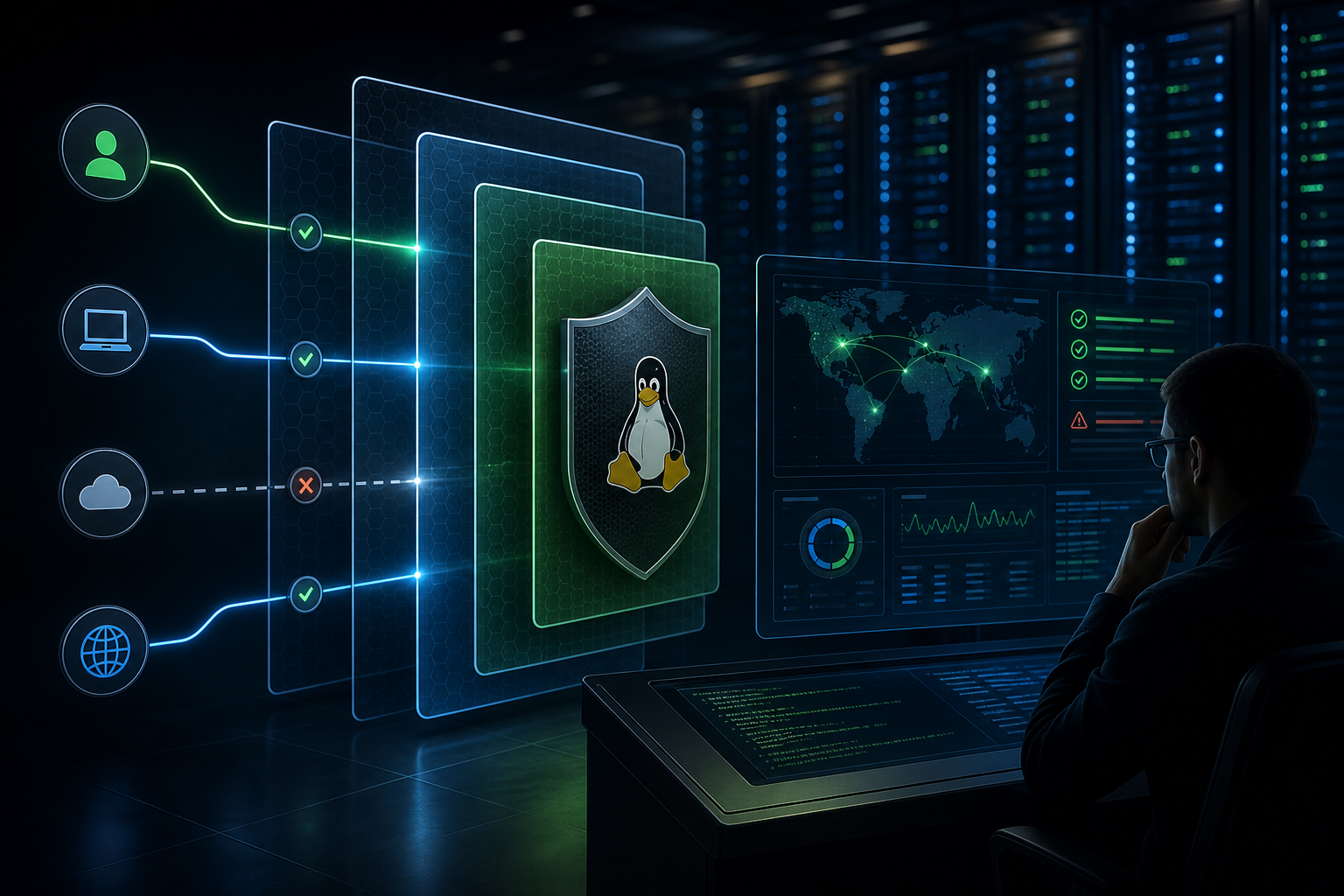

Why SELinux matters on a Red Hat system
The practical problem is simple: a service that is configured correctly at the application layer can still become a security liability if it is allowed to access more of the host than it actually needs. On Red Hat systems, SELinux policies help close that gap by confining processes, files, ports, and inter-process interactions to the minimum required set. That matters operationally because it reduces the blast radius of a compromised daemon, makes privilege boundaries explicit, and gives you a controllable enforcement layer that survives many application mistakes.
After reading this article, you should be able to decide whether SELinux policy hardening fits your environment, understand how policy enforcement works in practice, apply a compact validation workflow, and verify the right signals before moving changes into production.
Key takeaways
SELinux is most valuable when you want the host to enforce least privilege even if an application, package, or configuration change is imperfect. It is not a substitute for patching, access control, or secure service design, but it is one of the few mechanisms that can still contain damage when those controls fail.
In practical terms, hardening with SELinux policies means three things:
- Keep enforcing mode enabled whenever possible.
- Use policy and labels to allow only the accesses a service genuinely needs.
- Treat denials as evidence to investigate, not as something to silence immediately.
If you already manage Red Hat Enterprise Linux workloads, the operational model described in Hardening Red Hat Enterprise Linux with SELinux Policy Controls is the natural companion to this article because it focuses on policy controls and validation from an administrative perspective.
What SELinux is actually doing
SELinux is a mandatory access control system. Traditional Linux permissions answer a coarse question: does this user, group, or process have the file or socket permission? SELinux adds a second question: is this specific subject allowed to perform this action in this specific security context?
That distinction matters because many security incidents are not caused by a user directly doing the wrong thing. They happen when a service runs with more reach than intended, or when a process that should be isolated is able to read a sensitive directory, write to a socket, or connect to an unexpected port. SELinux policies constrain those behaviors even when Unix permissions alone would allow them.
The core pieces to keep in mind are:
- Contexts and labels: files, processes, and ports have SELinux labels that define how they may interact.
- Types and domains: services usually run in confined domains, and objects such as files are labeled with types that those domains are allowed to access.
- Enforcement modes: in enforcing mode, denied operations are blocked; in permissive mode, they are logged but not prevented.
The operational consequence is that hardening is not just a matter of “turning SELinux on.” It requires making sure your services are labeled and confined in a way that matches how they really operate.
Where SELinux adds the most value
SELinux policies are most useful when a system runs network-facing or privileged services that handle untrusted input. Web servers, SSH-adjacent management tools, reverse proxies, database servers, container hosts, and file-serving workloads all benefit from an additional control plane that limits unintended access paths.
A realistic scenario is a configuration management or application host that has worked for months with broad filesystem access. A package update changes how a service starts, or an operator moves one of its data directories. The service still launches, but it now needs access to a different path or port. Without SELinux, the service may quietly gain broader access through a manual permission change. With SELinux, the access request is evaluated against policy, which surfaces the mismatch instead of normalizing it.
This is also where troubleshooting discipline matters. A denial does not automatically mean the policy is “broken.” It may mean the service path, label, or port context no longer matches the intended design. If you need a practical way to reason about denials in a similar environment, the workflow in CentOS SELinux Troubleshooting: Fix Denials and Enforcing Mode is useful because the diagnosis pattern is the same even when the distribution, service mix, or package set differs.
How SELinux policies harden a system
SELinux hardens a system by making access decisions based on context, not just identity. That gives you two important security properties.
First, it narrows the path of compromise. If a web service is exploited, the attacker is still constrained by the SELinux domain assigned to that service. They may not be able to read SSH keys, write into arbitrary directories, or bind to privileged ports just because the process is running.
Second, it makes policy intent explicit and auditable. Rather than relying on broad filesystem ownership or ad hoc permission grants, you define which labels a service may touch. That improves both security review and operational change control.
A useful way to think about the model is this: if Unix permissions are the door lock, SELinux is the building access system that decides whether a specific badge can enter a specific room at a specific time. You generally want both.
Compact workflow for operational validation
Use this compact workflow when you are validating SELinux hardening for a service or host class:
1. Confirm SELinux is enabled and enforcing.
2. Identify the service domain and the target objects it must access.
3. Check labels on files, directories, and ports involved in the service path.
4. Exercise the service normally and collect any denials.
5. Distinguish real policy mismatches from stale labels or changed service behavior.
6. Apply the smallest safe policy or labeling change.
7. Re-test in enforcing mode and confirm the denials stop without widening access.
This workflow is intentionally compact because the goal is not to build policy from scratch in every case. The goal is to verify that the service can operate with the least permissive policy that still supports the intended function.
What this means in practice
In day-to-day operations, SELinux hardening usually shows up in one of four patterns.
A service cannot read a directory after a migration. The fix may be a label correction rather than a permission change, because the content moved into a path whose SELinux type no longer matches the service domain.
A daemon fails to bind to a non-default port. The issue may be that the port has not been assigned the correct SELinux port type, not that the application is misconfigured.
A script or helper process works interactively but fails under a service account. The user identity may be correct, but the process domain is different and more restricted.
A container or sandboxed workload loses access after a host policy change. The host may still be healthy, but the host labels no longer align with the workload’s expected confinement model.
These are not edge cases. They are the normal operational expression of mandatory access control. The key is to treat the denial as a signal about the actual trust boundary, then decide whether the object should be relabeled, the service should be moved back to an approved path, or the policy should be adjusted in a narrowly scoped way.
Decision guidance: when to use policy changes, relabeling, or exceptions
Not every denial should be solved the same way. Good SELinux hardening depends on choosing the smallest change that preserves the security boundary.
Use relabeling when the data or configuration has been moved to a valid location but inherited the wrong context. This is often the safest fix because it restores the intended policy rather than expanding it.
Use a policy adjustment when the service genuinely needs access that is consistent with its design, but the existing rules do not yet describe that behavior. This is appropriate when you can explain the business or technical need in terms of a stable service requirement.
Use an exception only when the service behavior is intentional but still outside the currently modeled policy, and only after confirming that the access is bounded and necessary. Exceptions are the most expensive choice because they can become permanent workarounds if no one revisits them.
A practical decision rule is this: if the service can be corrected by restoring the intended label or port context, do that first. If it needs a repeatable access pattern that belongs in policy, capture it there. Avoid broadening permissions just to make one deployment succeed.
Common mistakes that weaken hardening
The most common failure mode is disabling enforcement because a denial appears during rollout. That removes one of the strongest containment layers on the host and turns a validation problem into a security regression.
Another frequent mistake is using broad allow rules to quiet recurring denials without proving that the access is required. This can make the policy look clean while silently expanding what a service can touch.
A third mistake is forgetting that labels matter as much as rules. If files are copied, restored from backup, or deployed into a new path, the service may still fail even though the policy itself is correct.
Finally, teams sometimes validate only in a development environment with simplified data paths. Production directories, custom ports, bind mounts, and persistence volumes are exactly where SELinux assumptions tend to break, so final verification should reflect the real topology.
Production readiness checklist
Before you rely on SELinux policy hardening in production, verify the following:
- SELinux is in enforcing mode on the hosts that matter.
- The service’s expected file, directory, and port labels are documented.
- The application owner and platform owner agree on the service’s intended access pattern.
- Denials have been reviewed and either explained, fixed by relabeling, or justified as policy updates.
- Any policy changes are as narrow as possible and are tracked like code or configuration.
- A rollback path exists if a label or policy change affects availability.
- The validation environment reflects real production paths, ports, and persistent storage.
If you have a mixed environment, it is often helpful to pair this with operational troubleshooting patterns from SELinux denial analysis rather than treating every host as a one-off case.
Implementation trade-offs
SELinux hardening improves containment, but it introduces operational discipline. That is the main trade-off.
The security benefit is strong: a compromised service has less freedom, misconfigurations are more visible, and policy boundaries make it easier to reason about impact. The cost is that administrators must maintain label awareness, observe denials carefully, and avoid the temptation to disable enforcement during incidents.
There is also a usability trade-off. Strict policy can reveal assumptions that had been hidden by permissive file permissions or legacy service layouts. That is often a good thing, but it can increase the amount of change management required when you move workloads, restore backups, or alter ports.
For technical teams, the right balance is usually to keep SELinux active, document service contexts, and treat policy adjustments as controlled changes rather than emergency workarounds.
Validation signals worth checking
A hardened host should produce clear signals that it is both secure and functional. The most important checks are not exotic; they are the ones that tell you policy is behaving as intended.
You want to see that the service starts, performs its normal function, and does so without repeated SELinux denials tied to required operations. You also want to confirm that any denials you do observe correspond to unexpected accesses, not to missing labels or an outdated service path.
If a change is safe, the normal operational behavior should remain stable after the policy or label adjustment. If you must keep making broad exceptions to preserve functionality, that is a sign the service architecture or deployment path needs attention before the host can be considered hardened.
Final takeaway
SELinux policies harden Red Hat systems by enforcing least privilege at the kernel level, but the value comes only when enforcement is treated as an operational control, not a toggle. Keep enforcing mode enabled, validate labels and domains against real service behavior, and make the smallest possible change that restores intended access. If you can explain why a service needs each path, port, and object it touches, you are already close to a production-ready SELinux posture.
Use this guidance together with Just Enough Administration for RDP and Just-In-Time access to connect the workflow with related operational context already available on the site.