
Key takeaways
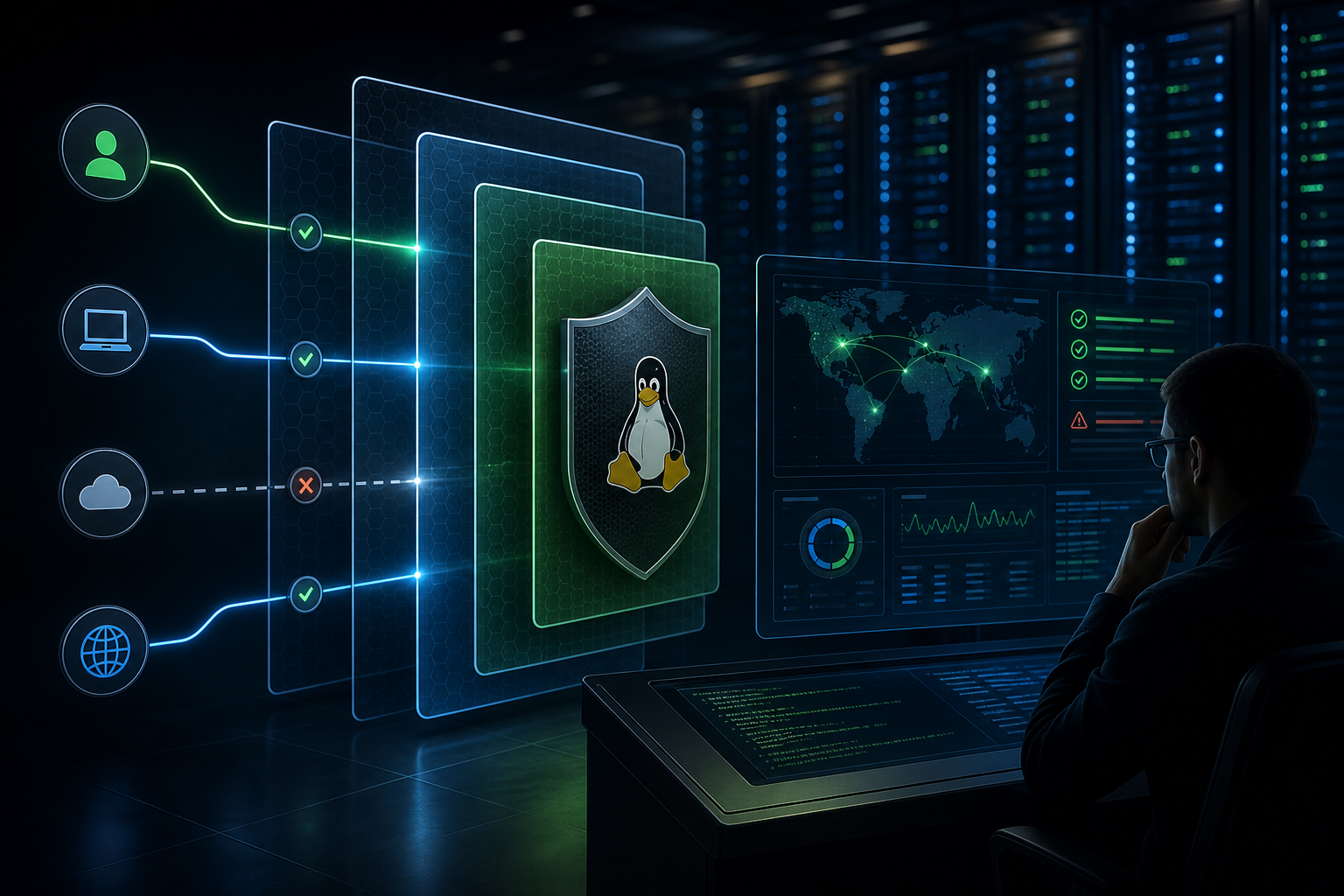
SELinux policy controls are one of the most effective ways to harden Red Hat Enterprise Linux because they restrict what a process can do even after authentication, configuration drift, or service compromise. The practical value is not that SELinux replaces patching, access control, or good service design; it is that it narrows the blast radius when those controls fail.
The main operational question is whether your service can run with targeted policy enforcement without creating avoidable denial noise or brittle exceptions. After reading this article, you should be able to judge where SELinux policy controls apply, understand how enforcement and type enforcement work in practice, use a lightweight validation workflow, and know what to confirm before production rollout.
Why SELinux matters operationally
A Linux host can be correctly patched and still be too permissive at the service layer. A daemon that is allowed to read arbitrary files, write unexpected paths, or connect to broad network destinations becomes a larger security problem if it is compromised. SELinux policy controls reduce that risk by binding processes to labeled resources and by allowing only explicitly permitted interactions.
That matters most on systems that host multiple services, handle sensitive data, or accept externally reachable traffic. In those environments, one misconfigured service or one vulnerable package can create a path into data that would otherwise have been isolated. SELinux is valuable because it operates as a mandatory control layer rather than a user-space convention.
It is also operationally important because policy mistakes can break services in ways that are not immediately obvious. When a process is blocked by SELinux, the failure may look like a permissions issue, an application bug, or a package regression. If you are already seeing blocked services or unexplained access failures, Troubleshooting SELinux Denials on Red Hat Enterprise Linux is a useful companion for interpreting denial evidence and distinguishing policy problems from application defects.
How SELinux policy controls work
SELinux assigns security contexts to processes, files, ports, and other objects. Policy then defines which types of processes may perform which actions on which types of objects. In practice, that means a web server process is not just a Unix user with file permissions; it is also confined by policy rules that may prevent it from reading database keys, writing to unexpected directories, or initiating connections outside its allowed role.
The important distinction is between traditional discretionary access control and SELinux mandatory access control. File mode bits and ownership still matter, but they are not the whole decision. A read can be blocked even when Unix permissions appear to allow it, if the policy does not permit the access in that security context.
For most production systems, the useful model is not "turn SELinux on and forget it," but "treat policy as an explicit part of service design." A service that needs access to a custom directory, nonstandard port, or unusual integration path should have that requirement expressed in policy rather than escaped by broadening the service account or weakening file permissions.
A practical workflow for policy-controlled hardening
A useful workflow is to start with baseline enforcement, observe the service under real load, and only then decide whether the policy should be adjusted. The goal is to make the service conform to policy where possible and to make policy changes as narrow as possible where necessary.
1. Confirm SELinux is enforcing on the target host.
2. Start or restart the service in a representative environment.
3. Observe for denials and identify the exact type, path, and action blocked.
4. Decide whether the denial indicates a real policy gap or an application design issue.
5. Prefer label changes, booleans, or narrowly scoped policy modules over broad permissive exceptions.
6. Re-test the service and verify no unexpected access is granted.
This workflow keeps the focus on evidence. The first question is not whether the service can be made to work by relaxing policy, but whether the observed access pattern is actually required. In many cases, the correct answer is to label a custom directory properly or assign a port type rather than disabling enforcement for the whole domain.
What this means in practice
Consider a common environment: a host runs a reverse proxy, an application service, and a database client process that reads certificates from a custom directory under /opt. The service starts during testing but fails after policy enforcement is enabled in production. The team sees no Unix permission problem, and the application logs are vague.
In this case, SELinux policy controls are doing their job. The process can reach its intended resources, but not the ones it was never supposed to touch. The practical response is to determine whether the service should be allowed to read that directory, whether the directory should be relabeled to match the expected file type, or whether the application should be reconfigured to use an approved path.
This is also where the difference between “works in permissive mode” and “is safe in enforcing mode” becomes operationally important. Permissive mode can help you learn what a service is trying to do, but it should not be treated as proof that the policy is production-ready. It only tells you that a denial would have happened.
Decision guidance: when to use policy adjustments and when not to
Not every denial deserves a custom rule. A narrow policy adjustment is justified when the access is part of the service’s intended function, the path or port can be precisely identified, and the change can be reviewed later without broadening the domain’s power.
A policy change is usually the wrong answer when the service is reaching into files it does not need, using arbitrary ports to avoid application cleanup, or depending on blanket access to shared directories. In those cases, the better control is often an application change, a packaging fix, or a service redesign that fits the expected SELinux domain model.
A good decision rule is this: if the request can be explained in one sentence using a specific object type, path, or port, it may be suitable for a narrow policy adjustment. If it requires “let the service do almost anything it wants,” the design is probably wrong for production hardening.
Common ways SELinux policy controls are used
The most practical uses are straightforward. Administrators often rely on file labeling so daemons can access only the content they are meant to read or write. They use port labeling to let a confined service listen on a nondefault port without opening broad network access. They also use booleans when a vendor-supported policy toggle exists for a known integration pattern.
Those options differ in risk and maintainability. Label changes are usually the cleanest when you control the filesystem layout. Booleans are convenient but can expand privilege more broadly than expected, so they should be reviewed carefully. Custom policy modules can be appropriate for well-understood exceptions, but they also add maintenance burden and should be documented like code.
If you need to evaluate what the denials actually mean before deciding on any of these paths, the denial evidence should come first. That is why a dedicated review of blocked operations is often necessary before you touch policy, especially after package upgrades or new service deployments.
Implementation trade-offs
SELinux policy controls improve containment, but they are not free. The trade-off is between stronger isolation and the engineering effort required to align service behavior with policy expectations. The more customized a service environment is, the more likely you are to spend time on labels, ports, and exceptions.
A second trade-off is operational visibility. When policy blocks an action, the error may not point directly to SELinux unless you know where to look. That means your operational runbooks need denial interpretation, not just service restart procedures. Teams that do not plan for this often misdiagnose policy enforcement as instability.
A third trade-off is change management. Policy changes should be reviewed the same way you would review a firewall rule or sudo privilege. Every exception should have an owner, a justification, and a revalidation plan. Otherwise, temporary allowances tend to become permanent and outlive the original business need.
Validation checks before production use
Before you rely on a policy-controlled service in production, verify the service under realistic paths, ports, and file locations, not just the default test setup. A policy that works on a clean lab host may still fail when configuration management, mounted storage, or backup agents introduce new access patterns.
At minimum, confirm three things. First, the service runs successfully in enforcing mode with no unexplained denials in the relevant workload path. Second, any custom labels, port types, or booleans are documented and intentionally set. Third, the change does not grant access beyond the service’s actual requirements.
A useful sanity check is to ask whether the service still behaves correctly after a restart, a relabel event, or a package update. SELinux problems often appear when a filesystem context changes or when a service is redeployed into a slightly different directory structure. That is normal, but it means production validation should include those conditions, not only a single startup test.
Common mistakes to avoid
The most common mistake is disabling enforcement to make the service work quickly and never returning to the policy issue. That creates a false sense of success while removing the protection you were trying to gain.
Another mistake is broadening access through generic fixes, such as making directories world-readable or giving a service account unnecessary privileges, when the actual problem is a labeling or type issue. This weakens multiple controls at once and usually creates a larger risk than the original denial.
A third mistake is treating every denial as proof that the policy is wrong. Some denials are the signal you wanted: they show the service is being constrained as intended. The task is to separate expected confinement from legitimate access requirements.
Production readiness checklist
Use this compact checklist before you declare a SELinux-hardened service ready for production:
- The service runs in enforcing mode on the target host class.
- Required files, directories, and ports are labeled or typed correctly.
- Any policy booleans are reviewed and documented.
- Denials have been examined and explained, not just suppressed.
- Exceptions are narrowly scoped and tied to a named service owner.
- Restart behavior and relabel behavior have been validated.
- Monitoring or logging is in place to detect new denials after change windows.
If one of these items is missing, the hardening work is not complete yet. The main point of SELinux policy controls is not to make systems harder to use; it is to make them harder to abuse while still allowing the service to operate predictably.
Final takeaway
Hardening Red Hat Enterprise Linux with SELinux policy controls is most effective when you treat policy as a deliberate operational boundary, not as an afterthought. The practical win comes from allowing only the access a service truly needs, validating that access under real conditions, and avoiding broad exceptions that weaken containment. If you can explain the service’s required access clearly, you can usually decide whether SELinux should enforce it as-is, support it with a narrow policy adjustment, or block it because the design needs to be corrected.
Use this guidance together with Windows 10 hardening to connect the workflow with related operational context already available on the site.
Use this guidance together with BitLocker recovery policies to connect the workflow with related operational context already available on the site.