
Key takeaways
VM isolation in Azure is not a single control; it is the combined effect of subnet design, security rules, private access paths, and careful control over east-west traffic. If any one layer is too broad, the isolation model weakens quickly.
The practical goal is not to make a VM unreachable, but to make its reachable paths explicit, minimal, and testable. That means you need to know which services may connect, from where, over which ports, and through which network boundaries.
A strong design also has to survive real operations. Patch management, backup agents, monitoring, and identity-based administration often create exceptions that are necessary but easy to overextend. Good isolation makes those exceptions visible and bounded.
Why VM isolation matters operationally
The practical problem behind [Azure Virtualization Network Security Best Practices for VM Isolation] is that many environments assume a virtual machine is isolated because it sits in a private subnet or has no public IP. In practice, that is only one part of the security picture. Misconfigured rules, shared services, overly permissive routing, and unintended private access can still expose the workload.
This matters operationally because VM isolation is usually protecting something more than the VM itself. It may be a domain controller, a bastion-hosted management tier, a sensitive application node, or a data-processing system that should only accept traffic from a very small set of peers. If isolation fails, the blast radius can extend beyond one machine into the broader environment.
After reading this article, you should be able to decide whether a VM isolation model is appropriate for your workload, understand the controls that actually create it, validate the design with practical checks, and verify what must be in place before production use.
What VM isolation means in Azure
In Azure, VM isolation means limiting both inbound and lateral access to a virtual machine so that only explicitly approved flows are possible. That typically includes separating management access from application access, restricting east-west traffic between subnets or workload tiers, and ensuring that private services are reachable only through defined endpoints or proxies.
A common mistake is to treat NSGs as the entire solution. NSGs are important, but they do not define the whole trust boundary. Routing, platform services, private endpoints, DNS behavior, and guest-level controls all affect whether the VM is really isolated.
For a deeper look at how network controls interact at the subnet and private access layer, see Azure VM Network Isolation with NSGs and Private Endpoints. That model is especially relevant when a workload must consume managed services without exposing them to broad network access.
How the isolation model works
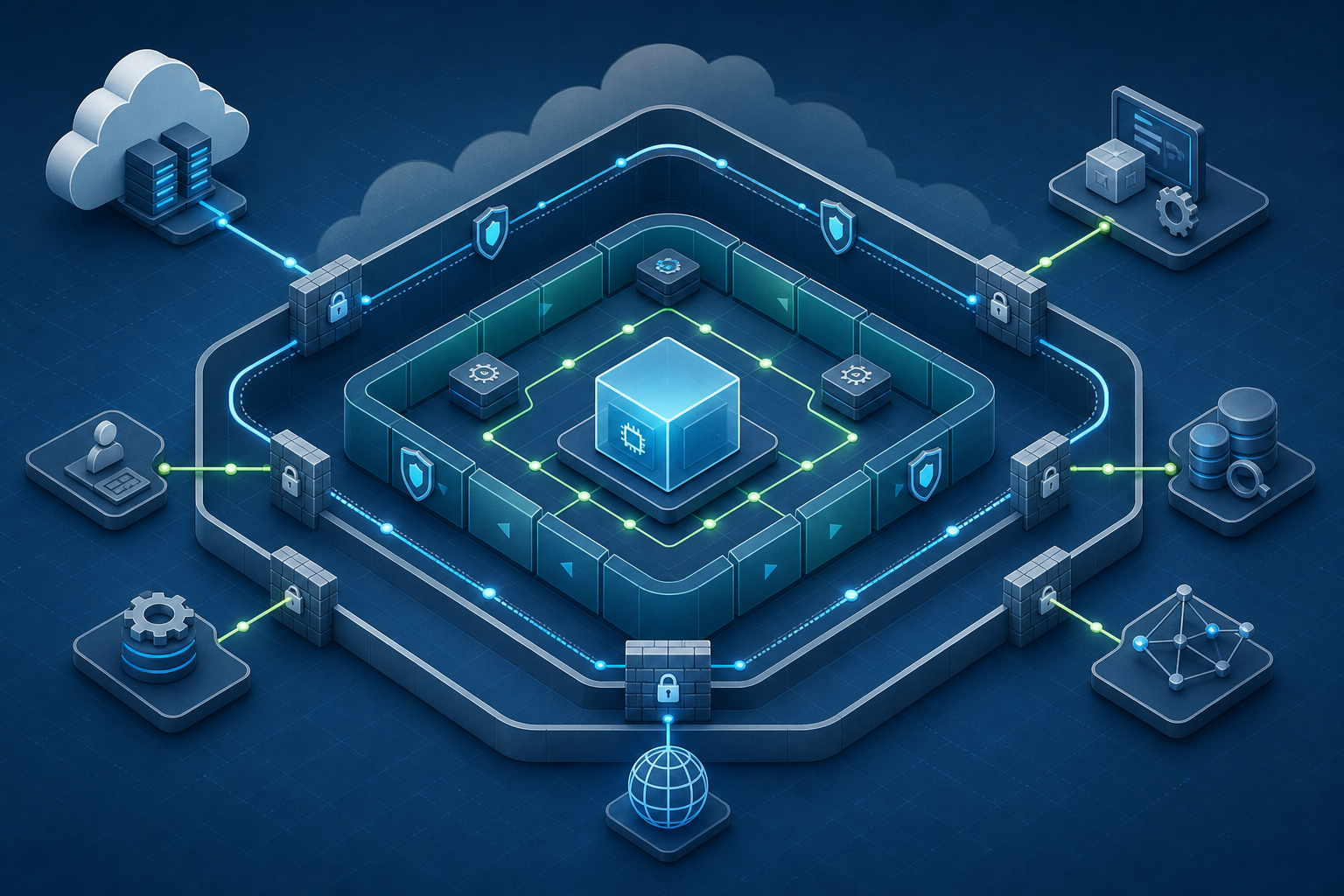
A practical Azure isolation design usually relies on four layers.
First, the network boundary: place the VM in a subnet whose routing and peer access are intentionally limited. If the workload is sensitive, avoid mixing unrelated systems in the same subnet unless the trust model is identical.
Second, the traffic policy: use network security rules to define which source networks, ports, and protocols are allowed. Keep the rules narrow and traceable to a business function, not a convenience requirement.
Third, the service access model: prefer private access paths for dependencies that should not be reachable over the public internet. When a workload needs storage, database, key management, or monitoring services, the access pattern should be explicit and auditable.
Fourth, the host and identity layer: isolation is stronger when the guest OS, local firewall, administrative access, and authentication controls all support the same boundary. A secure subnet is weaker if the VM accepts broad administrative access from shared jump hosts or untrusted management ranges.
A useful way to think about the design is that the network controls should describe the allowed business relationships, not just block bad traffic. If the only written rule is “deny all,” the result is usually brittle. If the rules clearly reflect application tiers, admin sources, and service dependencies, the design is more durable.
A compact validation workflow
Use this workflow to validate whether a VM isolation design is operationally sound before you rely on it in production.
1. Identify the VM's required inbound sources, outbound dependencies, and admin paths.
2. Map each path to a subnet, service endpoint, private endpoint, or jump/mgmt host.
3. Compare those paths with NSG and route rules to confirm there are no broad allowances.
4. Verify that no unintended public IP, load balancer rule, or peer subnet path exists.
5. Test connectivity from an approved source and from a disallowed source.
6. Review logs or flow evidence to confirm the observed traffic matches the intended design.
This workflow works because it forces a design review before implementation details obscure the real access model. If you cannot write down the expected sources and destinations, the isolation is probably not precise enough yet.
Practical scenario: a private application VM with shared dependencies
Consider a common environment: a private application VM in its own subnet, with no public IP, managed through a jump host, and dependent on a private data store plus centralized logging. At first glance, this looks isolated. In reality, the design can still leak trust in several ways.
The jump host may be allowed to reach too many subnets. The application subnet may permit broad east-west traffic for troubleshooting. DNS may resolve a service name to a public endpoint when the private endpoint was intended. Outbound access may be unrestricted, allowing the VM to reach internet destinations that were never part of the design.
This is the kind of environment where VM isolation succeeds or fails based on boundaries that are easy to overlook. If your workload has a management plane, a data plane, and a shared observability plane, you should assume each one can become a path into the VM unless it is explicitly constrained.
In practice, a secure design would typically keep the application VM reachable only from a defined administration source, permit only required service dependencies, and deny all other inbound traffic. If the VM must access a private PaaS dependency, the access path should be intentionally private and validated from DNS resolution through packet flow.
Common implementation patterns and trade-offs
The strongest isolation pattern is not always the simplest one to operate. There are real trade-offs between security, manageability, and failure recovery.
A subnet-per-tier model improves clarity because each tier can have its own rules and routes. The trade-off is more design overhead and a higher chance of rule sprawl if teams create one-off exceptions.
A shared management subnet can reduce operational friction for administration and monitoring. The trade-off is that a compromise in the management path can affect many VMs, so the management host itself must be controlled very tightly.
Private endpoints reduce exposure to public service paths and often make isolation easier to reason about. The trade-off is added dependency on DNS correctness and private network reachability, which can create confusing outages if not validated carefully.
Tighter outbound controls improve containment and reduce the chance of data exfiltration or unintended service discovery. The trade-off is that patching, telemetry, package retrieval, and extension workflows may need explicit allow rules or proxy patterns.
These trade-offs are not reasons to avoid isolation. They are reasons to choose a design that matches the workload’s operational tolerance. If your team cannot support frequent rule review, a very granular rule set may become less secure over time because people work around it.
What this means in practice
In practice, VM isolation should be treated as a documented access contract. For each VM or VM group, you should be able to answer four questions without guessing: who can reach it, what can they use to reach it, what does the VM need to reach outward, and how would you prove the policy is still true.
That usually means putting the minimal required paths into network rules, then validating those paths from the perspective of both success and failure. A design is not complete just because the intended flow works. It is only complete when unintended flows are demonstrably blocked as well.
It also means deciding which exceptions are acceptable. If a workload needs emergency access from a restricted admin subnet, document the source, duration, owner, and rollback condition. If a dependency must remain reachable through a private endpoint, make that dependency part of the baseline architecture rather than an exception.
When teams align on this model, isolation becomes easier to operate. When they do not, network rules slowly accumulate special cases until the original boundary is no longer meaningful.
Decision guidance: when this approach fits and when it does not
Use strong VM isolation when the workload has a clear trust boundary, a limited number of approved peer systems, or a compliance requirement that demands explicit network segmentation. It also fits well when the VM hosts a sensitive role and can tolerate the operational discipline needed to maintain narrow rules.
Be cautious when the workload is highly dynamic, frequently changing, or dependent on many service integrations that are not yet well understood. In those cases, isolation may still be appropriate, but you may need to start with a discovery phase before enforcing tight controls.
A good rule is this: if you cannot name the minimum legitimate sources and destinations for the VM, you are not ready to finalize the isolation policy. Likewise, if the team cannot validate access paths after changes, the design is too fragile for production.
For environments that need a broader design discussion around segmentation and virtual networking, Hyper-V VM Network Segmentation and VLAN Configuration Best Practices can help frame the same boundary-thinking principles in a different virtualization context.
Common mistakes that weaken isolation
One frequent mistake is assuming that “no public IP” equals “isolated.” Public exposure is only one attack path. Private lateral movement, misrouted traffic, and overly broad admin access are often more relevant.
Another mistake is allowing a single broad inbound rule for troubleshooting and never narrowing it later. Temporary exceptions are a common source of permanent risk.
Teams also often forget outbound control. A VM that can reach anything on the internet may not be isolated in any meaningful sense, even if inbound rules are tight.
A further problem is relying on service names without validating where they resolve. Private access designs can fail silently if DNS or route behavior points the VM to the wrong endpoint.
Finally, many designs stop at network policy and ignore the guest. If local firewall rules, authentication, or administrative group membership are too loose, the VM may still be reachable in ways the network layer does not prevent.
Production readiness checklist
Before production use, confirm the following items are true and documented:
- The VM’s approved inbound sources are listed and tied to a business or operational need.
- The approved outbound dependencies are known and intentionally allowed.
- Public exposure is absent or explicitly justified.
- East-west traffic is constrained to the minimum required peers and ports.
- Private service access is validated end to end, including name resolution where applicable.
- Administrative access is limited to a controlled management path.
- Logging or flow evidence is available to confirm that allowed and denied traffic match expectations.
- Exception rules have an owner, expiry expectation, or review cadence.
- The guest OS controls support the intended boundary.
- The team has a rollback plan if a network rule change blocks a required dependency.
Final takeaway
Azure VM isolation works when the design makes every legitimate path obvious and every other path verifiably unavailable. The most effective approach is layered: subnet boundaries, precise security rules, private access for dependencies, and host-level controls that all point in the same direction.
If you can validate the design from both the allowed and denied sides, and you can explain each exception in operational terms, the isolation model is strong enough to trust in production.
Use this guidance together with Python logging best practices and VMware VM snapshots to connect the workflow with related operational context already available on the site.