Why network isolation matters for Azure virtual machines
The operational problem is simple: an Azure virtual machine can be technically “private” and still be reachable in more ways than the team expects. A public IP address, an overly broad network security group (NSG) rule, a permissive service endpoint design, or an exposed management path can all create unintended access. If you are responsible for VM workloads that store sensitive data, host administrative tools, or connect to internal services, you need a design that limits who can reach the VM and which platform dependencies remain exposed.
This article explains how Azure VM network isolation works when you combine NSGs with private endpoints, what each control actually blocks, and how to decide whether the pattern fits your workload. By the end, you should be able to judge the right isolation boundary, validate the traffic paths that remain, and confirm what must be checked before production use.
Key takeaways
- NSGs control traffic at the subnet or NIC layer, but they do not make a VM inherently private by themselves.
- Private endpoints move access to supported PaaS services onto private IP addresses inside your virtual network.
- These controls solve different problems and are often used together rather than as substitutes.
- Isolation is only as strong as the surrounding design: routing, DNS, management access, and identity controls still matter.
- A production-safe design should prove that required traffic works while everything else is denied by default.
How NSGs and private endpoints work together
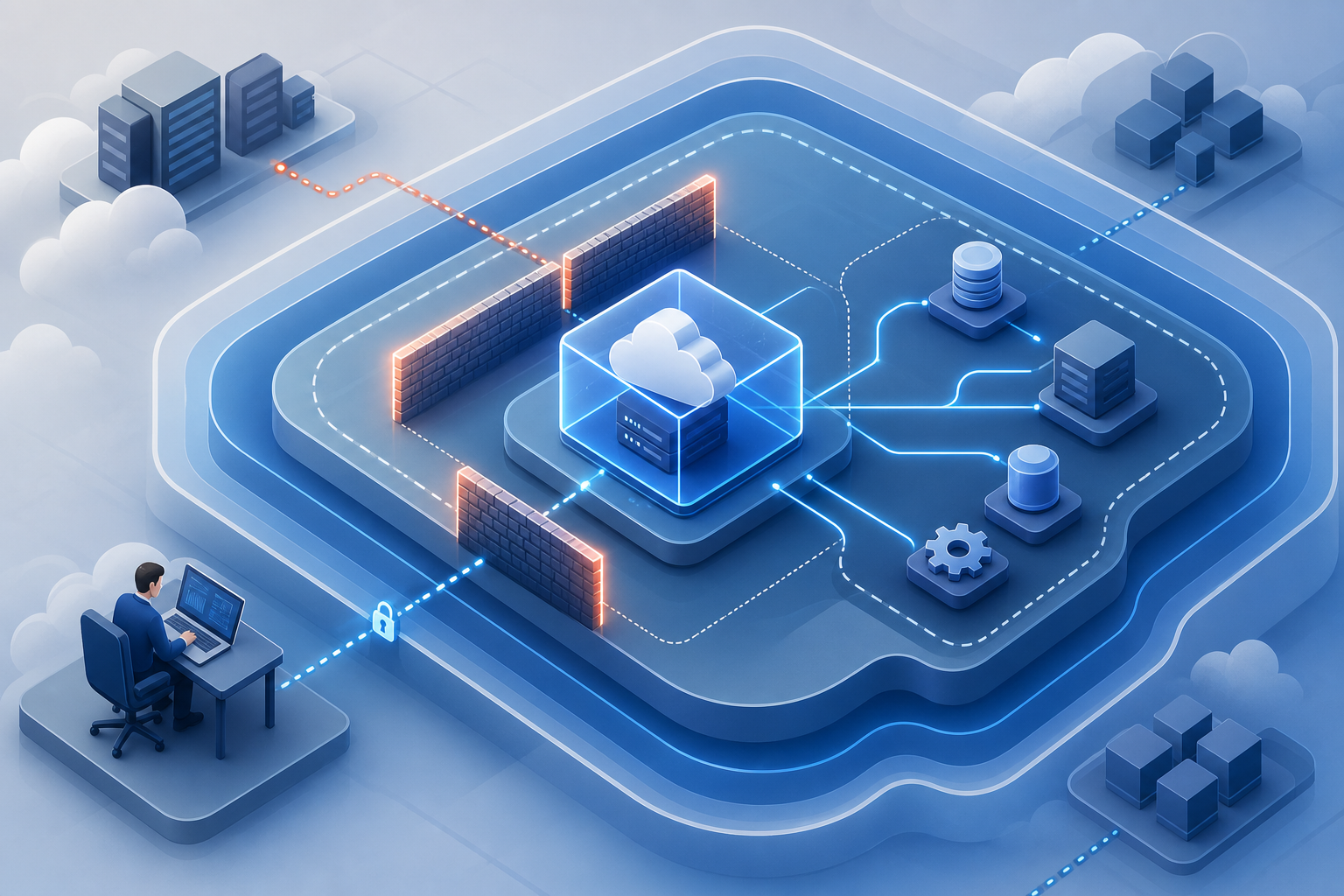
NSGs are stateful packet filters applied to subnets or network interfaces. In practice, they define which flows are allowed to reach a VM and which outbound flows can leave it. For a VM, NSGs are usually the first and most visible control for restricting SSH, RDP, application ports, and east-west traffic between subnets.
Private endpoints solve a different problem. They expose supported platform services through a private IP in your virtual network instead of through a public endpoint. That means a VM can reach a storage account, database, or other supported service without traversing the public internet. The service remains hosted by the provider, but the connection is anchored inside your private address space.
The important distinction is this: an NSG can restrict access to the VM itself, while a private endpoint can restrict how the VM reaches external services. If you are also tuning network behavior for performance or routing consistency, it can help to compare this design with Optimizing Azure VM Performance with Disk and Network Tuning, because isolation and latency goals often interact.
A secure design usually combines both layers:
- NSGs limit who can talk to the VM.
- Private endpoints remove the need for the VM to rely on public service endpoints.
- DNS ensures the service name resolves to the private address when private access is intended.
- Identity and platform permissions still govern what the VM can do once connected.
What this means in practice
A common misconception is that “private endpoint” means the VM is now isolated. In reality, private endpoints do not protect the VM from inbound access. They protect the path to the service behind the endpoint.
If a VM has a public IP and an NSG allows inbound SSH from anywhere, the VM is still exposed, even if every storage or database dependency is reached privately. Likewise, if the VM has no public IP but an application subnet NSG allows broad east-west access, internal movement may still be too easy.
A practical isolation design usually answers three questions:
- Who can initiate connections to the VM?
- Which required services can the VM reach, and by what path?
- What happens if a rule is too broad, DNS is wrong, or a private endpoint is unavailable?
If you can answer those questions with evidence rather than assumptions, the design is getting close to production-ready. For some environments, network isolation becomes part of a broader segmentation model similar in intent to Hyper-V VM Network Segmentation and VLAN Configuration Best Practices, even though the implementation model is different.
A compact operational workflow
Use this as a practical decision-and-validation flow rather than a procedural checklist.
1. Define the VM's trust boundary and required management paths
2. Remove unnecessary public exposure from the VM
3. Apply NSG rules that allow only required source, destination, and ports
4. Add private endpoints for supported dependent services
5. Update DNS so private names resolve to private IPs where intended
6. Validate that required application, admin, and service flows work
7. Confirm denied paths stay denied and document exceptions
A realistic scenario you may recognize
Consider a finance application running on a VM in a shared Azure virtual network. The workload needs to read from object storage, send telemetry to a monitoring backend, and allow administrative access only from a jump host subnet. The security team wants no public exposure, and the operations team wants the VM to remain reachable for patching and troubleshooting.
In that environment, the best design is usually not “block everything” but “allow only the exact traffic paths that justify themselves.” The VM subnet might allow inbound RDP or SSH only from a management subnet, and perhaps application ports only from an internal load balancer or app tier. Storage and database access should use private endpoints so the VM never needs to touch a public service endpoint. DNS should resolve the service names to the private address, and the team should validate that the application is not silently falling back to public resolution.
This is the point where isolation stops being theoretical. If an engineer can still sign in from a workstation on the internet, or if a dependency still resolves to a public endpoint, the design is incomplete even if private connectivity exists elsewhere in the environment.
Decision guidance: when this approach fits
Use NSGs plus private endpoints when you need both inbound restriction to the VM and private access to supported services. That pattern fits workloads with internal-only administration, regulated data paths, or a strong requirement to avoid public service exposure.
It is less suitable if:
- the VM must be publicly reachable for a customer-facing service,
- the workload depends heavily on third-party endpoints that do not support private connectivity,
- or the team cannot manage DNS and routing carefully enough to keep private name resolution correct.
A useful rule is to treat private endpoints as a service access pattern and NSGs as a VM access control. If your problem is “how does the VM reach data safely,” private endpoints help. If your problem is “who can reach the VM,” NSGs help. If both are true, you likely need both.
Implementation trade-offs you should expect
The security benefit of tighter isolation is real, but so is the operational cost. The tighter the network boundary, the more every dependency becomes explicit. That has consequences for troubleshooting, bootstrap operations, and incident response.
The main trade-offs are:
- Reduced attack surface vs. more configuration depth. You get fewer exposed paths, but you must manage NSGs, DNS, routing, and service permissions consistently.
- Better service privacy vs. added dependency on private name resolution. A private endpoint is only useful if clients resolve the private name correctly.
- Stronger policy enforcement vs. more change control overhead. Small changes to ports, source ranges, or service dependencies may require coordinated updates.
- Predictable access paths vs. more complex failure modes. When something breaks, the root cause may be the NSG, DNS, route table, or service-side permission rather than a single obvious firewall rule.
If your team already struggles with port sprawl or unmanaged scaling changes, it may help to validate capacity and placement first by reviewing Optimize Azure Virtual Machines with Right-Sizing and Autoscaling. An isolated design is easier to operate when the compute footprint is already under control.
Common mistakes that weaken isolation
The most frequent error is assuming that “no public IP” equals “no exposure.” That is not enough. A VM can still be reachable from within the virtual network, from peered networks, or through overly permissive management rules.
Another common mistake is allowing broad source prefixes such as entire address spaces when the real requirement is a narrow management subnet or a single load balancer. That pattern is convenient during deployment and painful during incident review.
Other recurring issues include:
- forgetting to update DNS after adding private endpoints,
- leaving service-side public access enabled when the private path is intended to be primary,
- placing NSG rules at both NIC and subnet scope without a clear precedence plan,
- and failing to verify outbound traffic from the VM, which can break patching, telemetry, or package retrieval.
The most subtle issue is assuming the control plane and data plane are equivalent. They are not. A VM may be restricted at the network layer but still be manageable through separate platform or identity-based channels if those are enabled and trusted.
Validation checks before production use
A practical validation approach is to prove the allowed paths and the denied paths separately. Do not rely on a single “it seems to work” test from one source.
Confirm the following:
- The VM has no unintended public IP exposure.
- Inbound access is limited to the explicit sources and ports required.
- Private endpoint connections resolve to private IP addresses from the VM and other intended clients.
- The application reaches only the intended service path, not a public fallback.
- Management access works only from the approved admin network or jump path.
- Denied flows remain denied when tested from a non-authorized subnet.
- Monitoring, patching, backup, and identity dependencies still function after the isolation rules are applied.
If the environment uses logging for network decisions, capture the evidence before and after the change. That makes it much easier to prove that the design is enforcing the intended boundary rather than merely appearing to do so.
Production readiness checklist
Before treating the design as production-ready, verify that you can answer these with evidence:
- Is the VM reachable only from approved administrative or application sources?
- Are all required service dependencies using private endpoints where supported?
- Does DNS resolve the private service names to the correct private addresses?
- Are NSG rules as narrow as the workload allows, with no temporary allow-all rules left behind?
- Have outbound dependencies for updates, logging, and identity been validated?
- Are route tables, peering paths, and firewall rules aligned with the same isolation intent?
- Is there a documented exception process for any necessary public or broader access?
Final takeaway
Azure VM network isolation is strongest when you treat NSGs and private endpoints as complementary controls rather than interchangeable ones. NSGs restrict who can reach the VM, private endpoints keep supported service traffic off public paths, and DNS plus routing make the design actually work. If you can validate the allowed flows, prove the denied flows, and document the dependencies that remain, you have a practical isolation model that is suitable for production instead of just theoretically secure.
Use this guidance together with SSL offload and Citrix Virtual Apps hardening to connect the workflow with related operational context already available on the site.