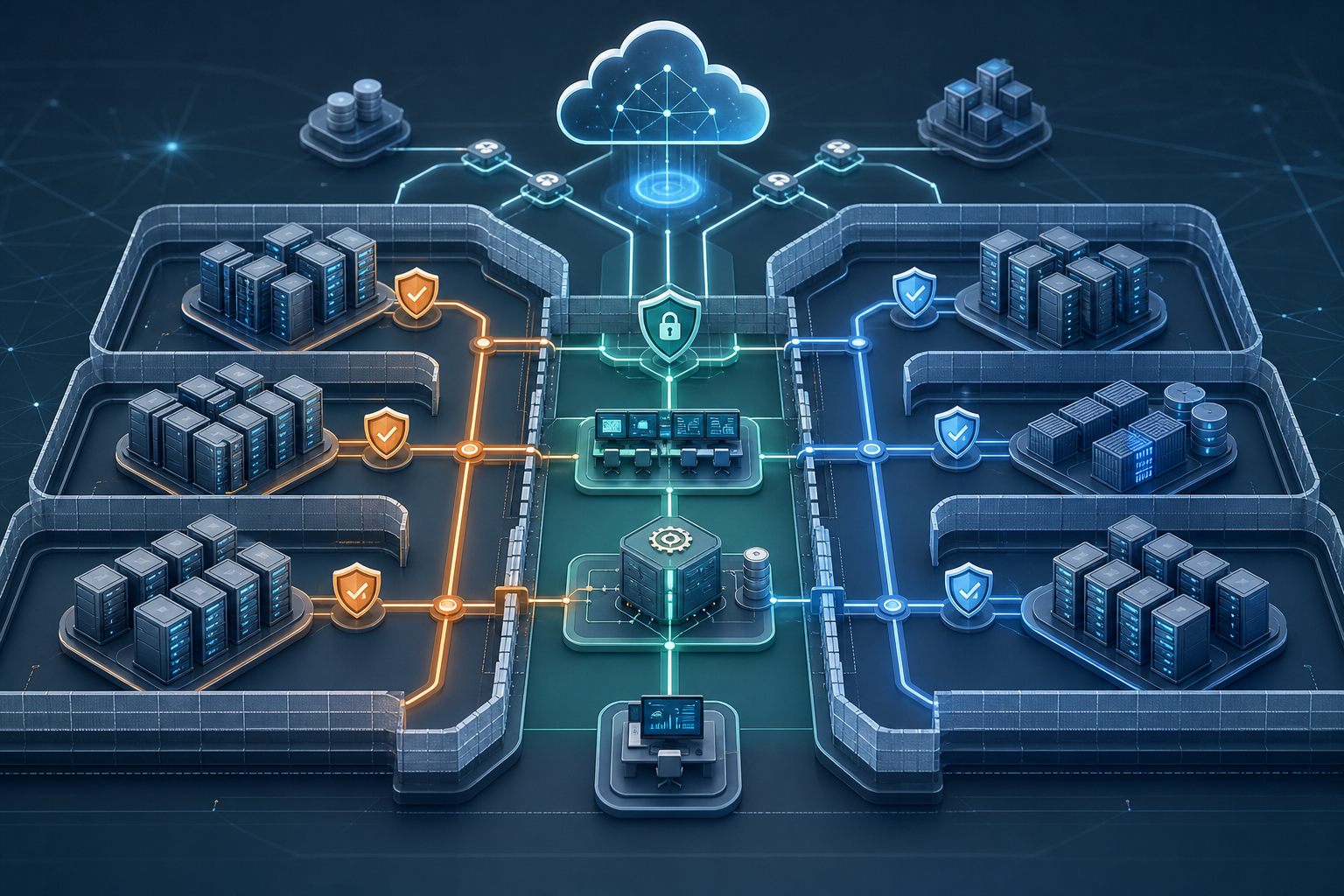

Key takeaways
Hybrid network segmentation in AWS virtualization is not just a routing exercise. It is a way to define and enforce trust boundaries between workloads that live in different administrative domains, different network zones, and often different security postures.
The practical goal is simple: only the traffic that needs to cross the boundary should cross it, and every allowed path should be explicit, observable, and reviewable. That matters because hybrid environments tend to accumulate exceptions quickly. Once routes, security groups, firewall rules, and DNS decisions drift apart, segmentation becomes difficult to prove and even harder to operate.
After reading this article, you should be able to decide whether hybrid network segmentation is the right control for your AWS virtualization environment, understand how the design works, apply a compact validation workflow, and check the main production risks before deployment. If you are also evaluating instance-level controls, the pattern complements AWS Virtualization Security Best Practices for EC2 Isolation and can be strengthened further with Securing AWS Virtual Machines with Nitro-Based Isolation.
Why this matters operationally
Hybrid virtualization environments usually connect AWS workloads to on-premises services, shared identity systems, patch repositories, monitoring stacks, and legacy applications that cannot move quickly. That connectivity is useful, but it creates a persistent risk: one weak segment can become a bridge into more trusted zones.
In practice, the problem is not whether traffic can flow. The problem is whether every flow is intentionally permitted, logged, and contained. Security teams want a smaller blast radius. Platform teams want stable connectivity. Network engineers want predictable routing. The design challenge is to satisfy all three without building a mesh of ad hoc exceptions.
This is why segmentation in AWS virtualization should be treated as a control plane design, not just an ACL exercise. Routing, firewall policy, DNS resolution, identity for management access, and inspection points all contribute to the effective boundary. If those pieces are designed separately, the result is often inconsistent enforcement. If they are designed together, the environment becomes much easier to reason about during incidents, audits, and change reviews.
What secure hybrid segmentation actually means
A secure hybrid segment is a boundary where traffic is allowed only for specific source, destination, protocol, and purpose combinations. The boundary is usually implemented with a mix of VPC design, subnet layout, route propagation rules, security groups or equivalent instance controls, network firewalling, and external connectivity such as VPN or dedicated circuits.
The important distinction is between connectivity and trust. A VPN or private circuit provides transport, but it does not by itself create segmentation. Likewise, a flat VPC with broad security group rules can be private without being well segmented. Secure hybrid segmentation requires that trust be intentionally narrowed at each layer.
A practical model is to divide the environment into zones such as user-facing application, internal application, shared services, management, and partner or on-premises integration. Each zone should have a documented purpose and a small set of approved cross-zone flows. If a flow cannot be explained in a sentence, it is usually a sign that the boundary is too loose.
How the design works
The most reliable hybrid segmentation designs align four layers:
- Network topology defines where traffic is allowed to enter and leave.
- Routing defines which destinations are reachable through which path.
- Stateful policy defines which flows are permitted at instance, subnet, or firewall level.
- Observation proves that the intended controls are actually being used.
In AWS virtualization, this usually means separating workloads into distinct VPCs or clearly separated subnet tiers, then using controlled routing to expose only the required services across the boundary. Security groups constrain instance-to-instance communication. Network ACLs can add subnet-level guardrails, though they are typically a coarse control. Centralized inspection or distributed firewalling can be used when the organization needs explicit egress control, traffic logging, or policy enforcement across multiple segments.
For hybrid traffic, the same discipline applies to the on-premises side. If a data center subnet can reach the entire VPC range, the cloud segment is not actually isolated from the hybrid path. Both sides must be constrained so that the cross-boundary path is narrow in both directions.
A useful mental model is “minimum reachable surface.” Ask of every segment: what must be reachable from where, and what must never be reachable even if an internal host is compromised? That question produces far better design decisions than asking only how to connect the environments.
Compact workflow for designing the boundary
A compact design workflow keeps the segmentation model practical without turning it into a full implementation checklist.
1. Identify trust zones and data sensitivity levels.
2. List required flows between zones, including management and logging.
3. Choose enforcement points for routing, security policy, and inspection.
4. Define deny-by-default rules and explicit exceptions.
5. Validate reachability from each segment and capture evidence.
6. Review logs, route tables, and policy drift on a recurring schedule.
This workflow is intentionally compact because the hard part is not producing more controls. It is making sure the controls line up. A route that exists but is blocked by policy is harmless but confusing. A policy that allows traffic to a subnet that no route can reach is harmless but misleading. The operational goal is consistency across all layers.
Practical scenario: when this looks like your environment
Consider a common setup: application servers run in AWS, while authentication, patching, and some reporting services remain on-premises. The cloud workloads need to talk to a directory service, a package mirror, and an internal API. Security requires that only the application subnets can reach those services, and only on a small number of ports. At the same time, the cloud environment must not be able to initiate connections into administrative subnets or internal developer networks.
That is a classic hybrid segmentation use case. The environment may already be “private” because it uses private connectivity, but private is not segmented. If the route tables expose the whole corporate CIDR range, if instance security groups are broad, and if DNS resolves internal names everywhere, then a compromised application instance may be able to pivot farther than intended.
In this scenario, segmentation succeeds when the teams can answer three questions clearly: which subnets may talk to the directory service, which ports are required, and what evidence shows that no other cloud subnet can use the same path. If those answers depend on tribal knowledge rather than policy and logs, the design is not ready.
Implementation trade-offs that matter
The best segmentation model depends on what you are optimizing for, because every control introduces trade-offs.
Stronger isolation versus simpler operations. More VPCs, more transit boundaries, and more firewall layers can reduce blast radius, but they also increase routing complexity and change management overhead. A design that is too fragmented can become brittle, especially if multiple teams own different zones.
Centralized inspection versus distributed controls. A central firewall or inspection layer makes logging and policy review easier, but it may become a bottleneck if all traffic must pass through it. Distributed security controls can scale better and reduce hairpinning, but they make it harder to maintain a single source of truth for policy intent.
Shared services versus segmentation purity. Shared authentication, logging, and update services are convenient, but they are also common pivot targets. If shared services must exist, they should be treated as protected tiers with tighter access rules, not as universally trusted infrastructure.
Private connectivity versus implicit trust. Private circuits and VPNs are useful for transport and operational continuity, but they should never be treated as a substitute for explicit policy. The on-premises side still needs segmentation, logging, and control of east-west movement.
A good rule is to accept some operational complexity if it materially reduces the size of an incident blast radius. Do not accept complexity just because it sounds secure. Every control should either reduce trust, improve observability, or make containment more reliable.
What this means in practice
In practice, secure hybrid segmentation means your team can prove three things before production use.
First, the path is intentional. Every permitted cross-boundary flow should map to a business or operational need, such as application-to-directory authentication or workload-to-monitoring export.
Second, the boundary is enforceable. The route exists only where needed, the security policy only allows the required ports and sources, and the destination segment cannot be reached through a more permissive alternate path.
Third, the boundary is observable. Logs, flow records, and configuration evidence should show whether the expected traffic is flowing and whether any unexpected attempts are being blocked.
A practical validation pattern is to test each segment from a known source and verify both allowed and denied behavior. For example, if one application subnet is supposed to reach an internal API on TCP 443, verify that it can do so, then verify that a different subnet cannot. If a management subnet must not initiate to application ports, validate that denial as carefully as the allow case. This is where How to Secure AWS Virtualization with Network Segmentation becomes useful as a broader design reference when you are formalizing boundary tests.
Decision guidance: when this approach fits
Hybrid network segmentation is the right control when you have at least one of the following conditions:
- AWS workloads must connect to internal enterprise services that cannot be moved quickly.
- Multiple teams share the same AWS environment but do not share the same trust level.
- Compliance or incident response requires proving which systems can reach which data.
- A compromised workload must not have a clear path to administrative or core infrastructure.
It may be the wrong primary mechanism when your environment is tiny, when connectivity is very stable but exposure is low, or when the team cannot support the added operational overhead of multi-layer policy management. In those cases, a simpler segment model may be safer than a theoretically stronger but poorly operated one.
The real decision is not “segmentation or not.” It is whether the segmentation boundary can be managed by the people who own it, with enough clarity to survive routine change and incident pressure.
Common mistakes
The most common failure is treating routing as the security boundary. A route table may expose reachability, but it does not define trust by itself. If policy is broader than intended, the route simply makes the mistake usable.
Another frequent error is overusing shared CIDR ranges or broad allow lists. These shortcuts make it harder to answer who can reach what, and they become especially dangerous when additional accounts, VPCs, or on-premises segments are added later.
Teams also often forget that management traffic is part of the attack surface. SSH, RDP, agent traffic, and administrative APIs are frequently left out of segmentation reviews even though they can be used for lateral movement.
A further mistake is assuming that DNS is harmless because it is not a transport layer. In reality, resolution scope can reveal internal names, enable service discovery across unintended zones, or create confusing reachability expectations if name-to-address mapping is too broad.
Finally, organizations sometimes validate only the happy path. If you do not test that denied traffic is actually denied, you have not proven segmentation. You have only proven connectivity.
Production readiness checklist
Use this checklist as a compact readiness gate before production use:
- Each trust zone has a documented purpose and owner.
- Every cross-boundary flow has a business or operational justification.
- Route tables and propagation rules reflect the intended reachable surface.
- Security policy is deny-by-default with explicit exceptions.
- Management access is segmented from application access.
- On-premises routes are constrained to the same standard as cloud routes.
- Logging is enabled for allowed and denied attempts where supported.
- Validation shows both permitted traffic and blocked unauthorized paths.
- Backup or break-glass access does not bypass the segmentation model without controls.
- Change owners know how to review the impact of new routes or policy exceptions.
If several of these items cannot be answered with evidence, the design is not yet production ready.
Final takeaway
Secure hybrid network segmentation in AWS virtualization works when you treat trust boundaries as a coordinated design across routing, policy, inspection, and logging rather than as a single control. The right design keeps permitted traffic narrow, makes denial the default, and gives you evidence that the boundary still holds after routine change.
If you can describe the allowed flows, prove the denied flows, and explain the operational trade-offs to the people who run the environment, you have a segmentation model that can survive production reality.
Use this guidance together with Azure VM backup strategies and Azure VM hardening to connect the workflow with related operational context already available on the site.