
Introduction
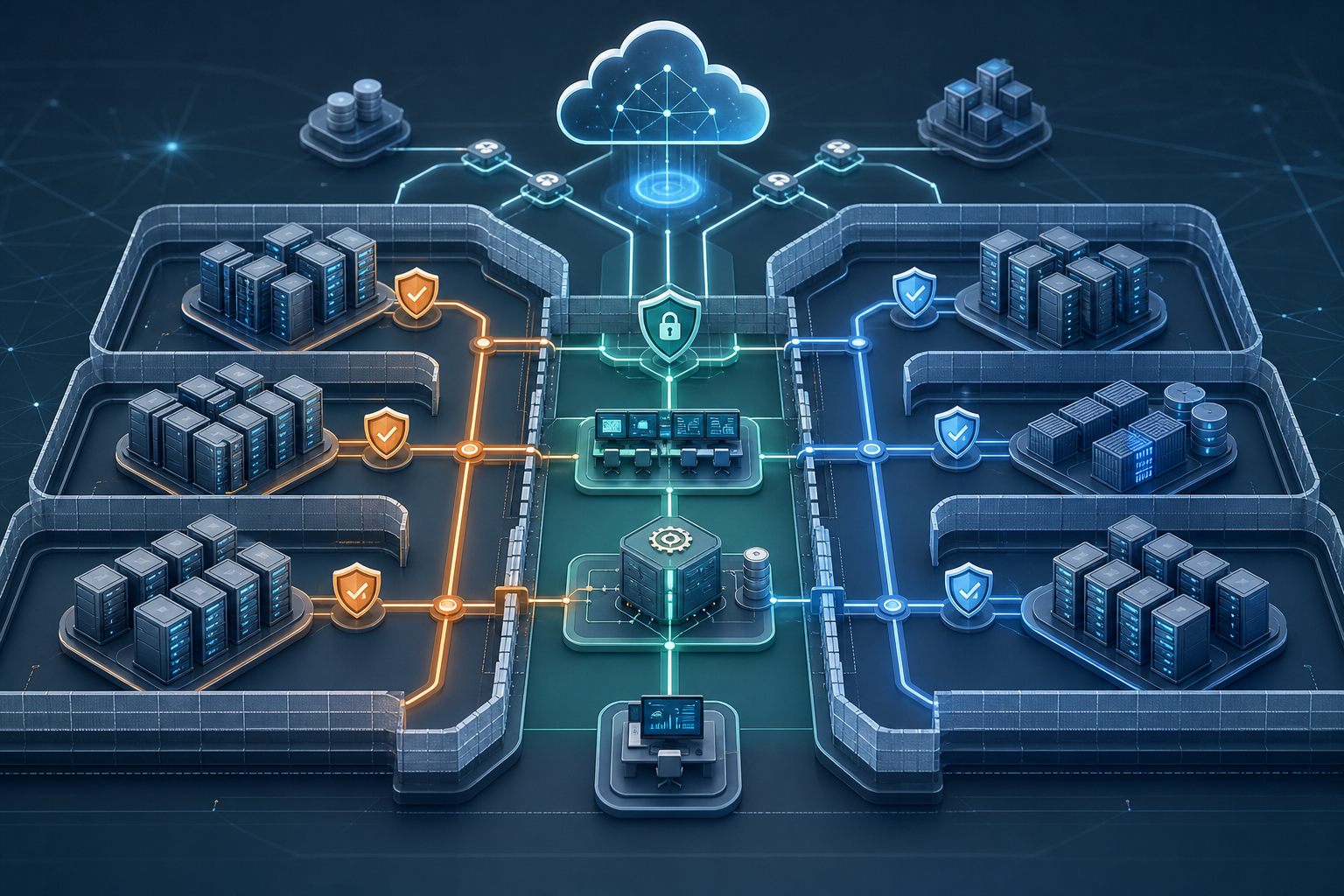
The practical problem is simple: if every virtual machine, management interface, and service in your AWS environment can talk to everything else, one compromised workload can quickly become a platform-wide incident. Network segmentation is how you reduce that blast radius. It lets you separate trust zones, restrict east-west traffic, and make it much harder for a single instance, subnet, or security rule mistake to expose the rest of the environment.
In this tutorial, you will build a segmentation model for AWS virtualization that separates management, application, and shared services traffic; applies least-privilege network rules; and gives you a validation workflow you can use before production rollout. You will also learn what to verify after implementation so the design stays effective as workloads change.
What you will build
The finished state should look like this:
- Workloads are placed into distinct subnets or network zones based on function and trust level.
- Virtual machines can only reach the ports and destinations they actually need.
- Administrative access is isolated from application traffic.
- Shared services such as logging, directory, or update endpoints are reachable without opening broad lateral paths.
- You have a repeatable method to verify segmentation using routing checks, packet-flow tests, and rule review.
If you are already aligning instance isolation with a stronger virtualization boundary, it is worth pairing this work with AWS Virtualization Security Best Practices for EC2 Isolation and Securing AWS Virtual Machines with Nitro-Based Isolation. Those controls reduce trust in the compute layer; segmentation reduces exposure across the network layer.
Prerequisites and stop-here-if warnings
Before you start, confirm the environment supports the segmentation model you want to apply.
Prerequisites
- You have administrative access to the virtual network, routing, and security controls for the target environment.
- You know which workloads belong in management, application, and shared-service zones.
- You have a current inventory of instance-to-instance dependencies, including ports and protocols.
- You can test from controlled sources without disrupting production users.
- You have a rollback path for network changes.
Stop here if any of these are true
- You do not know which systems must communicate with which other systems.
- The environment has undocumented direct access paths from the internet or from a broad corporate network segment.
- You cannot distinguish management access from application access.
- You lack a maintenance window or safe test path for network changes.
If those conditions are unresolved, document the traffic first. Segmentation implemented without a dependency map usually fails in one of two ways: it breaks a required application path, or it leaves broad exceptions that defeat the design.
Step 1: Define trust zones and traffic boundaries
Goal
Create a segmentation model that matches how the environment actually operates, not how the platform is organized by default.
Action
Start by separating workloads into zones with different trust levels. A practical minimum set is:
- Management zone for administration, bastions, automation controllers, and monitoring systems.
- Application zone for front-end and back-end virtual machines that serve workloads.
- Shared-services zone for DNS, identity, logging, patching, and artifact repositories.
- Ingress/egress zone for controlled entry points, reverse proxies, or network appliances if you use them.
For each zone, define:
- Who can initiate connections into the zone.
- Which outbound destinations are required.
- Which protocols and ports are necessary.
- Which flows are explicitly forbidden.
A simple rule helps: if two systems do not need to exchange state continuously, do not place them in the same trust boundary by default.
Expected output
You should have a written zone map and a dependency table that lists source zone, destination zone, port, protocol, and business reason.
Validation
Review the table with the system owner or application owner. A dependency is acceptable only if someone can explain why it exists.
Common failure
The most common mistake is drawing zones around organizational teams rather than communication patterns. That creates exceptions everywhere and leaves the resulting design hard to operate.
Step 2: Place workloads into isolated subnets or equivalent segments
Goal
Ensure each zone has a distinct network boundary that can be controlled independently.
Action
Create separate subnets, routing scopes, or equivalent logical segments for each trust zone. Keep management systems separate from application instances, and keep shared services out of broad application subnets unless they truly belong there.
Use the smallest practical routing domain that still supports the workload. When you need multiple tiers, place them in different segments and allow only the required inter-tier paths.
For AWS virtualization environments, this usually means:
- Distinct subnets for management and workload tiers.
- Separate route tables where traffic exposure must differ.
- Controlled access paths to administrative hosts.
- Avoiding unnecessary full-mesh connectivity between segments.
Expected output
Each zone has a clearly defined network location, and you can point to the route path used for inbound and outbound traffic.
Validation
Confirm that a workload in one segment cannot reach another segment unless a specific route and security rule exist. Check both directions of the traffic path, not just the source side.
Common failure
Teams often assume that different subnets automatically mean isolation. They do not. If routing, firewall policy, or security rules still allow broad communication, the segments are only organizational, not security boundaries.
Step 3: Restrict east-west traffic with least-privilege rules
Goal
Prevent lateral movement between virtual machines unless a known dependency requires it.
Action
Apply security rules so each instance or subnet only accepts traffic from approved sources. Keep the rules as specific as possible:
- Allow only the required source zone or source address range.
- Restrict ports to the exact services in use.
- Prefer application-specific ports over broad service ranges.
- Avoid using overly permissive source ranges for convenience.
If your design includes security groups or firewall policies, review them from the perspective of the destination system: “Which sources must be allowed to talk to me, and on which ports?” This perspective helps prevent accidental overexposure.
For environments that need a deeper treatment of instance-level isolation, the operational logic in AWS Virtualization Security Best Practices for EC2 Isolation is useful here because segmentation and instance isolation should reinforce the same blast-radius goal.
Expected output
Each workload has a narrow inbound policy and a matching outbound policy or route expectation that reflects only legitimate dependencies.
Validation
From an allowed source, confirm the connection succeeds on the intended port. From a disallowed source, confirm the connection fails. Validate at least one permitted path and one blocked path for each zone pair.
Common failure
The most frequent issue is a “temporary” allow rule that is never removed. Over time, these exceptions accumulate and turn a segmented design into an informal flat network.
Step 4: Separate management access from workload traffic
Goal
Protect administrative paths so that compromise of an application does not automatically expose management access.
Action
Use a dedicated management path for administration. That can include a bastion host, a hardened jump system, a private access mechanism, or a tightly controlled admin subnet. The key requirement is that management access must not share the same open network path as application traffic.
Apply the following principles:
- Administrative ports are not exposed to general application segments.
- Only approved operators, automation hosts, or identity-aware access paths can reach management systems.
- Administrative systems should not be used for normal application browsing or general-purpose workloads.
- Monitoring and logging should record who accessed management paths and when.
Expected output
Management systems are reachable only through the designated path, and application instances cannot initiate direct administrative connections.
Validation
Test from an application subnet and confirm that administrative ports are blocked. Then test from the approved management source and confirm that access works as expected.
Common failure
A common mistake is allowing SSH, RDP, or similar administrative access from a broad corporate range “just for convenience.” That makes the management plane much easier to reach than the workload plane and defeats the purpose of segmentation.
Step 5: Control access to shared services without creating lateral shortcuts
Goal
Allow workloads to use common services without turning those services into a transit path for unrestricted movement.
Action
Shared services such as DNS, logging, time synchronization, configuration management, or patch repositories often need to be reachable from many zones. That is acceptable, but each service should expose only the necessary ports and should not be used as a general relay between zones.
Place shared services in a dedicated zone when possible, then permit only the required source zones and destination ports. If a service is heavily reused, define the exact client set rather than allowing all internal addresses by default.
Expected output
Workloads can reach the shared services they depend on, but those services do not create broad east-west trust.
Validation
Verify that a workload can resolve names, send logs, or fetch updates only on the required ports. Confirm that the same workload cannot use the shared service host as a substitute path into another segment.
Common failure
Organizations sometimes place shared services in a “trusted” zone and then allow that zone to communicate widely in both directions. That makes the shared-service subnet a de facto backbone, which is usually wider than intended.
Step 6: Lock down inbound and outbound internet exposure
Goal
Minimize direct internet reachability and make egress deliberate.
Action
Only expose workloads that truly need public access, and place them behind controlled ingress points where possible. For everything else, prefer private connectivity and explicit outbound rules.
For outbound traffic, define which destinations are necessary for patching, identity, package retrieval, or external APIs. If a workload does not need open internet access, do not give it broad egress.
This matters because segmentation is not just about blocking inbound attacks. It also limits what a compromised instance can reach after an intrusion.
Expected output
Public exposure is limited to approved ingress points, and private workloads have narrow egress paths.
Validation
Check route tables, security rules, and any outbound filtering to ensure that private workloads cannot reach the internet except through approved mechanisms.
Common failure
A common design flaw is protecting inbound traffic while leaving outbound traffic unrestricted. That still allows data exfiltration, command-and-control access, and rapid worm-like propagation.
Step 7: Validate the segmentation with a repeatable test workflow
Goal
Prove that the environment behaves according to the design before you rely on it in production.
Action
Use a simple validation sequence for each zone pair:
- Identify an allowed source and destination.
- Test the intended service and port.
- Test one blocked source or blocked port.
- Confirm the route path and security rule responsible for the result.
- Record the evidence.
If you want a lightweight command-based check, use tools that verify connectivity without making assumptions about the service stack. For example, from a Linux test host you can confirm TCP reachability with nc, or use curl for HTTP services when you expect an application-layer response.
nc -vz 10.10.20.15 443
curl -I https://10.10.20.15
Treat a successful TCP handshake as only partial proof. For application traffic, validate the expected application response, not just the port being open.
Expected output
You have a documented pass/fail result for each critical allowed flow and each blocked flow.
Validation
The strongest validation includes both network-level and application-level checks. If the route is correct but the application still fails, the issue may be identity, TLS, host firewall, or service binding rather than segmentation.
Common failure
Teams often stop after confirming that a port is open from one source. That does not prove segmentation. You need evidence that the right source works and the wrong source fails.
Step 8: Operationalize change control and ongoing review
Goal
Keep segmentation effective after new workloads, patches, and exceptions are introduced.
Action
Treat segmentation as a living control. Put network changes through the same change-management process you use for production services, and require a dependency review for any new rule.
Operational follow-up should include:
- Periodic review of security rules and route tables.
- Removal of stale allow rules and unused test exceptions.
- Review of newly created subnets, interfaces, or peering paths.
- Logging and alerting for denied connections that may indicate drift or attempted lateral movement.
- Revalidation after major workload changes.
If you use automation, keep the approved traffic matrix in version control so changes are reviewable and repeatable.
Expected output
Segmentation rules remain aligned with actual service dependencies, and exceptions do not silently accumulate.
Validation
At each review cycle, compare actual traffic and configured rules against the approved matrix. Investigate any rule that no longer matches a documented dependency.
Common failure
The most common operational failure is treating segmentation as a one-time hardening task. Once workloads change, the original design can drift unless someone owns it.
Practical decision rules
Use these rules when you are deciding whether a connection should exist:
- If the connection is administrative, it belongs in the management path, not the application path.
- If the connection is required only by one service, allow only that service and only that port.
- If the connection exists “because it has always worked,” document it or remove it.
- If a rule is broad enough to support many unrelated workloads, it is probably too permissive.
- If you cannot explain the business need for a flow, do not approve it.
These rules are especially useful during reviews because they force the discussion back to operational necessity rather than convenience.
Common implementation mistakes to avoid
A segmentation project usually fails for predictable reasons:
- Building zones without a dependency inventory.
- Using broad source ranges for admin access.
- Leaving temporary exceptions in place.
- Allowing shared services to become a routing shortcut.
- Forgetting outbound controls.
- Declaring success without blocked-flow testing.
If you avoid these mistakes, your design is much more likely to hold up under real workload pressure.
Final verification before production use
Before you rely on the design in production, confirm the following:
- The approved traffic matrix matches the live rules.
- Each critical service has a tested allowed path.
- Each critical zone pair has at least one confirmed blocked path.
- Management access is isolated from normal application traffic.
- Shared services are reachable only on required ports.
- Outbound access is no broader than required for operations.
- A rollback plan exists if a change breaks a service.
When those checks pass, you have more than a set of network rules. You have a verifiable segmentation model that reduces blast radius, supports operational control, and gives security teams a repeatable way to prove isolation before production expansion.
Use this guidance together with VMware ESXi patch management and HDX policies to connect the workflow with related operational context already available on the site.