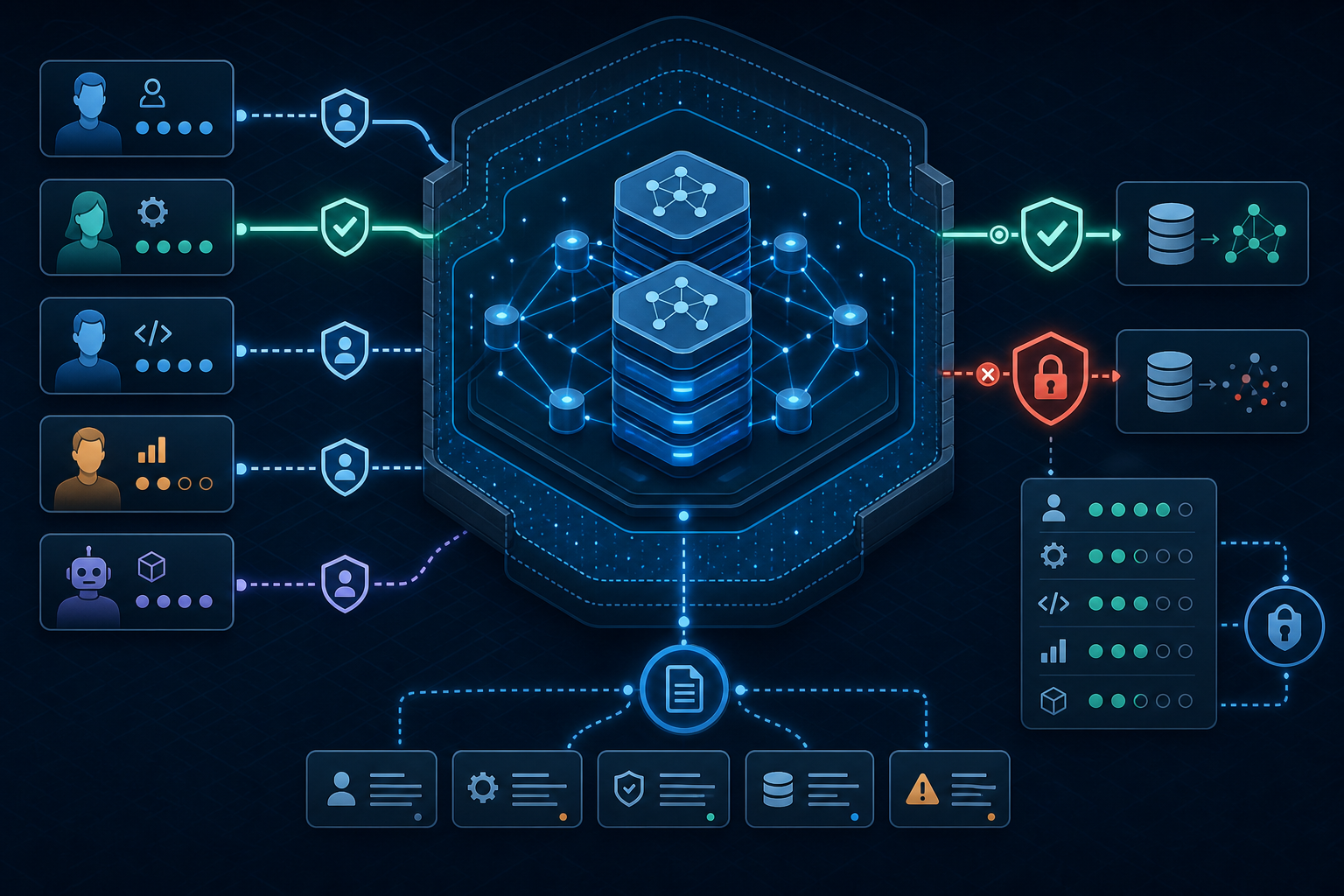
What are the most common NoSQL database security risks?
The most common risks are exposed network access, weak authentication, overly broad permissions, and unencrypted data in transit or at rest. In practice, the biggest failures usually come from default settings left in place, not from obscure protocol flaws.
A typical incident pattern is simple: a database is reachable from more places than intended, credentials are shared or long-lived, and the account can read or modify more data than the application needs. If you want a fast way to validate the basics, start with a NoSQL Database Security Checklist for Access Control and Encryption and verify network scope, TLS, encryption at rest, logging, and key handling before rollout.
A useful decision rule is this: if a service account can connect from the internet, or from a broad internal network segment, the environment is not yet in a safe operational state.
Why is access control so important in NoSQL environments?
Access control matters because NoSQL systems are often optimized for availability and scale, which can make permissive access easier to overlook. If credentials are compromised or a service is misconfigured, the resulting blast radius can be large unless access is narrowly scoped.
The practical goal is to map permissions to application functions, not to people’s convenience. For example, an API service that only reads user profile documents should not use the same account as a background job that writes audit events. If you need a structured approach, How to Secure NoSQL Databases with Role-Based Access Control explains how to limit access by job function and validate permissions before rollout.
Validation should be evidence-based: confirm which collections, databases, or keyspaces each role can read and write, then test that prohibited operations fail cleanly. If you cannot prove that a role cannot access data outside its scope, treat the configuration as incomplete.
Is network isolation enough to secure a NoSQL database?
No, network isolation is necessary but not sufficient. Segmentation reduces exposure, but it does not protect against compromised internal hosts, stolen credentials, or overly permissive service accounts.
A common example is a database that is only reachable from a private subnet, yet any workload in that subnet can authenticate with a shared admin credential. In that setup, an attacker who lands on one internal host may still reach the database and move laterally.
The practical control set is layered: restrict inbound paths, require strong authentication, enforce least privilege, and log access attempts. Before production, verify that the database is not listening on unintended interfaces and that security groups, firewall rules, or network policies match the intended application path. If the service must be reachable from multiple environments, document why and review that exception regularly.
Should NoSQL databases always use encryption in transit and at rest?
Yes, in nearly all production cases, both should be enabled. Encryption in transit protects credentials and query payloads from interception, while encryption at rest reduces exposure if storage is copied, backed up, or accessed outside the application path.
The nuance is operational: encryption only helps if certificate management, trust chains, and key handling are also correct. For example, TLS is not effective if clients are configured to skip certificate validation, and at-rest encryption is weaker if the encryption keys are stored alongside the data with no separation of duties.
A practical validation point is to confirm the connection profile rejects plain-text access where encrypted transport is expected, and that backups inherit the same protection assumptions as primary storage. If your environment uses managed keys, verify which rotation and access controls are actually enforced by the service or license tier.
How do weak credentials typically show up in NoSQL incidents?
Weak credentials usually show up as shared accounts, hard-coded secrets, overused admin credentials, or long-lived tokens that are rarely rotated. These problems are common because NoSQL deployments often involve application services, migration tools, batch jobs, and admin utilities that all need access, which encourages shortcuts.
A realistic example is a deployment pipeline that stores a production database password in plain text and reuses it across environments. If that secret is leaked, the attacker does not need to bypass the database itself; they can authenticate directly.
A practical rule is to avoid any account that cannot be traced to a specific workload and purpose. Rotate credentials on a schedule appropriate to their exposure, and verify that secret storage, not application code, is the source of truth. If the system cannot support passwordless or short-lived authentication, compensate with tighter scoping and stronger monitoring.
What logging and monitoring should be enabled?
You should log authentication events, authorization failures, administrative actions, schema or collection changes where available, and unusual connection patterns. The important question is not whether logging exists, but whether it records enough to reconstruct who accessed what, from where, and when.
For example, a failed login spike from one host can indicate a brute-force attempt, while a sudden new client IP using a privileged role can signal credential misuse. Monitoring should also catch configuration drift, such as a new listener address or an unexpected permission grant.
A good validation standard is to test that logs are searchable, time-synchronized, and retained long enough for incident review. If alerts are configured, confirm that they trigger on failed authentication bursts, privilege changes, and access from unexpected network zones. Logs that are enabled but not reviewed are a weak control, not a strong one.
How can you validate permissions before production rollout?
Validate permissions by testing the exact actions each workload must perform and confirming that everything else fails. In practice, that means enumerating required reads, writes, updates, and administrative functions, then executing a minimal test set against a staging environment or a production-like clone.
A useful method is to compare expected and actual outcomes. For example, a service role may need to read one collection and write to one audit path, but should fail if it attempts to list databases, modify indexes, or access another tenant’s data. If the denial behavior is inconsistent, investigate before release.
This is also where role design matters. A well-scoped role model is easier to validate than a shared privileged account because the test surface is smaller and the expected failures are clearer. As a rule, if you cannot describe the allowed operations in one paragraph, the role is probably too broad.
What is the safest way to handle administrative access?
The safest approach is to keep administrative access rare, time-bound, and separate from application credentials. Admin accounts should not be used by applications, CI jobs, or routine maintenance tasks if a narrower role can do the job.
A practical example is using a dedicated break-glass account for emergency recovery and a separate operational account for planned maintenance. That separation makes audit trails clearer and reduces the risk that a leaked admin token becomes a standing backdoor.
Before production, verify that admin access requires stronger controls than routine service access, such as additional approval, vault retrieval, or short-lived credentials where supported. If the database platform supports privileged role escalation, confirm it is logged and reversible. The decision rule is simple: if an admin account is needed every day, it is probably not really an emergency account.
Do backups and replicas need the same security controls as primary databases?
Yes. Backups, replicas, snapshots, and exports often contain the same sensitive data as the primary database, and they are frequently less protected because teams treat them as infrastructure artifacts instead of production data.
A common failure is storing backup files in a separate repository with weaker access controls or no encryption. Another is allowing replicas to accept broader network access than the primary cluster, which turns them into an easier entry point.
The validation point is straightforward: check who can access backup storage, how backups are encrypted, and whether restore workflows preserve the intended access model. If a backup can be restored into a new environment without tight controls, that environment should be treated as production-sensitive from day one.
How often should NoSQL security settings be reviewed?
They should be reviewed whenever there is a major change, and then on a regular cadence appropriate to the environment’s risk level. Major changes include new applications, schema changes, role changes, network changes, key rotation events, and platform upgrades.
In stable systems, monthly or quarterly reviews are common, but the exact interval should match the sensitivity of the data and the rate of change. The key is not the calendar alone; it is making sure drift does not accumulate between reviews.
A practical check is to compare the live configuration against the approved baseline and verify that access lists, TLS settings, encryption, and logging still match the documented state. If the review produces surprises every time, the operational process is not mature enough yet.
What should you verify before calling a NoSQL deployment production-ready?
You should verify that exposure is limited, authentication is unique per workload, permissions are least-privileged, encryption is active, logs are usable, and backups are protected. That combination does not guarantee security, but it does eliminate the most common and preventable failure modes.
A practical pre-production check is to walk through the system as an attacker would: can the service be reached from unintended networks, can a low-privilege account read sensitive data, can a secret be reused elsewhere, and can an admin action be traced after the fact? If any answer is unclear, the deployment is not ready.
Before sign-off, confirm the implementation against a checklist, run a permission test, and capture the evidence needed for audit or incident response. The right standard is not perfection; it is knowing exactly which protections are in place, which exceptions remain, and how you would detect misuse quickly if it happens.