Key takeaways
Prioritizing vulnerabilities by exploitability and impact is the difference between an actionable remediation queue and a long list of findings that no one can realistically clear. The useful question is not just whether a vulnerability exists, but whether it can be reached, weaponized, and used to cause meaningful harm in your environment.
A good prioritization model combines technical evidence, asset context, and business criticality. It should also account for compensating controls, exposure path, and whether exploit activity is already observed in the wild. Scores from scanners are a starting point, not the final decision.
The most practical outcome is a queue that tells operators what to fix first, what to mitigate quickly, what can wait, and what needs validation before it is treated as urgent.
Why this matters operationally
Most organizations already have more vulnerabilities than they can remediate in a single cycle. If every high score is treated equally, teams spend time on issues that are theoretically severe but operationally irrelevant, while exposed systems remain open to easy exploitation.
That is why exploitability and impact must be evaluated together. Exploitability tells you how likely an attacker is to turn the flaw into access. Impact tells you what happens if they do. A low-complexity remote flaw on an internet-facing identity system deserves a very different response from the same flaw on an isolated lab host with no privileged reach.
This distinction becomes especially important in environments with shared identity infrastructure, management planes, and flat internal networks. For example, if you are already watching for Active Directory password spray attacks, you know that an externally reachable identity weakness may create far more risk than a similar issue on a non-critical endpoint.
What exploitability and impact actually mean
Exploitability is the combination of conditions that determine whether a vulnerability can be used in practice. For operational prioritization, the relevant questions are straightforward: is the target reachable, is there a known exploit path, does the attacker need credentials, how much interaction is required, and are there barriers such as segmentation, authentication, or compensating controls?
Impact is the consequence if exploitation succeeds. That includes confidentiality loss, integrity compromise, service disruption, privilege escalation, lateral movement, persistence, and recovery cost. For some systems, the main impact is direct business interruption. For others, the greater risk is that a small foothold becomes a path to broader compromise.
The mistake many teams make is treating impact as a generic severity label. In practice, impact is contextual. A vulnerability on a domain controller, hypervisor, backup server, jump host, or credential store has higher systemic impact than the same vulnerability on a standalone workstation, because compromise would affect many downstream assets.
A practical prioritization model
A usable model does not need to be mathematically complex. It needs to produce defensible ordering based on evidence. A simple approach is to evaluate three dimensions for each vulnerability: exploitability, exposure, and impact.
Exploitability covers whether the issue is easy to weaponize. Consider public exploit availability, required privileges, attack complexity, attack vector, and whether exploitation is reliable.
Exposure covers whether the vulnerable asset is reachable in practice. Internet-facing systems, management networks, remote access services, and trusted internal paths all matter. A vulnerability with a public exploit on a directly exposed asset is generally more urgent than the same flaw on a host hidden behind layers of segmentation.
Impact covers what the asset can do and what would happen if it were compromised. Systems that authenticate users, store secrets, orchestrate deployment, or enforce trust boundaries should be weighted more heavily than commodity endpoints.
A simple decision rule is often enough:
- Fix first: exploitable, reachable, and high-impact.
- Mitigate quickly: exploitable and reachable, but with meaningful compensating controls or constrained blast radius.
- Schedule normally: technically severe but hard to reach, not actively exploited in your environment, or limited to low-value assets.
- Defer with justification: low exploitability, no realistic exposure, and minimal business impact.
Compact workflow for ranking findings
1. Confirm the finding is real and in-scope.
2. Determine whether the asset is reachable by a plausible attacker path.
3. Check exploitability evidence: public exploit, weaponization, privilege needed, reliability.
4. Assign impact based on asset role, trust level, and data or service consequence.
5. Apply compensating controls and exposure reductions.
6. Sort by highest combined risk, then by remediation effort and dependency.
7. Validate the top items with asset owners before assigning SLA or emergency response.
This workflow works best when the first pass is intentionally narrow. The goal is not to fully model every possible attack chain. The goal is to remove obvious false urgency and surface the few items that are truly dangerous right now.
A scenario that looks familiar in real environments
Imagine a mixed environment with a public web application, a VPN endpoint, a file server, a workstation fleet, and an identity tier that includes privileged administrative systems. Your scanner reports the same severity class across several hosts, including an outdated library on the web app, a remote code execution issue on the VPN appliance, and a local privilege escalation on a user workstation.
If you prioritize only by severity, you may end up remediating the workstation issue first because it is easier to patch. But the exploitability and impact picture is different.
The VPN appliance is reachable from the internet, has a high-value authentication role, and sits on a path that could expose additional internal resources. The web application may also be exposed, but if it is isolated from secrets and does not have trusted access to administrative systems, its impact may be lower. The workstation flaw may be important, but if it requires local access and affects only a non-privileged user context, it usually belongs below externally reachable identity or access-control issues.
If your environment uses a tiered admin model, the impact of any flaw that threatens privileged management systems rises sharply because the compromise path can cross trust boundaries. That is why infrastructure design matters when you rank vulnerabilities: a weakness in a high-trust layer is not equivalent to the same weakness in a low-trust endpoint tier.
What this means in practice
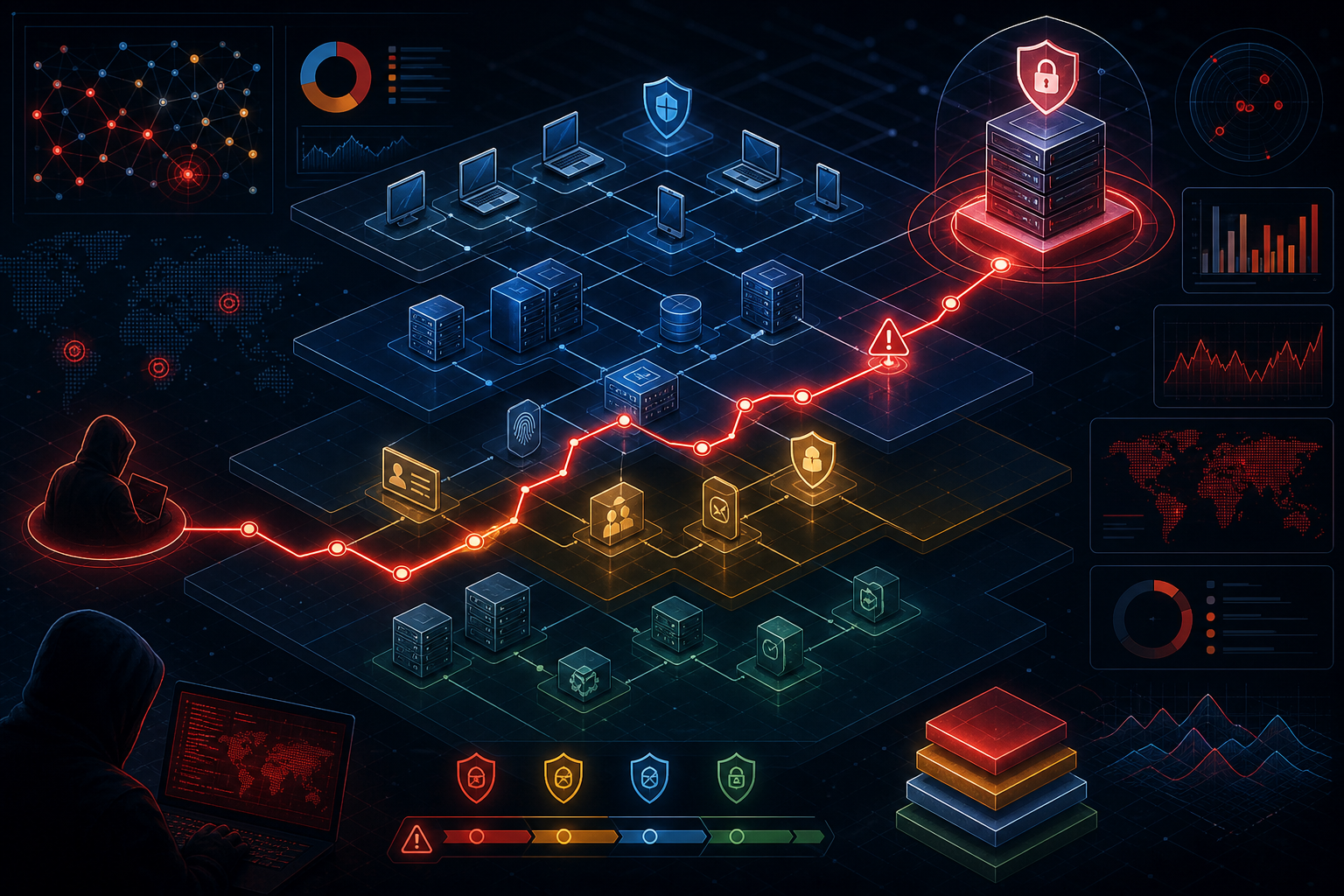
In practice, prioritization is about evidence-driven exceptions to the scan queue. You are asking, “Which issues create the shortest path from attacker capability to meaningful harm?” That means the top of the backlog should contain the vulnerabilities that are both exploitable and close to important assets, not simply the ones with the loudest score.
The best teams operationalize this with a small set of rules. Internet exposure increases priority. Known public exploitation increases priority. Privileged paths and identity systems increase priority. Active evidence of scanning or abuse increases priority. Strong segmentation, disabled services, and limited blast radius reduce priority, but only when the control is verified and current.
That last point matters. A vulnerability may be downgraded because it is “behind a firewall,” but the firewall may not protect every path. A management interface may be internal-only on paper and still reachable through VPN, jump hosts, or peer networks. If you are dealing with related authentication noise, pairing vulnerability review with monitoring for password spray detection can help confirm whether exposure is being actively tested.
Decision guidance for remediation queues
When two vulnerabilities compete for the same engineering capacity, use the following order of questions:
- Can an attacker reach it without already having privileged access?
- Is there a known exploit path or reliable weaponization?
- Would exploitation affect a critical service, identity boundary, or sensitive data store?
- Would compromise enable lateral movement or privilege escalation?
- Are there compensating controls that are proven and still in force?
- How quickly can the issue be fixed without introducing more risk than it removes?
The answer to the first three questions usually drives the top of the queue. The last three determine whether you patch immediately, mitigate first, or plan the change in a normal maintenance window.
A practical rule: if a vulnerability is reachable, weaponized, and sits on a trust boundary, treat it as a priority incident candidate rather than a routine patch ticket.
Implementation trade-offs
The main trade-off in exploitability-and-impact prioritization is speed versus precision. A lightweight model is fast to operate and easy to explain, but it can miss subtle attack chains. A richer model can account for dependency graphs, asset criticality, and attacker path analysis, but it requires better inventory, ownership data, and more maintenance.
There is also a tension between consistency and context. Standard severity scores help teams compare findings across tools, but operational risk depends on environment-specific factors that scanners often do not know. This is why a vulnerability on a hardened endpoint may not deserve the same treatment as a lower-scoring issue on a privileged management system.
Another trade-off is remediation cost. The highest-risk item is not always the fastest fix. In some cases, a temporary mitigation, access restriction, or compensating control is the right immediate action while the permanent fix is scheduled. The key is to document why the item is deferred and what evidence would justify raising or lowering its priority later.
Common mistakes
One common mistake is treating scanner severity as a final ranking. Severity is helpful, but it does not know whether the asset is exposed, segmented, or business-critical.
Another mistake is overvaluing exploitability while ignoring impact. A widely weaponized issue on a low-value, isolated system may be less urgent than a less publicized flaw on a high-trust asset.
Teams also often miss asset role changes. A server that was once a simple application host may now be part of a deployment pipeline, a secrets store, or an authentication path. Once the role changes, the impact changes too.
A fourth mistake is assuming compensating controls are permanent. A control that was effective last month may no longer apply after a network change, VPN expansion, or privilege reorganization. In environments with administrative segmentation, for example, a control plan should be validated against your actual trust boundaries, not just your intended design.
Production readiness checklist
Before using exploitability-and-impact prioritization in production, verify the following:
- Asset inventory is current enough to identify what each host or service actually does.
- Exposure paths are known, including VPN, management, partner, and internal routes.
- Criticality tiers are defined for identity, backup, management, and data systems.
- Compensating controls are documented and periodically validated.
- Vulnerability findings are deduplicated and confirmed to be in scope.
- Exceptions and deferrals require explicit business or technical justification.
- Remediation owners are assigned before priority is finalized.
- Emergency mitigation options exist for high-risk, hard-to-patch systems.
- Reassessment occurs after network, identity, or privilege changes.
Final takeaway
Prioritizing vulnerabilities by exploitability and impact means ranking the issues that are most reachable, most weaponizable, and most damaging if abused. Use scanner scores as input, then apply asset exposure, control validation, and business consequence to decide what rises to the top.
If you can explain why a vulnerability is urgent in terms of reachability, exploit path, and blast radius, you have a prioritization model that is operationally useful, defensible, and far better than severity alone.
Use this guidance together with DNSSEC validation failures to connect the workflow with related operational context already available on the site.
Use this guidance together with detect DNS tunneling in encrypted traffic to connect the workflow with related operational context already available on the site.