
Why SELinux and Firewalld matter together
The operational problem in CentOS 7 hardening is not simply closing ports or flipping SELinux to enforcing. It is making sure the system only accepts the traffic and actions it actually needs, without creating brittle exceptions that are hard to audit later. In real environments, insecure defaults often appear when a service is made reachable for troubleshooting, then left exposed, or when SELinux denials are bypassed instead of understood.
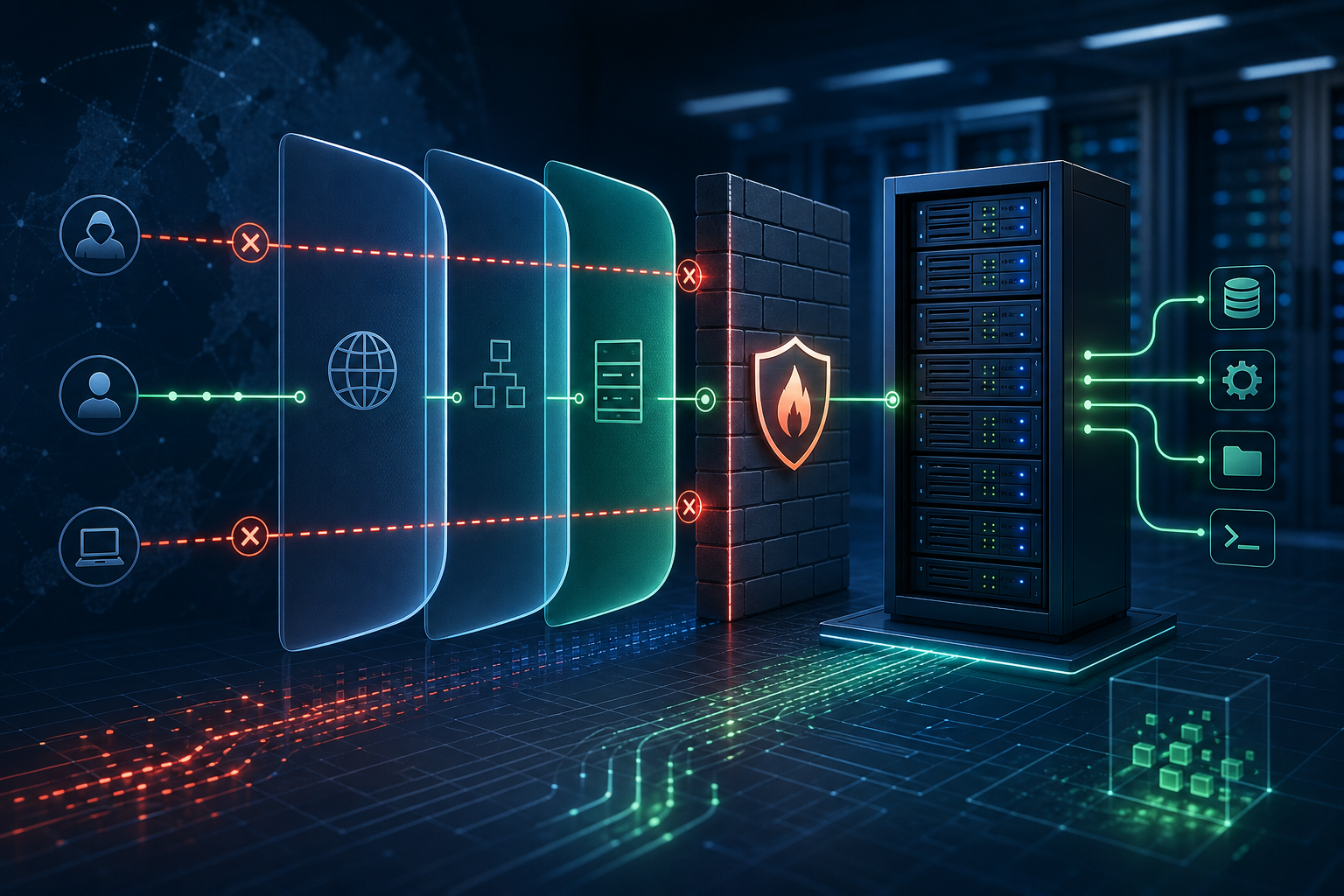
SELinux and Firewalld solve different parts of that problem. Firewalld controls network reachability. SELinux controls what processes can do after traffic reaches the host. Used together, they reduce the chance that an exposed service becomes an unrestricted service. After reading this article, you should be able to decide whether this approach fits your CentOS 7 host, understand the security boundary each tool provides, apply a practical validation workflow, and verify the system before it goes into production.
Key takeaways
- Firewalld limits which hosts and networks can reach a service.
- SELinux limits what a service can do even if it is reachable.
- Hardening works best when you allow only the minimum required network paths and keep SELinux in enforcing mode.
- Most production issues come from uncategorized exceptions, not from the controls themselves.
- Validation matters: you should confirm both network exposure and SELinux behavior after each change.
How the two controls work in practice
Firewalld is the network policy layer. It decides whether inbound traffic is accepted, dropped, or redirected according to the active zone and the rules attached to that zone. For service hardening, the important point is that opening a port is not the same as making the host safely available. Zone selection, source restrictions, and service definitions all affect the actual exposure. If you need a deeper review of rule design and source-based exposure, see CentOS 7 FirewallD Rules for Secure Service Exposure.
SELinux is the mandatory access control layer. Even if a packet reaches the daemon, SELinux can still prevent the process from reading files, binding sockets, writing to paths, or communicating with other services if that action is not allowed by policy. This is why SELinux is valuable in hardening: it contains the blast radius of a compromised or misconfigured application. But it only helps when it is enabled, enforcing, and aligned with the actual service context.
The two controls are complementary, not interchangeable. Firewalld answers, “Should this host accept this connection?” SELinux answers, “What is this process allowed to do?” If you disable one to make the other work, you usually trade a visible error for a hidden risk.
A compact workflow for hardening validation
1. Identify the service and the exact network sources it must accept.
2. Keep SELinux in enforcing mode and note any expected denials.
3. Confirm the firewalld zone attached to the active interface.
4. Allow only the required service or port, and prefer source-limited rules where possible.
5. Exercise the service from an approved client and inspect logs for SELinux denials.
6. Remove temporary exceptions and recheck after restart and reboot.
This workflow is intentionally compact because the hardening decision is usually not about complexity. It is about evidence. If the service works only when SELinux is permissive or when the firewall is broadly open, that is a sign the underlying policy has not been aligned with the application.
What this means in practice
A practical example is a CentOS 7 host running SSH, a web application, and a local backup agent. The common mistake is to open the SSH port broadly, allow the web service globally, and then disable SELinux because one application cannot write to its data directory. That makes the host operational, but not hardened.
A more defensible approach is to keep SSH restricted to administrative networks, allow only the web service required for the application, and investigate the SELinux denial instead of bypassing it. In many cases, the fix is not to weaken SELinux but to correct file labels, choose the right SELinux boolean, or place application data in a supported path. If SSH access needs to be tightened as part of the same hardening effort, Hardening CentOS 7 SSH with Key-Based Authentication and MFA fits naturally with this model because authentication hardening reduces the value of any network exposure that remains.
When this is done well, operations teams see a consistent pattern: the host exposes only the expected services, troubleshooting becomes more precise because denials are visible, and configuration drift is easier to spot. The controls do not remove the need for application-level security, but they make misconfiguration far less forgiving.
Decision guidance: when this approach applies
Use SELinux and Firewalld together when the host is a general-purpose server, a DMZ system, a shared service node, or anything that should remain resilient if one application misbehaves. This is especially appropriate when multiple teams touch the same server, because network exposure and privilege boundaries can be audited separately.
The approach is less useful if the system is a short-lived disposable image with no persistent services, or if the workload is already isolated behind another enforcement point and the host is not expected to manage inbound access itself. Even then, SELinux can still provide value, but the operational cost should be weighed against the control you already have elsewhere.
A useful rule is this: if you need to explain why a service is reachable, by whom, and what it can do after it is reached, then the combination of Firewalld and SELinux belongs in the design.
Typical validation checks before production
Before a host is treated as hardened, validate both layers separately and together. For Firewalld, confirm the active zone for the interface, the allowed services or ports, and any source restrictions that should apply. For SELinux, confirm that it is enforcing, not permissive, and that the service is not generating repeated denials during normal traffic.
A good production check is to ask three questions:
- Is the service reachable only from the intended source networks?
- Does the application function without broad firewall exceptions?
- Are SELinux denials either absent or clearly understood and intentionally handled?
If the answer to any of these is no, the system is not ready. That does not always mean the configuration is wrong. It may mean the service design is incomplete, the file labels are incorrect, or the firewall policy is more permissive than the application requires.
If you are standardizing rule design across several CentOS systems, CentOS FirewallD Configuration for Secure Server Hardening is useful context because it focuses on zoning and exposure decisions rather than simply opening ports.
Common mistakes that weaken hardening
One frequent mistake is treating permissive SELinux as a temporary state that can remain in place indefinitely. That creates a false sense of security because the system appears to work while policy enforcement is effectively disabled. Another common issue is using broad firewall rules during troubleshooting and never replacing them with source-specific policy.
A second mistake is to fix an SELinux denial by disabling SELinux instead of correcting labels, booleans, or policy expectations. That often hides an application packaging problem or an incorrect file path. A third mistake is to validate the service only from localhost. A service can appear healthy locally while being blocked externally by Firewalld or denied by SELinux once real traffic arrives.
There is also an audit problem. If exceptions are added in multiple places without clear ownership, no one can later tell whether access is intentional or accidental. In production, that is often more dangerous than a hard failure because it reduces visibility while expanding access.
Trade-offs to consider
SELinux increases precision, but it also increases the need for accurate labels and context-aware troubleshooting. Firewalld improves visibility and flexibility, but zone and source design must be maintained carefully. Together they can reduce risk substantially, but they also require teams to be willing to diagnose root cause rather than bypass controls.
The main operational trade-off is time versus resilience. A permissive configuration is faster to make work, but it is harder to secure later and more vulnerable to configuration drift. A hardened configuration takes more upfront validation, but it gives you clearer failure modes and better containment if a service is compromised.
Another trade-off is between generic convenience and least privilege. If many systems use the same broad rules, administration may be simpler in the short term. But if the environment needs strong segregation, source-limited access and enforced SELinux policy are usually worth the extra effort.
How to interpret SELinux and firewall symptoms
When a service fails, the symptom usually points to the layer that is blocking it, but not always. If a connection is refused or filtered before reaching the service, Firewalld is the first place to inspect. If the service starts but cannot read, write, bind, or call another component, SELinux is often involved.
The important distinction is that a network allow rule does not guarantee application success. A web server can be reachable while still unable to serve content because SELinux prevents access to the document root. Likewise, a daemon can function locally and still be unreachable remotely because the active zone does not allow its port.
A practical validation habit is to inspect both logs and policy state after any change. That means verifying the firewall zone, checking whether the service is allowed, and reviewing SELinux denials in the context of the application’s intended behavior. If you only test one layer, the other may still be silently constraining the host.
Production readiness checklist
Use this as a compact acceptance check before declaring the host hardened:
- SELinux is enabled and enforcing.
- The active Firewalld zone is correct for the interface.
- Only required services or ports are allowed.
- Source restrictions are in place where the service does not need broad exposure.
- The application works from an approved external client, not only from localhost.
- SELinux logs show no unexpected denials during normal operation.
- Any exceptions are documented with an owner and a reason.
- Temporary troubleshooting changes have been removed.
Final takeaway
CentOS 7 hardening with SELinux and Firewalld is not about adding two security products and hoping for better results. It is about using network policy and mandatory access control together so that a reachable service is still constrained, observable, and defensible. If you can validate exposure, confirm enforcing SELinux, and explain every exception, you have a practical hardening model that scales much better than ad hoc port opening and permissive policy.
Use this guidance together with BitLocker recovery key management and SELinux access denials to connect the workflow with related operational context already available on the site.