
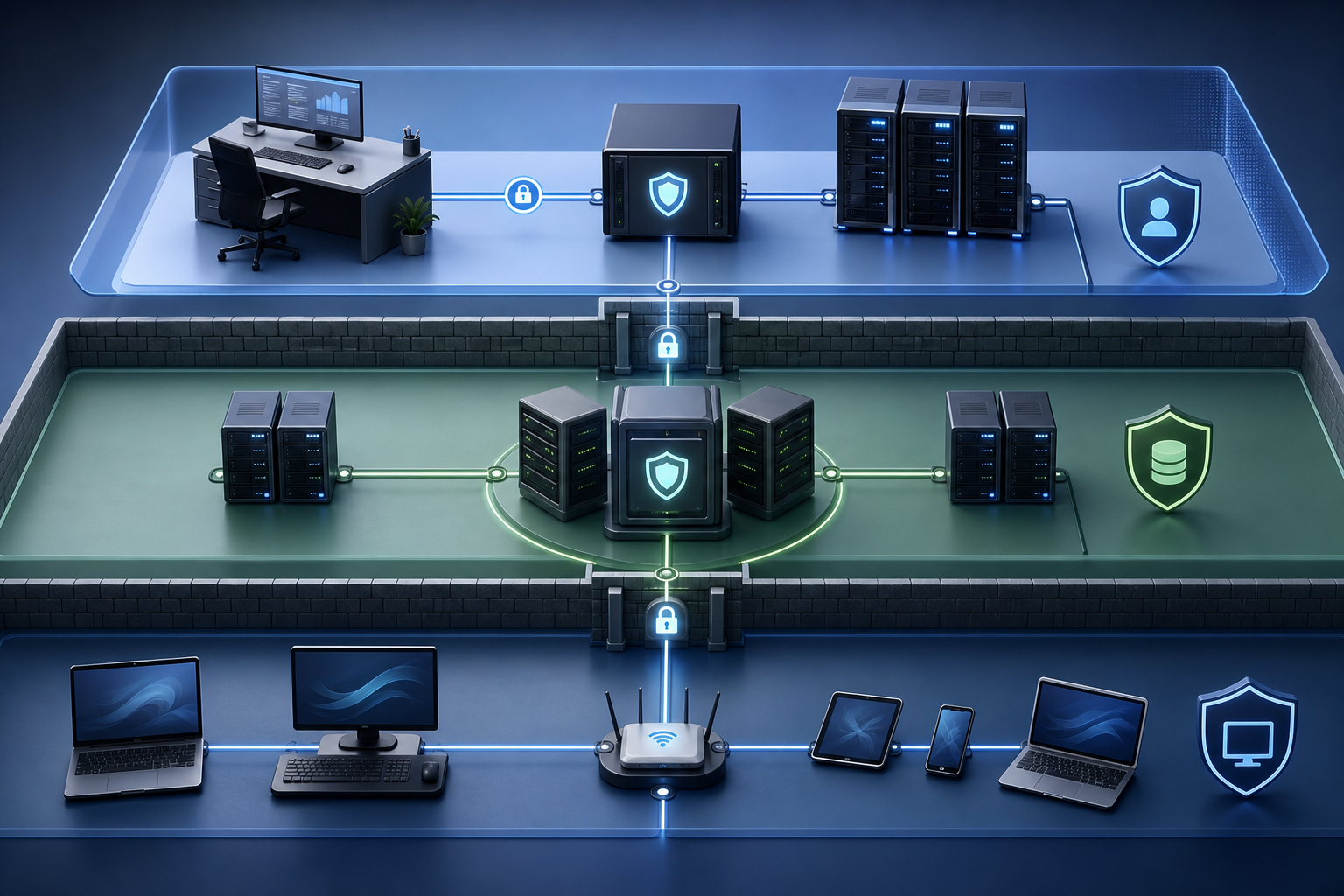
Why a tiering model matters
The practical problem behind privileged access in Active Directory is simple: if a single admin account can manage domain controllers, servers, workstations, and identity infrastructure from one login, then one credential compromise can turn into full environment compromise. A tiering model addresses that by separating administrative trust into distinct levels so sensitive systems are not reachable from lower-trust assets and routine administration cannot easily be used as a pivot point.
Operationally, this matters because most real-world identity breaches rely on lateral movement, credential theft, delegated access abuse, or session hijacking after an initial foothold. A tiering model does not eliminate those risks, but it sharply limits blast radius and makes detection and recovery more reliable. After reading this article, you should be able to decide whether the model fits your environment, understand how the trust boundaries work, apply a practical validation workflow, and verify the controls that matter before production rollout.
Key takeaways
A tiering model is not just an administrative naming convention. It is a control framework for privileged access that depends on strict separation of accounts, devices, and management paths.
- Tier 0 protects identity infrastructure and other systems that can grant or rewrite trust.
- Tier 1 covers server administration and infrastructure services.
- Tier 2 covers user workstations and lower-trust endpoints.
- Privileged accounts should only be used from devices and sessions that match their tier.
- The model only works if logon paths, remote management, delegation, and service accounts are aligned with the boundary design.
If you are also reviewing attack paths that target identity controls, it helps to pair tiering with monitoring for credential-based attacks such as password spray activity and with checks for delegation abuse that can bypass intended trust boundaries, such as Kerberos delegation abuse.
What the tiering model actually is
A tiering model is a privilege segmentation strategy. Instead of treating every administrator as equally trusted everywhere, the environment is divided into levels based on what can be controlled from that privilege set.
A common interpretation is:
- Tier 0: the most sensitive identity and trust infrastructure, such as domain controllers, identity management systems, PKI, federation services, and systems that can directly alter authentication or authorization.
- Tier 1: application and infrastructure servers, virtualization hosts, backup platforms, management servers, and other high-value systems that are not themselves part of the identity control plane.
- Tier 2: end-user devices, help desk support actions, and routine desktop administration.
The key idea is not the exact label set. The key idea is that a Tier 0 account must never be exposed to Tier 1 or Tier 2 trust zones, because any credential material, token, or session captured in a lower tier can be used to reach the higher tier.
In practice, the model combines three kinds of separation:
- Account separation — different admin accounts for different tiers.
- Device separation — privileged accounts can only log on from managed devices at the same tier or above.
- Path separation — management protocols, remote desktop, jump hosts, and delegation routes are constrained so lower tiers cannot reach higher tiers.
How it works in a production environment
The tiering model works by reducing the number of places where privileged credentials ever exist. That means a Tier 0 administrator should use a Tier 0 workstation or equivalent hardened management endpoint, connect only to Tier 0 systems, and avoid mixed-use activity such as email, web browsing, or general-purpose troubleshooting from that session.
This matters because compromise often happens through the endpoint, not the server being managed. If an admin signs into a workstation used for regular browsing, the attacker does not need to break domain security directly; they only need to steal tokens, cached credentials, or session artifacts. Tiering makes that harder by minimizing cross-trust exposure.
The model also works through operational policy. For example, if a Tier 1 admin account is barred from logging on to Tier 0 systems, then a compromised server admin should not automatically be able to interact with domain controllers, directory synchronization systems, or PKI. Similarly, a Tier 2 support account should not be able to initiate remote management sessions into infrastructure servers unless the environment explicitly and safely allows it.
The design is strongest when the following controls are consistent:
- Logon restrictions for privileged accounts.
- Separate administrative workstations or privileged access workstations.
- Restricted remote management protocols and jump paths.
- No unnecessary privilege inheritance through groups, nested groups, or broad local admin assignments.
- Event logging and alerting on tier boundary violations.
A compact workflow for validating the model
Before expanding or enforcing tiering, use a narrow validation workflow that confirms the boundary actually exists.
1. Identify Tier 0 systems and accounts.
2. Verify where each privileged account can log on interactively and remotely.
3. Confirm the admin workstation or jump path is isolated from lower tiers.
4. Test whether credentials can be reused across tiers.
5. Review delegation, local admin, and service account paths for cross-tier exposure.
6. Record violations, fix them, then retest before broad enforcement.
This is not a full implementation guide. It is a validation sequence that tells you whether your current design matches your policy. If the workflow exposes a cross-tier path, the tiering model is incomplete even if the account naming looks orderly.
Practical scenario: when this should look familiar
Consider a mid-sized enterprise where the directory team manages domain controllers, the infrastructure team manages hypervisors and file servers, and help desk staff reset passwords and support desktop issues. On paper, the environment may already have different admin groups. In practice, the same engineer might use a daily laptop, RDP into a server, open the directory console, and then reuse that session to access other systems.
That environment usually shows a few recognizable signs:
- Admins have one primary account that works everywhere.
- Jump boxes exist, but they are not the only path used.
- Server administration and workstation support happen from the same endpoint.
- Local administrator rights are widely delegated to simplify support.
- Service accounts have broad reach because they were created before privilege boundaries were formalized.
In this scenario, the organization does not lack permissions; it lacks trust separation. A tiering model is useful because it forces the team to define where each privilege class is allowed to operate and what it must never touch.
What this means in practice
In practice, tiering changes daily administration. The most important effect is that privileged users need to think in terms of context, not just identity. The same person may have multiple accounts, multiple management devices, and multiple access paths, each with a narrower purpose.
That sounds inconvenient because it adds friction. It is supposed to. The model trades convenience for containment. The right question is not whether it adds overhead, but whether the overhead is smaller than the blast radius reduction you gain.
A practical tiering program usually means:
- Tier 0 accounts are rare, tightly controlled, and used only for identity and trust infrastructure.
- Admin tasks happen from hardened management devices, not from mixed-use endpoints.
- Remote tools and scripts are restricted to the minimum tier they need.
- Service accounts are reviewed to ensure they are not de facto cross-tier administrators.
- Monitoring rules focus on impossible or unusual access paths, not just bad passwords.
This is also where detection and policy reinforce each other. A tier model becomes much easier to defend if alerting is tuned to spot boundary violations, such as a privileged account authenticating from an unexpected device class or a directory admin touching a non-approved host range.
Decision guidance: when the model fits, and when it may not
A tiering model is a strong fit when you have multiple admin teams, mixed infrastructure criticality, regulatory or audit pressure, or a known history of lateral movement risk. It is especially useful where identity compromise would be catastrophic, because the model directly protects the control plane that can reset, delegate, or erase access.
It may be a weaker fit, or require a modified version, when the environment is very small, highly centralized, or lacks the operational capacity to maintain separate admin identities and endpoints. In those cases, trying to enforce a strict three-tier model without support processes often leads to workarounds, and workarounds defeat the purpose.
Use this decision rule: if you cannot name the systems that are most trusted, the accounts that can administer them, and the only devices allowed to reach them, the environment is not ready for a meaningful tier model yet.
A good rule of thumb is to start where the impact is highest. Identity infrastructure, federation, PKI, backup systems, and virtualization management often deserve Tier 0 scrutiny even before the rest of the environment is fully segmented.
Implementation trade-offs you should expect
The biggest trade-off is operational complexity. Separate accounts, restricted logon paths, hardened workstations, and tier-specific support procedures all create more objects to manage and more ways for administrators to make mistakes.
Other trade-offs include:
- User friction: admins may need to sign into more than one account or device.
- Tool compatibility: some legacy management tools assume broad network reach.
- Exception pressure: urgent troubleshooting often leads to policy bypasses.
- Service account sprawl: automation can accidentally recreate cross-tier access.
- Visibility gaps: if logs are not centralized, boundary violations may go unnoticed.
These trade-offs do not mean the model is bad. They mean the model must be designed with operating reality in mind. A tiering design that cannot support incident response, backup restore, or break-glass access will be bypassed during the first major outage.
Common mistakes that weaken the model
Several mistakes show up repeatedly in environments that claim to have tiering but still suffer from cross-tier exposure.
The most common is mixing admin and daily-use activity on the same workstation. Even if the account names are separate, a compromised endpoint can still become a credential theft source.
Another common mistake is allowing a trusted admin group to have local administrator rights everywhere “for convenience.” That often turns a nominal Tier 1 or Tier 2 boundary into a paper control.
Teams also frequently underestimate delegated access. If a service account can perform privileged operations across multiple scopes, it may effectively bypass the tier model unless it is constrained and monitored. Broad delegation paths are especially important to review if you rely on Kerberos-based administration or remote service delegation patterns.
Finally, some environments define tiers but never test the enforcement. If no one validates whether a Tier 2 admin can reach Tier 0 through RDP, WinRM, delegated services, backup tooling, or automation, then the boundary is assumed rather than proven.
Production readiness checklist
Before treating the tiering model as production-ready, verify the following:
- Tier 0 systems are explicitly identified and documented.
- Separate administrative accounts exist for each intended tier.
- Privileged logon restrictions are enforced and tested.
- Tier 0 administration occurs only from approved hardened devices or jump paths.
- Lower-tier systems cannot initiate management paths into higher-tier systems.
- Service accounts have been reviewed for cross-tier privilege.
- Local administrator rights are justified, not inherited by default.
- Logging captures authentication, logon type, and source device or host context.
- Boundary violation alerts are tested before rollout.
- Break-glass access is documented, monitored, and excluded from normal use.
If any of these items are only partially true, the model is still a design goal, not a finished control.
Final takeaways
An Active Directory tiering model is a practical way to reduce privileged access risk by separating identity control, server administration, and workstation support into distinct trust zones. Its value is not in the labels themselves, but in the enforced limits on where credentials, sessions, and management paths can exist.
If you are considering it for your environment, focus first on the highest-value trust boundaries, prove that the boundaries are enforced, and then expand only after validation shows that accounts, devices, and delegation paths all behave as intended. A tiering model is effective when it changes real access paths, not when it only changes documentation.
Use this guidance together with Red Hat vulnerability patching to connect the workflow with related operational context already available on the site.