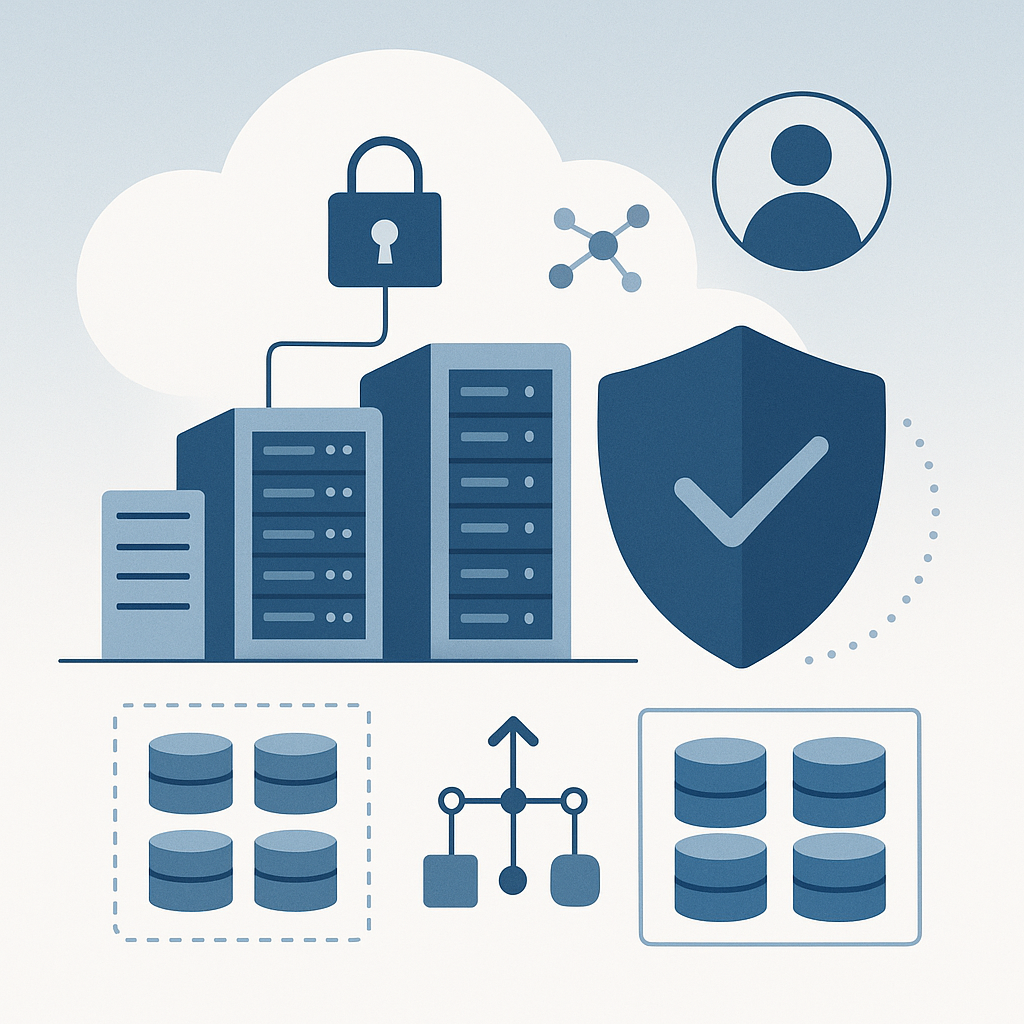
Tenant isolation is a core property of any multi-tenant system: one tenant must not be able to read, modify, or influence another tenant’s data or workloads beyond what the product explicitly allows. Data segmentation is how you make that promise real—by designing boundaries at the identity, application, database, storage, network, and operational layers so that access decisions are enforced consistently and can be audited.
This guide focuses on practical techniques IT administrators and system engineers can apply when building, migrating, or operating shared platforms (SaaS, internal “platform-as-a-service,” shared Kubernetes clusters, shared databases, and shared networks). The goal is not only confidentiality (preventing data leakage), but also integrity (preventing cross-tenant modification), availability (containing noisy neighbors and abuse), and compliance (being able to prove the controls exist and work).
A useful way to read this article is as a set of stacked layers. You start by selecting an isolation model that matches your risk and cost constraints. Then you implement segmentation and policy enforcement at each layer, because no single control is sufficient on its own. Finally, you validate isolation continuously using logging, tests, and operational practices.
Clarifying terms: tenant, isolation boundary, and segmentation
A tenant is an independently administered customer, business unit, or organization that shares a common platform while expecting separation from others. Tenants often map to contracts and billing, but for engineering purposes the key attribute is that tenants have distinct identity contexts, data ownership, and administrative control.
An isolation boundary is the technical line that prevents cross-tenant access or impact. Boundaries can be strong (separate cloud accounts/subscriptions, separate clusters) or soft (row-level checks in a shared database), and a platform typically uses more than one boundary.
Data segmentation is the act of partitioning data and related resources so enforcement points can make unambiguous decisions. Segmentation includes logical partitioning (tenant IDs and policies), physical partitioning (separate databases or storage accounts), and operational partitioning (separate keys, separate backups, separate monitoring views). The segmentation approach you choose determines which enforcement mechanisms are possible and how hard it is to audit.
Throughout this guide, “tenant isolation” is the primary objective, and “data segmentation” is the means to achieve it.
Why tenant isolation fails in real systems
Isolation failures rarely come from one catastrophic bug; they tend to emerge from gaps between layers or between design intent and operational reality. Understanding common failure modes helps you design controls that complement each other.
One frequent failure is authorization drift: a service starts with strict tenant checks, but a later feature adds a new query path or cache layer that bypasses those checks. This is common when the tenant context is not carried end-to-end (for example, a background job that runs with “system” privileges and forgets to filter by tenant).
Another frequent failure is implicit trust between internal services. Microservices and internal APIs often assume calls are “from inside the network,” so they skip fine-grained authorization. In a multi-tenant environment, internal does not mean safe; a compromised service, SSRF, or misconfigured gateway can become a bridge across tenants.
The third pattern is shared operational artifacts: backups, logs, metrics, and support tooling often become unsegmented data pools. Even if the production database is segmented, a centralized log search that exposes payloads can create an easier path to cross-tenant data exposure.
These failure modes foreshadow the structure of the rest of the guide: you mitigate them by making tenant context explicit, enforcing it at multiple layers, and ensuring operational systems respect the same boundaries.
Choosing an isolation model: shared, partitioned, or dedicated
Before implementing specific controls, decide which isolation model fits your product and risk profile. Most platforms land on a hybrid, but it helps to define a default model and the exceptions.
Fully shared model (logical isolation)
In a fully shared model, tenants share the same application deployment and the same underlying data stores. Isolation is mostly logical: tenant identifiers, authorization policies, and query filters enforce separation.
This model is cost-effective and operationally simple—one fleet to patch, one schema to evolve—but it places heavy reliance on software correctness. If your only boundary is “application code filters rows,” then defects, injection vulnerabilities, and misrouted tenant context can become isolation incidents.
Logical isolation can still be strong when implemented with defense in depth. For example, database-enforced row-level security (RLS) can ensure the database rejects cross-tenant queries even if application code is wrong.
Partitioned model (shared compute, segmented data)
A partitioned model keeps shared application infrastructure but introduces stronger segmentation in data and supporting resources. Examples include a database-per-tenant, schema-per-tenant, or storage container-per-tenant approach while still running shared stateless services.
Partitioning reduces blast radius. If a tenant’s data lives in its own database, a mistaken query in the app is less likely to cross boundaries because the connection string itself points to that tenant’s database. However, partitioning adds complexity in provisioning, schema migrations, and capacity planning.
Partitioned designs are common in systems that must support “premium isolation” tiers, data residency requirements, or customers with strict compliance expectations.
Dedicated model (strong physical isolation)
In a dedicated model, tenants have separate deployments—separate cloud accounts/subscriptions, clusters, or even separate VPC/VNets. This provides the strongest isolation boundary and can simplify compliance narratives.
The trade-off is cost and operational overhead. Dedicated deployments require automation to keep parity across tenants (patching, configuration baselines, monitoring) and can lead to version skew if not managed carefully.
Many organizations adopt dedicated isolation for a small number of high-value or high-risk tenants while keeping most tenants on a shared or partitioned model.
A practical decision framework
The decision is rarely binary. A practical approach is to define baseline controls for the shared model and then add stronger boundaries where risk or requirements demand it. Consider:
- Data sensitivity and regulatory impact (PII, PHI, PCI).
- Tenant-controlled administrators and integrations (risk of compromise).
- Scale and performance isolation needs (noisy neighbor concerns).
- Customer contractual requirements (data residency, dedicated keys).
- Engineering maturity (ability to sustain automation, testing, and audits).
Once you pick a model, the rest of the design becomes an exercise in making the tenant boundary explicit and enforceable at every layer.
Establishing a tenant identity plane (authentication and tenant context)
Every downstream control depends on one foundational fact: the system must reliably know “which tenant is this request operating on?” and “what is this principal allowed to do within that tenant?” Getting tenant identity wrong creates systemic isolation failures.
Tenant-aware authentication
Authentication (AuthN) proves who the caller is; authorization (AuthZ) decides what they can do. For tenant isolation, you need both, and you need tenant scoping to be part of the security model.
If you use an external identity provider (IdP) such as Microsoft Entra ID, Okta, or an internal OIDC provider, ensure that tokens carry an unforgeable tenant identifier (often a claim like tid, tenant_id, or a customer GUID). Do not accept tenant identifiers from request headers or query parameters as the source of truth unless they are cryptographically bound to identity.
A common approach is:
- Use OIDC/OAuth2 for user and service authentication.
- Include tenant identity in the access token as a claim.
- Derive tenant context from the validated token on every request.
- Propagate tenant context to downstream services using signed tokens or mTLS-bound identities rather than plain headers.
Service-to-service identity and the “confused deputy” problem
In microservice environments, internal calls can accidentally become a cross-tenant bridge. The “confused deputy” problem occurs when a service with broad privileges is tricked into performing an action on behalf of a less-privileged caller.
To prevent this, avoid using a single omnipotent service identity for internal calls. Instead, use a combination of:
- Per-service identities with least privilege.
- Delegation tokens that carry the original user identity and tenant context.
- Explicit authorization at each service boundary.
If you cannot forward the user identity, forward a constrained “act-as” token scoped to tenant and operation, with short TTLs.
Real-world scenario: cross-tenant access via background jobs
A common incident pattern appears during platform growth. Imagine a SaaS that adds an asynchronous export feature. The export job runs under a system identity and pulls data using a “get all records for account” query. During refactoring, the team changes “account” to “tenant,” but one code path still uses an unscoped query. In production, the job starts exporting records across all tenants.
This scenario illustrates why the tenant context must be a first-class parameter in every data access path, not an optional filter. It also illustrates why database-side enforcement (like RLS) is valuable: it can turn this category of bug into a failed query instead of a data breach.
Authorization strategies: RBAC, ABAC, and policy enforcement points
Once you have authenticated identity and tenant context, authorization must be enforced consistently. The core requirement is that every access decision is tenant-scoped.
RBAC within a tenant
Role-based access control (RBAC) assigns permissions to roles (e.g., TenantAdmin, Auditor, BillingUser) and assigns users to roles. RBAC is straightforward for administrators and works well when permissions are stable.
The key for tenant isolation is that roles must be tenant-scoped. Avoid global roles that implicitly span tenants unless you have a separate “platform operator” plane with strict controls and auditing.
ABAC and resource attributes
Attribute-based access control (ABAC) makes decisions based on attributes of the principal (claims, groups) and attributes of the resource (tenant_id, classification, environment). ABAC is powerful for multi-tenant systems because tenant identity itself becomes an attribute, and policies can express rules like “principal.tenant_id must equal resource.tenant_id.”
ABAC tends to be more flexible than RBAC for systems with complex sharing models (for example, a managed service provider that legitimately accesses multiple tenants). It also tends to be harder to reason about without good tooling and test coverage.
Centralized policy engines
Policy engines (for example, Open Policy Agent) can help standardize enforcement and reduce duplication across services. The critical detail is where the policy is enforced: you need a policy enforcement point (PEP) close to the resource being protected. Centralizing decision logic is useful, but do not centralize enforcement in a way that creates a bypass path.
If you adopt a policy engine, treat tenant isolation rules as “non-negotiable invariants” and write them as explicit checks. Keep policies versioned, tested, and deployed with the same rigor as application code.
Example policy concept
At a minimum, your authorization layer should enforce:
- The caller’s tenant context matches the target resource’s tenant.
- The caller has the required permission for the operation.
- Elevated operations (exports, bulk deletes) have additional checks (MFA, step-up auth, approval workflows) when appropriate.
Even if you implement these checks in different technologies, the conceptual policy should remain consistent.
Data layer segmentation patterns (database and storage)
The data layer is where many tenant isolation programs succeed or fail. Application-level checks are important, but you should design the data layer so that incorrect application code is less likely to leak data.
Row-level segmentation (shared tables)
Row-level segmentation stores multiple tenants’ data in the same tables with a tenant_id column. This approach is efficient and simplifies schema management.
The weakness is obvious: if a query omits the tenant_id predicate, you can return cross-tenant data. Mitigations include:
- Database row-level security (where supported).
- Mandatory query patterns via ORM filters and code reviews.
- Strict database permissions that restrict ad hoc querying.
- Automated tests that simulate cross-tenant access attempts.
Row-level segmentation is often the baseline for SaaS at scale, but it requires discipline and defense in depth.
Schema-level segmentation (schema per tenant)
Schema-per-tenant creates separate schemas (namespaces) within a shared database instance. It provides stronger separation than row-level segmentation and can reduce accidental cross-tenant joins.
Operationally, schema-per-tenant can become heavy at high tenant counts, depending on the database engine. You must also consider how schema migrations are applied across many schemas and how you manage connection pooling and permissions.
Database-per-tenant segmentation
Database-per-tenant provides a stronger and simpler boundary: connecting to the wrong database is harder to do accidentally if your connection resolution is correct, and database-level permissions can prevent cross-tenant reads.
This pattern is attractive when tenants have distinct retention policies, residency requirements, or encryption key requirements. It can also help with performance isolation.
The cost is operational complexity: provisioning, backups, migrations, and monitoring scale with the number of tenants unless you build automation.
Storage segmentation: buckets, containers, prefixes
Object storage often holds the artifacts most likely to be shared unintentionally: exports, reports, attachments, logs, and backups. A frequent mistake is to segment storage only by prefix (e.g., s3://bucket/tenantA/...) while granting broader bucket permissions.
A stronger pattern is to segment by container/bucket per tenant when feasible, or at least enforce IAM policies that limit principals to a specific prefix and prohibit listing outside that prefix.
Be careful with pre-signed URLs and shared CDN distributions. A pre-signed URL is effectively a bearer token to the object; ensure TTLs are short and that object keys are unguessable if URLs might leak.
Database-enforced isolation with PostgreSQL RLS (practical example)
PostgreSQL row-level security (RLS) is one of the most practical defenses for shared-table designs because it moves the tenant check into the database engine.
The core idea is that even if an application query forgets the tenant predicate, the database will still filter rows based on a session setting.
Minimal RLS pattern
You store tenant_id in each tenant-scoped table and create a policy that compares it to a session variable. The application sets the session variable at connection time.
-- Example table
CREATE TABLE orders (
  id            uuid PRIMARY KEY,
  tenant_id     uuid NOT NULL,
  created_at    timestamptz NOT NULL DEFAULT now(),
  amount_cents  bigint NOT NULL
);

-- Enable RLS
ALTER TABLE orders ENABLE ROW LEVEL SECURITY;

-- Policy: only allow access to rows matching the session tenant
CREATE POLICY tenant_isolation_orders ON orders
  USING (tenant_id = current_setting('app.tenant_id')::uuid);

-- Optional: prevent bypass by restricting table privileges
REVOKE ALL ON orders FROM PUBLIC;
On the application side (or in a connection pooler), set app.tenant_id after authenticating the request and before running queries.
sql
-- Per connection/session
SELECT set_config('app.tenant_id', '11111111-2222-3333-4444-555555555555', true);
This does not eliminate the need for application authorization, but it meaningfully reduces the risk of cross-tenant reads from coding mistakes.
Operational considerations for RLS
RLS introduces new failure modes that are mostly operational: connection pooling must not leak session settings between tenants, and privileged roles must be controlled.
If you use a transaction-level pooler (like PgBouncer in transaction mode), session settings can be lost or mixed; you need a strategy that reliably sets tenant context per transaction or uses a pooler mode compatible with session state. Many teams enforce “set tenant context at the start of every transaction” and treat missing context as a hard failure.
You must also control database roles with BYPASSRLS privileges. Any role with bypass rights can defeat the isolation policy. Reserve such roles for tightly controlled administrative workflows and ensure their use is heavily audited.
Network and compute isolation: from subnets to Kubernetes namespaces
Even with strong identity and data controls, compute and network segmentation matter for containing compromise and reducing blast radius. The goal is not to rely on the network for authorization, but to ensure that a compromised component cannot easily pivot into other tenants’ resources.
Environment boundaries: dev/test/prod and tenant tiers
Start by separating environments. It is surprisingly common for tenant isolation to be undermined by a “support” workflow that queries production data from a development network, or by copying production databases into less-secure test environments.
Define explicit environment boundaries (accounts/subscriptions/projects) and enforce them with policy. Then consider whether you need tenant tiers: for example, a shared pool for most tenants and a separate cluster for regulated tenants.
Kubernetes multi-tenancy: namespaces are not a full boundary
Kubernetes namespaces provide a resource scoping mechanism, but they are not a complete security boundary by themselves. If you run multiple tenants in one cluster, you need to treat multi-tenancy as a structured design:
- Use namespaces for segmentation and apply RBAC per namespace.
- Use NetworkPolicies to restrict east-west traffic.
- Use Pod Security (or equivalent) to prevent privileged workloads.
- Control admission (e.g., validating policies) to enforce baseline security.
- Consider node pool separation for higher-risk tenants.
A frequent anti-pattern is “one namespace per tenant” without network policies. In that setup, a compromised pod may reach internal services that assume trust based on being inside the cluster.
Real-world scenario: shared cluster, leaked metrics, and lateral movement
Consider a platform team that hosts multiple internal tenants (business units) on a shared Kubernetes cluster. They use namespaces and RBAC, but they expose a shared Prometheus and Grafana instance to “all engineers.” A dashboard includes HTTP request logs with query parameters and occasionally bearer tokens.
No production database was directly accessible across namespaces, but the operational telemetry became the cross-tenant leak path. The fix required segmenting observability access, scrubbing sensitive fields, and enforcing namespace-specific views—demonstrating that isolation must apply to operational data as well as primary data stores.
Tenant-aware secrets, encryption, and key management
Encryption helps with tenant isolation in two ways: it reduces the impact of storage compromise, and it can create cryptographic boundaries when you use separate keys per tenant.
Encrypt in transit and bind identities
Transport encryption (TLS) is table stakes. For tenant isolation, pay attention to how services authenticate each other. Mutual TLS (mTLS) or cloud-native service identities can prevent unauthorized internal callers from reaching sensitive endpoints.
Where possible, bind authorization decisions to authenticated service identities rather than IP allowlists. IP-based controls can support segmentation, but they are brittle and easy to misconfigure in dynamic environments.
Encrypt at rest and decide on key granularity
Most cloud services encrypt at rest by default, but tenant isolation programs often need finer control over keys:
- A single platform key is operationally simple but creates shared blast radius.
- Per-environment keys reduce blast radius across environments.
- Per-tenant keys create strong segmentation and can support “customer-managed keys” (CMK) requirements.
Per-tenant keys add complexity (key lifecycle, rotation, performance overhead in envelope encryption, and operational tooling). For many systems, a pragmatic compromise is per-tenant keys for regulated/high-value tenants and per-environment keys for the shared tier.
Envelope encryption and per-tenant data keys
Envelope encryption uses a master key (in KMS/Key Vault) to encrypt data keys, which then encrypt the actual data. If you maintain a distinct data key per tenant (or per tenant per dataset), you can revoke access or rotate keys with clearer blast-radius control.
The implementation details vary across providers, but the architectural principle is consistent: keys are a resource that must be segmented and access-controlled like any other.
Application-layer tenancy: making tenant context unskippable
Even with database enforcement, the application layer must still behave correctly because it shapes which resources are requested and what operations are allowed. The strongest pattern is to make tenant context unskippable at compile-time or at least at code-review-time.
Tenant context as a required parameter
Design your internal service APIs so that tenant context is required. For example, rather than:
GetOrder(orderId)
prefer:
GetOrder(tenantId, orderId)
Even better, use a tenant-scoped identifier that cannot be referenced without a tenant context (for example, a composite key or a wrapper type in strongly typed languages). This reduces the chance of writing an unscoped query path.
Avoiding “global” caches without tenant keys
Caches are a classic isolation hazard. Any cache key that does not include tenant identity can serve the wrong data to the wrong tenant. This includes in-memory caches, distributed caches (Redis), and CDN caches.
A safe default is: every cached object that represents tenant data must include tenant identity in the cache key. Additionally, consider whether cached entries might contain authorization-dependent fields; if so, user identity or role may need to be part of the key as well.
Background processing and queue segmentation
Queues and background workers need tenant-aware design. If a single queue carries jobs for all tenants, ensure that:
- Each job includes an immutable tenant identifier.
- The worker sets tenant context before accessing data stores.
- Any retry/dead-letter mechanisms preserve tenant context.
- Operational tooling (replay, requeue) respects tenant boundaries.
If you segment queues per tenant, you gain stronger isolation but increase operational overhead. Many teams keep shared queues but enforce strict job schemas and validation.
Observability and operations: isolating logs, metrics, and support access
Operational systems frequently become the “shadow data plane” that breaks tenant isolation. A mature design segments not only primary data but also the artifacts generated by running the system.
Log segmentation and sensitive data handling
Logs should be treated as production data. At minimum:
- Include tenant identifiers as structured fields in logs to support auditing and incident response.
- Avoid logging sensitive payloads by default (tokens, PII, request bodies).
- Apply access controls to log search tools based on tenant scope.
If your support engineers need cross-tenant visibility, implement break-glass workflows with strong authentication, just-in-time access, ticket linkage, and tamper-evident audit logs.
Metrics and traces
Metrics are often aggregated and less sensitive, but tags/labels can still leak tenant identifiers, hostnames, or request paths. Distributed tracing can capture headers and payload metadata that may include tenant-specific details.
Design your observability instrumentation to:
- Scrub or hash sensitive labels.
- Avoid high-cardinality tenant labels where it harms performance, while still enabling tenant-level diagnostics when required.
- Segment access to traces that include request attributes.
Real-world scenario: support tooling as the weakest link
A B2B SaaS might have excellent database controls but a support portal that allows searching “by email” across all tenants. An agent enters an email address and sees results from multiple customers because the tool queries a shared user directory without tenant scoping.
This failure is common because support tooling is built for convenience and often bypasses the application’s main authorization paths. Fixing it typically requires defining support personas, scoping queries by tenant, and implementing auditable access workflows. The broader lesson is that tenant isolation is an organizational property: internal tools must follow the same segmentation rules as the product.
Designing segmentation for compliance without overbuilding
Regulatory requirements often drive tenant isolation investments, but it is easy to overbuild controls that are expensive to operate. The practical approach is to map requirements to enforceable controls and then to evidence.
Mapping requirements to layers
For example:
- GDPR focuses on protecting personal data and enforcing least privilege, plus the ability to delete/export data per subject. Tenant isolation supports GDPR by reducing unauthorized access and limiting breach impact.
- HIPAA requires safeguards for PHI, audit controls, and access controls. Tenant isolation supports HIPAA by ensuring one covered entity’s PHI cannot leak to another.
- PCI DSS emphasizes segmentation of cardholder data environments. If only certain tenants process payments, you may isolate those tenants’ payment workflows and storage.
Rather than trying to “be compliant” in the abstract, define which tenant data is in scope and then select segmentation boundaries that reduce audit scope.
Evidence: proving isolation exists
Auditors and security reviews typically want proof that isolation is not just a design statement. Practical evidence includes:
- IAM policies showing tenant-scoped access.
- Database policies (like RLS) and role permissions.
- Network policies and security group rules.
- Logging that records tenant identifiers and access decisions.
- Automated tests or controls that verify cross-tenant access attempts are denied.
Building these evidence artifacts into infrastructure-as-code and CI pipelines makes them easier to maintain.
Implementing tenant isolation step by step (a pragmatic build order)
Tenant isolation is easier when you implement it in a deliberate order. The order below reflects dependencies: later layers assume earlier layers are reliable.
Step 1: Define the tenant boundary and inventory tenant-scoped resources
Start by documenting what “tenant” means in your platform. Is it a customer organization, a workspace, a subscription, or something else? Then inventory which resources are tenant-scoped:
- Data tables and object storage paths
- API endpoints and service operations
- Caches and search indexes
- Background jobs and queues
- Logs, metrics, traces, and support tooling
- Encryption keys and secrets
This inventory becomes your segmentation map. Without it, teams tend to secure the obvious database tables while forgetting exports, search, and telemetry.
Step 2: Make tenant identity explicit and immutable in requests
Update your authentication layer so every request has an authenticated tenant context. Ensure it is derived from validated tokens rather than client-provided parameters.
At the gateway or API edge, reject requests that lack tenant context, and standardize how tenant identity is propagated to internal services. For service-to-service calls, use identities and tokens that are tenant-scoped.
Step 3: Enforce tenant checks at the data plane
Introduce enforcement in the data plane where possible:
- For shared relational databases, use RLS or equivalent mechanisms if supported.
- For object storage, enforce prefix/container restrictions via IAM policies.
- For search indexes, ensure tenant filters are mandatory and ideally enforced by index partitioning.
Even if you cannot implement database-enforced isolation everywhere, implement it where it provides the most leverage: the tables with the most sensitive data or the highest query complexity.
Step 4: Align application-layer patterns (repositories, caches, jobs)
Refactor data access patterns so tenant context is always present and difficult to omit. Standardize repository interfaces, query builders, and cache key patterns.
This step is where you reduce “authorization drift.” If every team implements tenancy differently, you will accumulate inconsistent behaviors. A shared library or service template can help, but only if it is adopted widely.
Step 5: Segment operational planes (logging, support, admin)
After production access is controlled, apply the same rigor to operational access. This includes:
- Tenant-scoped views in log and trace tools.
- Just-in-time access for support engineers.
- Redaction and data minimization in telemetry.
This step is often postponed, but it is where many real incidents occur because operational systems concentrate data.
Step 6: Validate continuously with tests and monitoring
Finally, treat tenant isolation as a continuously verified property. Add automated tests that attempt cross-tenant access at the API layer and, where feasible, at the data layer.
You can also monitor for suspicious patterns: for example, queries that return unusually large result sets, exports spanning multiple tenant IDs, or administrative actions performed without ticket linkage.
Cloud IAM examples: tenant-scoped access patterns
Cloud IAM is frequently part of tenant isolation, especially in partitioned or dedicated models. The key is to avoid broad roles that allow cross-tenant resource access.
Azure: subscription/resource group patterns
In Azure, a strong boundary is the subscription. Many organizations use:
- One subscription per environment for shared tiers.
- One subscription per regulated tenant for dedicated tiers.
Within a shared subscription, resource groups can segment resources, but remember that resource group boundaries are not as strong as subscription boundaries for some governance patterns.
A practical pattern for per-tenant data segmentation is a storage account per tenant (or per tenant per region) with a managed identity that has access only to that tenant’s storage. Provisioning can be done with Azure CLI as part of automation.
bash

# Example: create a storage account for a tenant

TENANT_KEY="tenant-1234"
RG="rg-saas-prod"
LOC="eastus"
SA="st${TENANT_KEY//-/}"

az storage account create \
  --name "$SA" \
  --resource-group "$RG" \
  --location "$LOC" \
  --sku Standard_LRS \
  --https-only true \
  --min-tls-version TLS1_2
The isolation comes from combining resource placement with identity-scoped access. The provisioning script alone is not enough; you must also bind access policies so only the correct workload identity can read/write that storage.
AWS: account and IAM boundary patterns
In AWS, the strongest boundary is an AWS account. Dedicated tenants often map well to separate accounts managed via AWS Organizations. For shared models, you may still use separate VPCs, separate KMS keys, and strict IAM policies.
A common storage segmentation approach is one S3 bucket per tenant or strict prefix policies within a shared bucket. If you use prefix policies, validate that principals cannot list the whole bucket or access other prefixes.
GCP: project boundary patterns
In GCP, projects serve as strong administrative boundaries. Dedicated tenants may map to projects, while shared tiers use shared projects with strong IAM and resource-level controls.
Across all clouds, the conceptual model is the same: strong administrative boundaries reduce blast radius, but you must still enforce tenant identity at the application layer.
Handling shared resources safely: search, analytics, and reporting
Some subsystems are naturally shared because they depend on aggregation: search clusters, analytics warehouses, and reporting pipelines. These are common places where tenant isolation becomes subtle.
Search indexes
Search engines often store denormalized documents that may include sensitive fields. If you use a shared index, ensure tenant filters are mandatory and cannot be bypassed. Better, partition indexes by tenant or by tenant tier when feasible.
Also consider access paths: if you expose a query DSL to clients or internal tools, it may allow complex queries that accidentally omit tenant filters. Wrap search in a service that enforces tenant filters server-side.
Analytics and data warehouses
Analytics pipelines frequently extract data from production systems into a warehouse where different access patterns apply. If the warehouse becomes broadly accessible internally, it can undermine tenant isolation.
Implement warehouse-level segmentation (separate datasets/schemas per tenant or per tenant tier) and enforce access via IAM and views. If you must keep shared tables, implement row-level policies and ensure that analysts and BI tools cannot query raw tables without tenant constraints.
Reporting exports
Exports are high-risk because they intentionally package data for download. Treat export generation and export storage as tenant-scoped resources. Ensure download authorization checks the tenant, the requesting principal, and the export job ownership.
Avoid putting exports in shared public buckets or long-lived URLs. Short-lived, tenant-scoped tokens and strict object ACLs are safer.
Performance isolation as part of tenant isolation
Tenant isolation is not only about confidentiality. Availability is also a security property: one tenant should not be able to starve others.
Resource quotas and rate limits
Implement tenant-aware rate limiting at the API edge and in internal services for expensive operations. Rate limits should be based on authenticated tenant identity, not IP address.
In Kubernetes, use resource quotas and limit ranges per namespace if namespaces map to tenants or tenant tiers. At the database level, consider connection limits and workload management features.
Noisy neighbor containment
If you use shared databases, a single tenant’s expensive queries can degrade performance for others. Mitigations include query timeouts, plan management, and partitioning strategies.
In a partitioned model, database-per-tenant naturally contains noisy neighbors, but you must still manage shared dependencies like message brokers and caches.
Migration strategies: moving from weak to strong isolation
Many platforms start with a simple shared design and later need stronger segmentation. Migrations can be risky because they touch identity, data, and operations.
Strengthening logical isolation first
A common path is:
- Make tenant context explicit everywhere.
- Add consistent authorization middleware.
- Add database-enforced RLS where possible.
- Clean up operational data exposure.
This path improves safety without changing physical topology.
Introducing partitioning incrementally
If you need stronger boundaries, introduce partitioning for the highest-risk or highest-value tenants first. For example, you might move regulated tenants to database-per-tenant while leaving others in shared tables.
The practical challenge is routing: your application must map tenant identity to the correct data location. This is often implemented via a “tenant directory” service that stores the tenant’s data placement (shared cluster, dedicated cluster, region, database connection reference). Treat the tenant directory as critical infrastructure and protect it accordingly.
Minimizing dual-write complexity
Avoid long-lived dual-write (writing to both old and new stores) unless you have a robust consistency strategy. Prefer cutover approaches where you migrate a tenant’s data, validate, and then switch routing.
A staged approach reduces risk: start with tenants that have smaller datasets and lower operational criticality, then expand.
Validating tenant isolation: testing, audit, and operational drills
Even strong designs can degrade over time as features change. Validation should be ongoing and automated where possible.
Automated cross-tenant tests
Build tests that:
- Create two tenants (A and B).
- Populate similar data in both.
- Attempt access from A to B’s resources across every API endpoint.
- Verify that caches, exports, and search results remain tenant-scoped.
These tests are especially valuable for regression prevention when teams add endpoints.
Logging and auditing for investigations
When incidents happen, speed matters. Ensure logs include:
- Tenant ID
- Principal ID (user/service)
- Authorization decision outcomes
- Resource identifiers
Design logs so you can answer: “Which tenant was accessed?” and “Was that access authorized?” without reconstructing context from many systems.
Operational access drills
Run periodic drills around support access and break-glass flows. Validate that:
- Elevated access requires approvals.
- Actions are logged with ticket references.
- Access expires automatically.
- You can review who accessed which tenant’s data.
These drills turn policy into practice.
Putting it together: an end-to-end mini-case (shared SaaS evolving to segmented tiers)
To connect the patterns discussed so far, consider an end-to-end scenario that many system engineers encounter.
A SaaS starts with a shared model: one Kubernetes cluster per environment, one PostgreSQL database, and a shared object storage bucket. Each row in core tables includes tenant_id, and the application enforces filters. Over time, the company signs healthcare customers and needs stronger guarantees. They decide to offer a “regulated tier.”
The first improvement is to make tenant identity explicit: tokens include a tenant claim, internal calls use short-lived service tokens, and the gateway rejects requests without tenant context. Next, they add PostgreSQL RLS on sensitive tables and update the connection pool to set app.tenant_id at the start of each transaction. This reduces the chance that an unscoped query will leak data.
Then they address storage: exports move from a shared bucket prefix to a bucket per regulated tenant with IAM policies granting access only to the tenant’s workload identity. Observability is updated so regulated tenants’ traces are accessible only to on-call engineers with just-in-time approval.
Finally, they introduce data placement routing: most tenants remain in the shared database, but regulated tenants move to database-per-tenant instances with per-tenant encryption keys. The application uses a tenant directory to route connections. Because the identity and authorization layers already treat tenant context as mandatory, the routing change does not require rewriting the entire application—only the data access layer.
This progression illustrates the central theme: tenant isolation improves fastest when you start with identity and enforcement invariants, then add stronger segmentation boundaries where they provide clear risk reduction.